 Indar
Free workout plan generator
Indar's free workout plan generator builds a full week of training from your goal, experience, days, minutes and equipment, with the sets, reps, rest and effort for every exercise, timed to fit the minutes you pick. For a beginner training three days a week for 60 minutes in a gym, the generator gives three full-body workouts of 7 to 9 exercises, 2 or 3 sets each, stopping every set 2 or 3 reps short of failure. A workout plan is a written week of training: which days you train, which exercises, and how many sets and reps of each. This one is the plan engine inside the Indar app, and no sign-up is needed: copy the link or print it. Starting out? Open the beginner three-day plan.
Sets × reps. Reps in reserve: stop each set with that many reps still in you. A superset is one set of each, back to back, then the rest.


On Android? Get it on Google PlayOn iPhone? Get it on the App Store
Scan with your phone's camera to get Indar.
Free to download. Yearly Pro starts with a 7-day free trial.
Hard sets a week, by main muscle
Each exercise counts for the muscle it trains most, the way the plan's weekly limits count them.
Why it looks like this
What is a good workout plan for beginners?
A good workout plan for beginners is three full-body workouts a week, each built on a squat or hinge, a press and a pull, then a few smaller exercises, with 2 or 3 sets of each and every set stopped 2 or 3 reps short of failure. Three days fits the American College of Sports Medicine's 2009 advice for novices of 2 to 3 days a week (ACSM, 2009). The World Health Organization advises adults to do muscle-strengthening work for all major muscle groups on 2 or more days a week for their health (WHO; Bull et al., 2020).
Here is what the generator gives a beginner who wants to build muscle, by where they train. Each row opens that plan in full.
| Beginner plan | Days | Exercises a day | Sets a week, big muscles |
|---|---|---|---|
| Gym, 60 minutesMonday, Wednesday, Friday | 3 | 7 to 9 | 6 to 10 |
| Gym, 45 minutesMonday, Wednesday, Friday | 3 | 7 to 8 | 6 |
| Gym, 60 minutesMonday and Thursday | 2 | 8 to 10 | 4 to 9 |
| Dumbbells at home, 60 minutesdumbbells and a bench | 3 | 8 to 9 | 7 to 10 |
| Bands and bodyweight, 45 minutesbands and a door or bar | 3 | 8 | 6 to 8 |
"Big muscles" are the chest, back, shoulders, quads and hamstrings, each counted the way the plan counts them (a squat counts for the quads, a row for the back). The three-day gym week is printed exercise by exercise in the build muscle guide. In each of these plans, every big muscle is trained on every training day. The 45-minute and two-day plans start under 10 sets a week for some big muscles; 60 minutes on three days gets closer. Picking Lose fat instead of Build muscle gives a beginner the same week: what changes for fat loss is the food, which the calorie deficit calculator works out.
How should a beginner start a workout plan?
A beginner should start with light weights, the reps in reserve the plan shows, and one rep more each session before any more weight. In the first weeks the job is learning each lift and turning up: the plan for someone starting out leaves out pull-ups, dips and conventional deadlifts, and stops every set well short of failure while you learn each lift. A session with a barbell lift opens with warm-up sets before it (the empty bar, then lighter sets up to the work weight), and the plan's timing counts them. How to choose the first weights is under the weights below, and how to add reps and then weight is in the progressive overload guide.
A beginner plan isn't meant to last. In Indar, after 8 steady weeks with at least three in four planned sessions done (4 weeks for someone coming back after a break), the plan steps up to the one for 6 months to 3 years of lifting: mostly 3 sets an exercise, a rep closer to failure, and the harder lifts. Here, pick "6 months to 3 years" once you've trained steadily for about two months to see that week.
What about cardio and rest days?
Keep some cardio alongside the plan: the WHO advises adults to do 150 to 300 minutes of moderate aerobic activity a week, such as brisk walking or easy cycling, or 75 to 150 minutes of vigorous activity, as well as muscle-strengthening work on 2 or more days (WHO). The days between lifting sessions are a good place for it. If you already run, ride or play a sport, add it under "Other sport or training": from 3 to 4 hours a week of steady sport, or 1 to 2 hours of hard sport, the plan eases off your leg days.
How does the generator build your plan?
The generator picks a split from your days, exercises from your equipment, and sets, reps and effort from your experience, then times every session to your minutes. It is the program engine from the Indar app, running in your browser: the same answers always give the same week, and nothing you pick here leaves the page.
1. The split, from your days
One day a week is one full-body session that trains every movement once. Two or three days are full-body sessions that alternate a heavy day and a volume day (the full body workout guide shows the three-day week in full). Four days are upper and lower body, twice each. Five are push, pull and legs, then upper and lower. Six are push, pull and legs twice (the push pull legs guide shows that week in full; the workout split guide compares them). With three days or more and 45 minutes or more, the chest, back, shoulders and quads are each trained at least twice a week. That spreads a muscle's weekly sets over shorter sessions; when the weekly sets are the same, how often a muscle is trained makes no meaningful difference to growth (Schoenfeld et al., 2019).
2. Exercises, from your equipment
Each day is a list of movements: a squat, a hinge, a press, a row, a pulldown, then smaller work for the arms, shoulders, calves and core. Each movement gets the best exercise your setup allows, and when it comes back later in the week the next one on its list is used, so a back squat early in the week is a hack squat later. Big lifts go first, while you're fresh. Dumbbells only means dumbbells and bodyweight; bands and bodyweight means harder versions (feet raised, one leg) as you get stronger.
3. Sets, reps and effort
Heavy days put the day's main lift at 6 to 8 reps, or 3 to 5 on the bar for a strength goal. Volume days and the other lifts use 8 to 12, and small exercises 10 to 20, which leaves room to add reps before the next dumbbell. Every exercise shows its reps in reserve: the reps you'd still have when you stop (Zourdos et al., 2016). Across 15 studies, training to failure gave at most a trivial advantage for growth over stopping short of it (Refalo et al., 2023). Starting out, it's 2 or 3 sets per exercise, stopping 2 or 3 reps short; trained lifters usually get 3 or 4 sets, stopping 1 or 2 short.
Each muscle has a ceiling of hard sets a week in Indar's plans: 10 in your first months, 16 after six months of steady training, 20 after three years. More sets build more muscle, a graded dose-response across 15 studies (Schoenfeld et al., 2017), and the ACSM's 2026 review of 137 systematic reviews found more growth from 10 or more sets a week (Currier et al., 2026). The ceiling is Indar's limit on how fast to add them. A six-day plan trains everything twice from the templates alone, so it trims back to the ceiling.
4. Timed to your minutes
Each session is timed the way it runs: two minutes to get started, warm-up sets (the empty bar, then about 40, 60 and 80% of the work weight before the first barbell lift, fewer before later ones), about 3 seconds a rep (3.5 on a big lift), the planned rest, and after each exercise at least 90 seconds of rest plus 30 to set up the next. Small exercises for muscles that don't compete are supersets from the start: curls rest while pushdowns work. When a session still runs long, more exercises pair up (a press with a row, calves beside raises), rests are cut to the useful minimum in sessions of 45 minutes or less, sets come off the small exercises, then exercises trained on another day go, then sets come off the big lifts. A week never loses its only row, hinge, press or squat. When there's time to spare, the main lift gets a set, then leg curls, calves and side delts, then more sets on the small exercises.
5. Focus area and other sport
A focus area adds an exercise and sets for those muscles on the days that train them, and lets them go up to 4 sets a week past the usual ceiling. If the sessions have no room for more, the plan stays balanced and says so. If you also run, fight or play a sport, your legs are already working: leg lifts stop a rep further from failure and leg days take fewer sets, more so the more and the harder you train.
How do I choose the weights?
Choose a weight you can lift for the plan's reps with the reps in reserve it shows still in you. The plan gives sets, reps and effort, not kilos, because that weight is yours alone. To find it, start light, add weight each set, and stop where the last rep is hard but clean with those reps still in you. Next time, keep the weight and add a rep. When every set reaches the top of the range, add the smallest step: 2.5 kg (5 lb) on a barbell, the next dumbbell, a pin on a machine. The plate calculator works out what to put on each side of the bar and the warm-up sets before it.
Indar does this part for you. It remembers every set, picks the weight for each one, moves you up when you reach the top of the range, and drops the weight a little when you fall short of the reps three sessions running, or stall for six sessions on a big lift. After three weeks or more away from a lift, its weight starts about 10% lighter (20% after six weeks) so you can build back up.
Who this isn't for
This plan is for healthy adults. If you have a heart condition, chest pain or fainting with exercise, or you've been told not to exercise, a doctor needs to clear you first. If you're pregnant, check with your doctor or midwife before starting a program. Lifting with pain or an injury is a job for a physiotherapist, who can tell you what to swap. If you're 55 or over and new to lifting, the app starts you on machines and simpler lifts, which load the back and joints less; this page doesn't ask your age, so swap the barbell lifts for their machine or dumbbell versions for your first months.
Common questions
Is this workout plan generator free?
Yes. The plan, its link and the printout are free, with no sign-up and no email needed, and the plan is built in your browser from the answers you pick.
Is three days a week enough for a beginner?
Yes. In the beginner plans this generator builds for muscle, three full-body days of 45 minutes or more train every big muscle three times a week, and the ACSM's 2009 position stand advised 2 to 3 days a week for people new to lifting. A fourth day adds a few sets (at 45 minutes, 6 a week for each big muscle on three days and 8 to 10 on four) but never past 10, the ceiling for a beginner's plan.
Can I do a beginner workout plan at home?
Yes. Pick Dumbbells only or Bands and bodyweight and the generator builds the same full-body week from that kit: 8 or 9 exercises in 60 minutes with dumbbells and a bench, or 8 in 45 minutes with bands and bodyweight, where moves get harder (feet raised, one leg) as you get stronger.
When should a beginner change their workout plan?
After about two months of steady training. Indar steps a beginner's plan up after 8 steady weeks with at least three in four sessions done, to mostly 3 sets an exercise, a rep closer to failure and harder lifts; here, pick 6 months to 3 years to see that week. Swap an exercise sooner only if it hurts or your gym doesn't have it, and see a physiotherapist if pain stays.
How many days a week should I lift weights?
Two or three days to start, then as many as you can keep up on a busy week. The ACSM's 2009 position stand advised 2 to 3 days a week for beginners, 3 to 4 after about six months of steady training and 4 to 5 for advanced lifters, and the WHO advises adults to do muscle-strengthening work on 2 or more days a week for their health.
How many sets per muscle should I do each week?
About 10 sets a week for each muscle is a good target: the ACSM's 2026 review found more growth from 10 or more. This plan allows up to 10 in your first months, 16 after six months of steady training and 20 after three years.
Should I train to failure?
Not usually. Across 15 studies, training to failure gave at most a trivial advantage for growth over stopping short of it, so this plan shows how many reps to leave in reserve on every exercise.
How long should a workout take?
However long you have. This plan times every session the way it runs, with warm-up sets, the reps themselves, rest and setting up the next exercise, and fits the workout to the minutes you pick, from 30 to 120.
Sources
- American College of Sports Medicine. Progression models in resistance training for healthy adults. Med Sci Sports Exerc. 2009.
- Currier BS, et al. American College of Sports Medicine position stand. Resistance training prescription for muscle function, hypertrophy, and physical performance in healthy adults: an overview of reviews. Med Sci Sports Exerc. 2026.
- World Health Organization Europe. Physical activity, fact sheet. Read 25 November 2026.
- Bull FC, et al. World Health Organization 2020 guidelines on physical activity and sedentary behaviour. Br J Sports Med. 2020.
- Schoenfeld BJ, Grgic J, Krieger J. How many times per week should a muscle be trained to maximize muscle hypertrophy? A systematic review and meta-analysis of studies examining the effects of resistance training frequency. J Sports Sci. 2019.
- Schoenfeld BJ, Ogborn D, Krieger JW. Dose-response relationship between weekly resistance training volume and increases in muscle mass: a systematic review and meta-analysis. J Sports Sci. 2017.
- Refalo MC, et al. Influence of resistance training proximity-to-failure on skeletal muscle hypertrophy: a systematic review with meta-analysis. Sports Med. 2023.
- Zourdos MC, et al. Novel resistance training-specific rating of perceived exertion scale measuring repetitions in reserve. J Strength Cond Res. 2016.
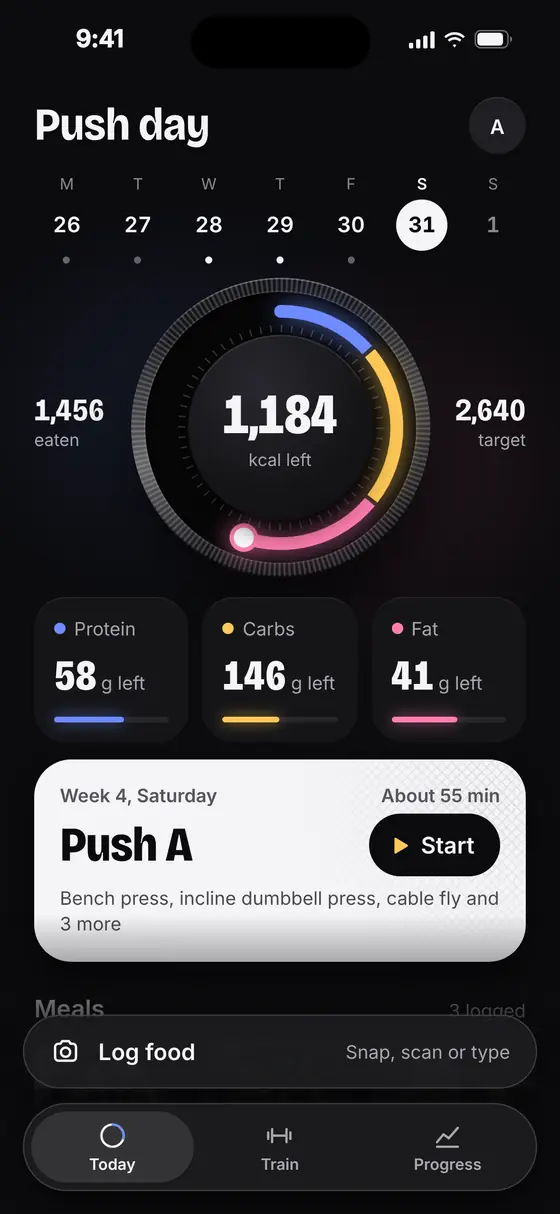

Get this plan in Indar, with the weights picked for you
Indar builds this program around your week, picks the weight for every set from your last session, and moves you up when you're ready. A missed session comes back later in the week, never counted against you.
On Android? Get it on Google PlayOn iPhone? Get it on the App Store
Scan with your phone's camera to get Indar.
Free to download. Yearly Pro starts with a 7-day free trial.