 Indar
Best workout split: pick it by your days a week
The best workout split is the one that matches the number of days you can train: full body for two or three days a week, upper lower for four, push pull legs plus an upper and a lower day for five, and push pull legs for six. When the weekly sets are the same, split and full body routines give the same strength gains (14 studies) and the same muscle growth (the 4 to 6 of them that measured it), so the days you will keep up matter more than the split's name. Below is what each split gives the same lifter in sets and hours, from Indar's plan engine, and what changes for beginners and experienced lifters.
The short answer
- Two or three days: full body every session (the three-day week).
- Four days: upper lower, two upper days and two lower days.
- Five days: push, pull, legs, then an upper and a lower day.
- Six days: push pull legs, each workout twice (the six-day week).
- Not sure? Pick fewer days you will keep over more days you will skip: a missed day on a split can leave a muscle untrained that week.
- Whichever you pick, what grows muscle is enough hard sets a week and adding reps or weight over time.
What is a workout split?
A workout split is the way you divide your training across the week: which muscles each session works. A full body split trains everything every session. An upper lower split alternates upper body days (chest, back, shoulders, arms) with lower body days (quads, hamstrings, glutes, calves). Push pull legs has a push day (chest, shoulders, triceps), a pull day (back, biceps, rear shoulders) and a leg day. A body part split, often called a bro split, gives each muscle group its own day: chest on Monday, back on Tuesday, and so on.
The split decides two things: how often each muscle is trained, and how many sets fit in each session. A muscle you train twice a week can have its weekly sets spread over two shorter sessions; trained once, all of them land on one day.
What is the best workout split?
No split builds more muscle by itself: pick the one that fits your days. Here is what four reviews of the research found:
- Split against full body. With equal weekly sets, bench press and leg strength rose by the same amount on both kinds of routine across 14 studies and 392 people; arm and thigh size and lean mass, measured in 4 to 6 of those studies, grew the same too. The authors' conclusion: choose the routine you prefer (Ramos-Campo et al., 2024).
- Once a week against more. The earlier review pooled 10 studies and came out in favour of twice a week over once, leaving three against two open (Schoenfeld et al., 2016). The later one, with 25 studies, found that with the weekly sets held equal, how often a muscle was trained made no meaningful difference; where the more frequent group also did more sets, it gained a little more (Schoenfeld et al., 2019).
- The guidelines. In its 2026 position stand, the American College of Sports Medicine summed up 137 systematic reviews (over 30,000 people): training at least twice a week helped strength, and at least 10 sets a week helped muscle size, while few other choices changed results consistently (Currier et al., 2026).
Read together: the weekly sets do the work, and the split is how you fit them into your week. That's why Indar's plan engine chooses the split from your days, not from your goal. For someone with six months to three years of training and an hour a session, every split it builds from two to six days a week trains chest, back, shoulders and quads at least twice a week.
Which split for how many days a week?
Here is the split for each number of days, and what each week gives one lifter: someone with six months to three years of steady training who wants muscle, training up to an hour a session in a full gym. Every week is the output of Indar's plan engine for those answers, and the hours, rounded, include warm-up sets.
| Days | Split | The workouts, in order | Time a week |
|---|---|---|---|
| 2 | Full body | A heavy, B volume | 2 hours |
| 3 | Full body | A heavy, B volume, C heavy | 3 hours |
| 4 | Upper lower | upper and lower heavy, then upper and lower volume | 4 hours |
| 5 | Push pull legs, upper lower | push, pull and legs heavy, then upper and lower volume | 5 hours |
| 6 | Push pull legs | push, pull and legs heavy, then all three again for volume | 5½ hours |
A heavy day starts with its main lift at 6 to 8 reps; a volume day mostly uses more reps at lighter weights. The lifts change between the two versions of a day (a back squat on one leg day, a hack squat on the other), so the week covers more movements.
How many sets does each split give a muscle?
More days give a muscle more weekly sets, up to a ceiling. These are the hard sets a week for the same lifter, counting each exercise toward the muscle it's aimed at, with how many sessions train that muscle ("9 in 3" is 9 sets spread over 3 sessions):
| Muscle | 2 daysfull body | 3 daysfull body | 4 daysupper lower | 5 daysPPL, upper lower | 6 dayspush pull legs |
|---|---|---|---|---|---|
| Chest | 6 in 2 | 9 in 3 | 10 in 2 | 14 in 2 | 16 in 2 |
| Back | 9 in 2 | 13 in 3 | 15 in 3 | 16 in 3 | 16 in 3 |
| Shoulders | 6 in 2 | 10 in 3 | 12 in 2 | 16 in 3 | 16 in 4 |
| Quads | 6 in 2 | 10 in 3 | 13 in 2 | 12 in 2 | 12 in 2 |
| Hamstrings | 3 in 1 | 6 in 2 | 10 in 2 | 8 in 2 | 8 in 2 |
| Glutes | 0 | 0 | 3 in 1 | 6 in 2 | 6 in 2 |
| Biceps | 3 in 1 | 6 in 2 | 6 in 2 | 8 in 2 | 8 in 2 |
| Triceps | 6 in 2 | 6 in 2 | 6 in 2 | 6 in 2 | 8 in 2 |
| Calves | 3 in 1 | 6 in 2 | 6 in 2 | 11 in 4 | 9 in 4 |
Three things stand out. Going from three days to six nearly doubles the time (about 3 hours to about 5½) and takes the chest from 9 sets to 16, but the quads only from 10 to 12. Four days of upper lower gives the quads and hamstrings more sets than any other split here: its first leg day has 4 sets of squats and 4 of Romanian deadlifts, plus leg extensions and leg curls. And squats, hinges, presses and rows train more than the muscle they're counted for, which is why the glutes get work on every split, even the full body weeks that aim no sets at them.
The ceiling is Indar's cap on weekly sets for a muscle: 10 in your first months, 16 after six months of steady training and 20 after three years. A review of 15 studies found muscle grew more as weekly sets went up (Schoenfeld et al., 2017).
Open any of these weeks in the workout plan generator to see every exercise, set, rep and rest: two days, three, four, five or six.
What is the best split for beginners?
For beginners, full body three days a week is the best split: it trains every big muscle two or three times a week in about 3 hours. In Indar's plans more days add little in your first months, because a new lifter is capped at 10 hard sets a week for a muscle, so the extra days mostly add hours:
| Lifter | 3 days, full body | 4 days, upper lower | 6 days, push pull legs |
|---|---|---|---|
| New to lifting60 minutes a session | chest 7, back 6, quads 8; about 3 hours | chest 9, back 8, quads 10; about 3¾ hours | chest 10, back 10, quads 10; about 4½ hours |
| Three years or more75 minutes a session | chest 9, back 13, quads 11; about 3¾ hours | chest 12, back 18, quads 15; about 5 hours | chest 20, back 20, quads 13; about 6¼ hours |
The two rows tell opposite stories. A new lifter's chest, back and quads get 6 to 10 sets on any of these weeks, so three days does the job. After three years, three full body days still give the chest only 9 sets against a cap of 20: more days is how an experienced lifter fits more sets, and four or six days is where the extra comes from. For a new lifter's three days with every exercise, see the muscle guide's beginner week.
Is a bro split (one muscle a day) worth it?
A bro split can build muscle: when the weekly sets were equal, the 2019 analysis of 25 studies found no meaningful difference by how often a muscle was trained. Head to head in 20 trained men, a split hitting each muscle once a week and three full body days gave the same bench press and squat strength, while the full body group grew more in one of the three muscle sites measured (Schoenfeld et al., 2015).
Indar's plan engine doesn't build a bro split: on five or six days it uses push pull legs, which trains chest, back and legs twice in the same number of days (why twice, in the push pull legs guide). If you enjoy a bro split and keep the weekly sets up, it will still work.
What is the best workout split for women?
The best split for women is the same as for men: the one that fits the days you can train. In a 2025 analysis of 29 studies where men and women did the same program, muscle grew by a similar share of its starting size in both (Refalo et al., 2025), and Indar's plan engine doesn't ask your sex when it builds a split.
What changes a week is what you want to grow most. Choosing the lower body as the focus area in the generator moves sets toward the legs: on the four-day upper lower week above, the glutes go from 3 to 6 sets, the quads from 13 to 14 and the hamstrings from 10 to 9, with the time taken from core work (5 sets to 2). See that week.
What is the best workout split for weight loss?
No split is a fat loss split: losing fat comes from eating fewer calories than you burn, so pick the split by your days, as above. Indar's plan engine gives a fat loss goal the same split and the same sets as a muscle goal. Set your calories with the calorie guide and keep the deficit to a safe size, and keep lifting through it.
What are the common mistakes?
- More days than you will keep. Miss a day of a split and that day's muscles go without for the week (miss legs on a four-day upper lower and your legs get one session). On full body, the next session trains everything again.
- Push pull legs on three days. That leaves each muscle a single session a week; spread over the same three days, full body reaches chest, back, shoulders and quads three times each (more in the push pull legs guide).
- Adding days without adding sets. A new split doesn't grow you by itself; the weekly sets and beating last time do. If a week leaves a muscle under 10 sets and you want it to grow, add sets, on the days you have or on one more.
- Switching splits every few weeks. Each switch resets the numbers you were beating. Stay on one split and its main lifts long enough to add reps and weight to them (progressive overload).
Common questions
Is upper lower or push pull legs better?
Neither has been shown to build more muscle: no review has compared the two directly, and split and full body routines gave the same results when the weekly sets matched. Upper lower fits four days and push pull legs six, both training chest, back and quads at least twice a week.
How many days a week should I train?
Two or more: the American College of Sports Medicine's 2026 position stand found strength rose more with at least 2 sessions a week. For someone with six months to three years of training, three days of full body gives chest, back, shoulders and quads 9 to 13 sets each in about 3 hours. Add days when you want more sets a week, not because a split asks for them.
Does the workout split matter for building muscle?
Not much when the weekly sets are the same: a 2019 analysis of 25 studies found training frequency made no meaningful difference to muscle growth with equal sets, and a 2024 analysis found split and full body routines gave the same strength across 14 studies and the same growth in the 4 to 6 that measured it. The split matters for how many sets fit in your week without very long sessions.
What's the best workout split for 3 days a week?
Full body: three full body days train chest, back, shoulders and quads three times a week each. Push pull legs on three days trains each muscle once. The full body workout guide has the three-day week in full, with sets, reps and rest.
What's the best workout split for 5 days a week?
Push, pull and legs, then an upper and a lower day: chest and quads are trained twice a week, and back and shoulders three times. For someone with six months to three years of training, that week takes about 5 hours and gives chest 14 sets and back and shoulders 16.
Who this isn't for
This guide is for healthy adults. If you have a heart condition, chest pain or fainting with exercise, or you've been told not to exercise, a doctor needs to clear you first. If you're pregnant, check with your doctor or midwife before starting or changing a program. Training around pain or an injury is a job for a physiotherapist (physical therapist), who can tell you what to swap.
Sources
- Ramos-Campo DJ, Benito-Peinado PJ, Andreu-Caravaca L, Rojo-Tirado MA, Rubio-Arias JÁ. Efficacy of split versus full-body resistance training on strength and muscle growth: a systematic review with meta-analysis. J Strength Cond Res. 2024.
- Schoenfeld BJ, Ogborn D, Krieger JW. Effects of resistance training frequency on measures of muscle hypertrophy: a systematic review and meta-analysis. Sports Med. 2016.
- Schoenfeld BJ, Grgic J, Krieger J. How many times per week should a muscle be trained to maximize muscle hypertrophy? A systematic review and meta-analysis of studies examining the effects of resistance training frequency. J Sports Sci. 2019.
- Currier BS, D'Souza AC, Singh MAF, et al. American College of Sports Medicine position stand. Resistance training prescription for muscle function, hypertrophy, and physical performance in healthy adults: an overview of reviews. Med Sci Sports Exerc. 2026.
- Schoenfeld BJ, Ogborn D, Krieger JW. Dose-response relationship between weekly resistance training volume and increases in muscle mass: a systematic review and meta-analysis. J Sports Sci. 2017.
- Schoenfeld BJ, Ratamess NA, Peterson MD, Contreras B, Tiryaki-Sonmez G. Influence of resistance training frequency on muscular adaptations in well-trained men. J Strength Cond Res. 2015.
- Refalo MC, Nuckols G, Galpin AJ, Gallagher IJ, Hamilton DL, Fyfe JJ. Sex differences in absolute and relative changes in muscle size following resistance training in healthy adults: a systematic review with Bayesian meta-analysis. PeerJ. 2025.

The split that fits your week
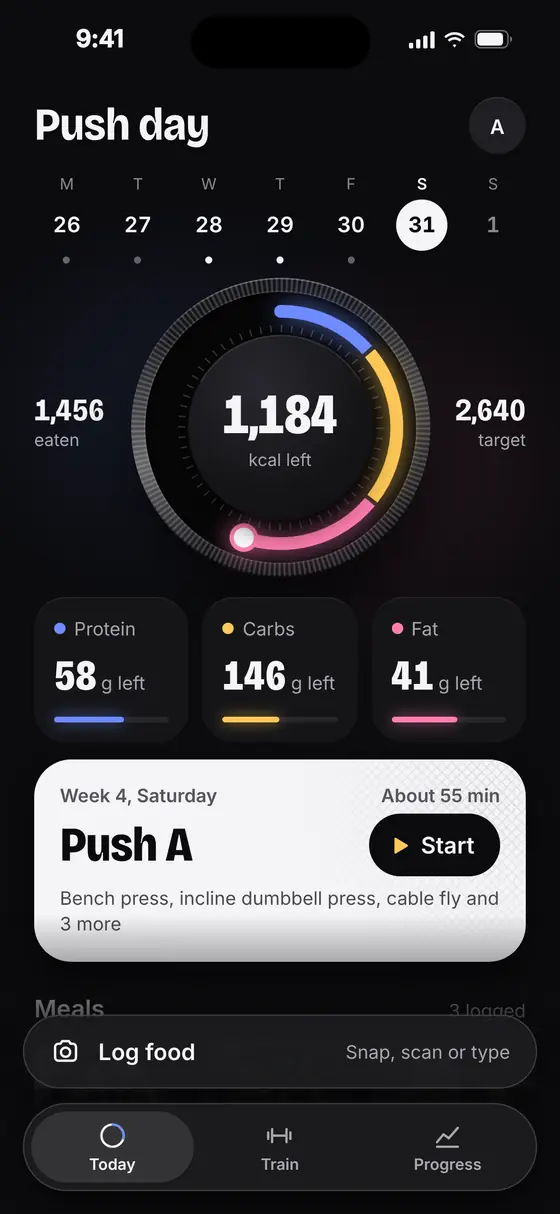
Tell Indar your days, minutes and equipment: it builds the split, sets each set's weight from your last session, and moves a missed session later in the week.


On Android? Get it on Google PlayOn iPhone? Get it on the App Store
Scan with your phone's camera to get Indar.
Free to download. Yearly Pro starts with a 7-day free trial.