 Indar
Full body workout: a three-day plan for every muscle
A full body workout trains your legs, chest, back, shoulders and arms in the same session, so three of them a week train your chest, back, shoulders and quads three times each. In Indar's plan a full body session takes about an hour: two leg lifts, a press and a pull for 3 or 4 sets each, then a few smaller exercises for the shoulders, arms and calves. Below is a full three-day week from Indar's plan engine, with the sets, reps, effort and rest for every exercise, and versions for dumbbells, bands, 45 minutes and two days.
The short answer
- Three days a week, any three: Monday, Wednesday and Friday, say. A day off between them is fine but not needed.
- Every session: a squat or lunge, a hinge or leg curl, a press and a pull, then small exercises for the shoulders, arms and calves.
- Three different days: a heavy day, a volume day and a second heavy day, with different lifts, so the week covers more.
- About an hour each: 7 or 8 exercises, mostly 3 sets. With 45 minutes, keep the big lifts and drop some small ones.
- Every set hard: stop 1 or 2 reps short of failure, add a rep each time, then weight.
- More than three days? Four: upper and lower. Five: push, pull, legs, then upper and lower. Six: push pull legs. Which split for your days compares them.
What is a full body workout?
A full body workout is a strength session that trains every major muscle group, instead of one or two of them. A split does the opposite: a chest day, a leg day, or push, pull and legs on different days. Full body trains each muscle more often with fewer sets each time; a split trains it less often with more sets each time.
Neither builds more muscle by itself. A meta-analysis of 14 studies with 392 people found split and full body routines built the same strength and muscle when the weekly sets were the same, and concluded you can pick the one you prefer (Ramos-Campo et al., 2024). What makes full body the better pick is a short week: on three days, it's the way to train every muscle more than once.
How many days a week should you do a full body workout?
Do a full body workout three days a week: for someone with six months to three years of training, that trains chest, back, shoulders and quads three times a week each in about 3 hours of gym time. Two days a week also works and still trains chest, back, shoulders and quads twice.
More visits fit more sets. On three days a week, full body is how Indar's plan engine reaches every big muscle more than once. Training a muscle twice a week grew it more than once a week in a meta-analysis of 10 studies (Schoenfeld et al., 2016), though a later analysis of 25 studies found the difference went away once the weekly sets matched (Schoenfeld et al., 2019). Read together, the gain is practical: seeing a muscle three times a week lets you give it 9 to 13 sets without any one session running long. The push pull legs guide goes through the same studies for six days.
Trained lifters have tested it head to head. In a trial of 20 trained men, three full body days a week grew the elbow flexors (the muscles at the front of the upper arm) more than a split that trained each muscle once a week, with no difference for the triceps, the thighs or strength (Schoenfeld et al., 2015).
The guidelines agree. The American College of Sports Medicine's 2026 position stand pooled 137 systematic reviews covering more than 30,000 people: strength went up more with 2 or more sessions a week, and muscle size with 10 or more sets a week for a muscle (Currier et al., 2026). The week below has three sessions and gives chest, back, shoulders and quads 9 to 13 counted sets each, before the extra work presses, rows and squats add.
What does a three-day full body workout plan look like?
This is the week Indar's plan engine builds for someone with six months to three years of steady training who wants muscle, training three days for up to an hour in a full gym. Day A and Day C are heavy (the first lift at 6 to 8 reps); Day B is a volume day: after the deadlift, more reps at lighter weights. The lifts change from day to day: the squat on Day A is a hack squat on Day C, and Day B has the deadlift. "In reserve" is how many reps you'd still have when you stop. Rest is between sets; the two exercises of a superset are done one set each, back to back, then the rest. The minutes include warm-up sets.
Day 1: Full body A, heavy (about 62 minutes)
| Exercise | Sets × reps | In reserve |
|---|---|---|
| Back squatrest 3 min | 3 × 6 to 8 | 2 |
| Bench presssuperset with lat pulldown | 3 × 8 to 10 | 2 |
| Lat pulldown2 min after each round | 3 × 8 to 10 | 2 |
| Romanian deadliftrest 2½ min | 3 × 8 to 10 | 2 |
| Lateral raiserest 75 s | 3 × 12 to 20 | 1 |
| Dumbbell curlsuperset with triceps pushdown | 3 × 12 to 20 | 1 |
| Triceps pushdown1 min after each round | 3 × 10 to 15 | 1 |
Day 2: Full body B, volume (about 61 minutes)
| Exercise | Sets × reps | In reserve |
|---|---|---|
| Deadliftrest 2½ min | 3 × 5 to 8 | 2 |
| Incline dumbbell presssuperset with chest-supported row | 3 × 10 to 12 | 2 |
| Chest-supported row2 min after each round | 3 × 10 to 12 | 2 |
| Bulgarian split squatrest 2 min | 3 × 10 to 12 | 2 |
| Face pullrest 1 min | 3 × 12 to 15 | 1 |
| Overhead triceps extensionsuperset with standing calf raise | 3 × 12 to 15 | 1 |
| Standing calf raise1 min after each round | 3 × 12 to 15 | 1 |
| Cable crunchrest 1 min | 2 × 12 to 15 | 1 |
Day 3: Full body C, heavy (about 60 minutes)
| Exercise | Sets × reps | In reserve |
|---|---|---|
| Hack squatrest 3 min | 4 × 6 to 8 | 2 |
| Overhead presssuperset with chest-supported row | 4 × 8 to 10 | 2 |
| Chest-supported row2 min after each round | 4 × 8 to 10 | 2 |
| Lying leg curlsuperset with seated calf raise | 3 × 10 to 15 | 1 |
| Seated calf raise1 min after each round | 3 × 10 to 15 | 1 |
| Cable flyrest 75 s | 3 × 10 to 15 | 1 |
| Cable curlrest 75 s | 3 × 10 to 15 | 1 |
What the week adds up to. Counting each exercise toward the muscle it's aimed at, here are the hard sets a week and how many of the three days train each muscle:
| Muscle | Hard sets a week | Days that train it |
|---|---|---|
| Back | 13 | 3 |
| Quads | 10 | 3 |
| Shoulders | 10 | 3 |
| Chest | 9 | 3 |
| Hamstrings | 6 | 2 |
| Biceps | 6 | 2 |
| Triceps | 6 | 2 |
| Calves | 6 | 2 |
| Core | 2 | 1 |
| Glutes | none aimed at them | squats, lunges and hinges train them on all 3 |
Presses, rows, squats and hinges train more than the muscle they're counted for (a bench press works the triceps, a Romanian deadlift the glutes), so most muscles get more work than their line shows. Across 15 studies, more weekly sets went with more growth (Schoenfeld et al., 2017). The same engine's six-day push pull legs week gives chest, back and shoulders 16 sets each, at about 5½ hours a week: more work for nearly twice the time (the full six days).
Warm-ups. The minutes above count them. Before the day's first barbell lift for the upper or lower body: the empty bar, then about 40, 60 and 80% of your work weight. Before a later barbell lift for the same half, just the 60 and 80% sets. Before the first dumbbell or machine lift for a half, one light set. Small exercises go straight in.
Can you do a full body workout at home?
Yes: with dumbbells and a bench, Indar's plan engine builds the same three days in about the same hour, and with bands and bodyweight too (shown here at 45 minutes a session). Same person as above.
Dumbbells and a bench. About 3 hours a week. It gives the quads 11 hard sets, chest, back, shoulders and hamstrings 9 each, and the arms and calves 6:
| Day | Exercises, sets × reps |
|---|---|
| Day Aheavy, about 62 minutes | Goblet squat: 4 × 8 to 12 Dumbbell bench press: 3 × 8 to 10 Dumbbell Romanian deadlift: 3 × 8 to 12 Dumbbell pullover: 3 × 12 to 20 Lateral raise: 3 × 12 to 20 Dumbbell curl: 3 × 12 to 20, superset with dumbbell overhead triceps extension Dumbbell overhead triceps extension: 3 × 12 to 20 |
| Day Bvolume, about 62 minutes | Dumbbell Romanian deadlift: 3 × 8 to 12 Incline dumbbell press: 3 × 10 to 12, superset with one-arm dumbbell row One-arm dumbbell row: 3 × 10 to 12 Bulgarian split squat: 3 × 10 to 12 Dumbbell rear delt fly: 3 × 12 to 20 Dumbbell overhead triceps extension: 3 × 12 to 20, superset with dumbbell calf raise Dumbbell calf raise: 3 × 12 to 20 Dead bug: 2 × 12 to 20 |
| Day Cheavy, about 62 minutes | Goblet squat: 4 × 8 to 12 Dumbbell shoulder press: 3 × 8 to 10 Chest-supported dumbbell row: 3 × 8 to 10 Dumbbell leg curl: 3 × 12 to 20, superset with dumbbell calf raise Dumbbell calf raise: 3 × 12 to 20 Dumbbell fly: 3 × 12 to 20 Hammer curl: 3 × 12 to 20 |
Bands and bodyweight. Resistance bands and a door or bar to anchor them, 45 minutes a session, about 2¼ hours a week. It gives chest, back and quads 9 hard sets each, hamstrings and shoulders 8, and the arms and calves 2 to 5:
| Day | Exercises, sets × reps |
|---|---|
| Day Aheavy, about 46 minutes | Bodyweight squat: 3 × 12 to 20 Push-up: 3 × 10 to 15, superset with band pulldown Band pulldown: 3 × 10 to 15 Single-leg Romanian deadlift: 3 × 12 to 20 Band lateral raise: 3 × 12 to 20 Band curl: 2 × 12 to 20, superset with band triceps extension Band triceps extension: 2 × 12 to 20 |
| Day Bvolume, about 45 minutes | Single-leg Romanian deadlift: 3 × 12 to 20 Push-up: 3 × 10 to 15, superset with band row Band row: 3 × 10 to 15 Split squat: 3 × 12 to 20 Band pull-apart: 2 × 12 to 20 Band triceps extension: 2 × 12 to 20 |
| Day Cheavy, about 43 minutes | Bodyweight squat: 3 × 12 to 20 Pike push-up: 3 × 10 to 15, superset with band row Band row: 3 × 10 to 15 Band leg curl: 2 × 12 to 20, superset with single-leg calf raise Single-leg calf raise: 2 × 12 to 20 Band chest fly: 3 × 12 to 20 Band curl: 3 × 12 to 20 |
With bands and bodyweight, progress comes from reps and harder versions more than load: how to progress without weights.
How long should a full body workout be?
About an hour is enough for a full body workout with 7 or 8 exercises: each day in the week above is 60 to 62 minutes with warm-ups. With 45 minutes, the engine keeps each day's leg lifts, press and pull and cuts small exercises, so the same week becomes:
| Day | Exercises, sets × reps |
|---|---|
| Day Aheavy, about 45 minutes | Back squat: 3 × 6 to 8 Bench press: 3 × 8 to 10, superset with lat pulldown Lat pulldown: 3 × 8 to 10 Romanian deadlift: 3 × 8 to 10 Lateral raise: 2 × 12 to 20 |
| Day Bvolume, about 46 minutes | Deadlift: 4 × 5 to 8 Incline dumbbell press: 3 × 10 to 12, superset with chest-supported row Chest-supported row: 3 × 10 to 12 Bulgarian split squat: 3 × 10 to 12 Overhead triceps extension: 2 × 12 to 15 |
| Day Cheavy, about 45 minutes | Hack squat: 3 × 6 to 8 Overhead press: 3 × 8 to 10, superset with chest-supported row Chest-supported row: 3 × 8 to 10 Lying leg curl: 2 × 10 to 15, superset with seated calf raise Seated calf raise: 2 × 10 to 15 Cable fly: 3 × 10 to 15 Cable curl: 3 × 10 to 15 |
That's about 2¼ hours a week. Back stays at 13 hard sets and chest at 9, quads go to 9, and the arms, calves and shoulders lose the most (the face pull goes) (triceps and calves get 2 sets a week each). If arms matter to you, an hour pays.
Only two days? The engine builds Day A and Day B above: about 2 hours a week, with chest, back, shoulders and quads trained twice, and the hamstrings, biceps and calves once (3 sets a week each). See the two-day week.
Is full body better than a split?
Full body is not better than a split for muscle or strength: with the same weekly sets, the 14 studies in the meta-analysis above found the same results (Ramos-Campo, above). Pick the one that fits your week. Indar's plan engine builds full body for one to three days a week, upper and lower for four, push, pull, legs, upper and lower for five, and push pull legs for six.
Full body suits you if you train three days or fewer, if you miss sessions (miss one full body day and chest, back, shoulders and quads are still trained twice that week), or if you like a few heavy lifts each time. A split suits you if you can train four or more days and would rather do shorter sessions with fewer muscles in each.
How do you progress on a full body workout?
Add a rep, then weight. Keep the weight and add a rep each session. When your first set reaches the top of its range and the rest are within two reps of it, add the smallest step: 2.5 kg on most barbell lifts and 5 kg on deadlifts (5 lb on any bar if you lift in pounds), the next dumbbell, a pin on a machine. The progressive overload guide works this through session by session, with what to do when you stall.
Effort: close to failure, not at it. In this week, big lifts stop with 2 reps left and small ones with 1. Across 15 studies, going all the way to failure gave at most a trivial advantage for growth over stopping short of it (Refalo et al., 2023), and the next full body session is only a day or two away.
Days in a row are fine. In two small trials, three sessions on consecutive days built strength and changed body composition about as much as the same sessions on alternate days: 30 recreationally active men doing the same five machine lifts each session over 12 weeks (Yang et al., 2018) and 21 men over 7 weeks (da Silva Carvalho and Rodrigues Santos, 2018). So pick the days that fit your week.
What are the common mistakes?
- The same workout three times: it works, but the three different days on this page train chest, back and quads with three different exercises a week each.
- Too many exercises: across 111 studies of healthy men, more sets in one workout went with slightly smaller gains (Benito et al., 2020). Seven or eight exercises in an hour is plenty.
- Only pushing and squatting: every day needs a pull (a row or pulldown), and the week needs a hinge and a leg curl for the hamstrings.
- Failure on every set: at most a trivial extra growth (Refalo, above), with the next full body session only a day or two away.
- A new program every few weeks: you can't add weight to a lift you rarely repeat. Keep the same main lifts for a few months and beat them.
Common questions
Is a full body workout good for beginners?
Yes, and it's what Indar builds for anyone training three days a week. For people new to lifting, the engine gives 2 or 3 sets an exercise, up to 10 hard sets a week for a muscle, and stops every set 2 or 3 reps short of failure. The beginner's three-day week is printed in full in the muscle guide.
Can you do a full body workout every day?
You can, but Indar doesn't plan it: from four days a week, its plan engine moves to upper and lower or push pull legs, so each session trains fewer muscles and each muscle still gets days off. The consecutive-day trials on this page tested three sessions a week, not daily training.
How many exercises should a full body workout have?
Seven or eight in an hour: a squat or lunge, a hinge or leg curl, a press and a pull, then smaller exercises for the shoulders, arms, calves and core. In 45 minutes the engine keeps five to seven, dropping small exercises first.
Is full body or push pull legs better?
Neither is better for muscle or strength: across 14 studies, split and full body routines gave the same results when the weekly sets were the same. Full body fits three days or fewer; push pull legs needs six days to train every muscle twice.
Can you build muscle with only full body workouts?
Yes: full body routines built as much muscle and strength as splits with the same weekly sets, across 14 studies. The three-day week on this page gives chest, back, shoulders and quads 9 to 13 hard sets a week each, plus the work presses, rows and squats add.
Who this isn't for
This guide is for healthy adults. If you have a heart condition, chest pain or fainting with exercise, or you've been told not to exercise, a doctor needs to clear you first. If you're pregnant, check with your doctor or midwife before starting a program. Lifting with pain or an injury is a job for a physiotherapist, who can tell you what to swap.
Sources
- Ramos-Campo DJ, Benito-Peinado PJ, Andreu-Caravaca L, Rojo-Tirado MA, Rubio-Arias JÁ. Efficacy of split versus full-body resistance training on strength and muscle growth: a systematic review with meta-analysis. J Strength Cond Res. 2024.
- Schoenfeld BJ, Ogborn D, Krieger JW. Effects of resistance training frequency on measures of muscle hypertrophy: a systematic review and meta-analysis. Sports Med. 2016.
- Schoenfeld BJ, Grgic J, Krieger J. How many times per week should a muscle be trained to maximize muscle hypertrophy? A systematic review and meta-analysis of studies examining the effects of resistance training frequency. J Sports Sci. 2019.
- Benito PJ, Cupeiro R, Ramos-Campo DJ, Alcaraz PE, Rubio-Arias JÁ. A systematic review with meta-analysis of the effect of resistance training on whole-body muscle growth in healthy adult males. Int J Environ Res Public Health. 2020.
- Schoenfeld BJ, Ratamess NA, Peterson MD, Contreras B, Tiryaki-Sonmez G. Influence of resistance training frequency on muscular adaptations in well-trained men. J Strength Cond Res. 2015.
- Currier BS, D'Souza AC, Singh MAF, et al. American College of Sports Medicine position stand. Resistance training prescription for muscle function, hypertrophy, and physical performance in healthy adults: an overview of reviews. Med Sci Sports Exerc. 2026.
- Schoenfeld BJ, Ogborn D, Krieger JW. Dose-response relationship between weekly resistance training volume and increases in muscle mass: a systematic review and meta-analysis. J Sports Sci. 2017.
- Refalo MC, Helms ER, Trexler ET, Hamilton DL, Fyfe JJ. Influence of resistance training proximity-to-failure on skeletal muscle hypertrophy: a systematic review with meta-analysis. Sports Med. 2023.
- Yang Y, Bay PB, Wang YR, Huang J, Teo HWJ, Goh J. Effects of consecutive versus non-consecutive days of resistance training on strength, body composition, and red blood cells. Front Physiol. 2018.
- da Silva Carvalho AD, Rodrigues Santos JA. Nonconsecutive versus consecutive-day resistance training in recreationally trained subjects. J Sports Med Phys Fitness. 2018.

Three days, planned for you
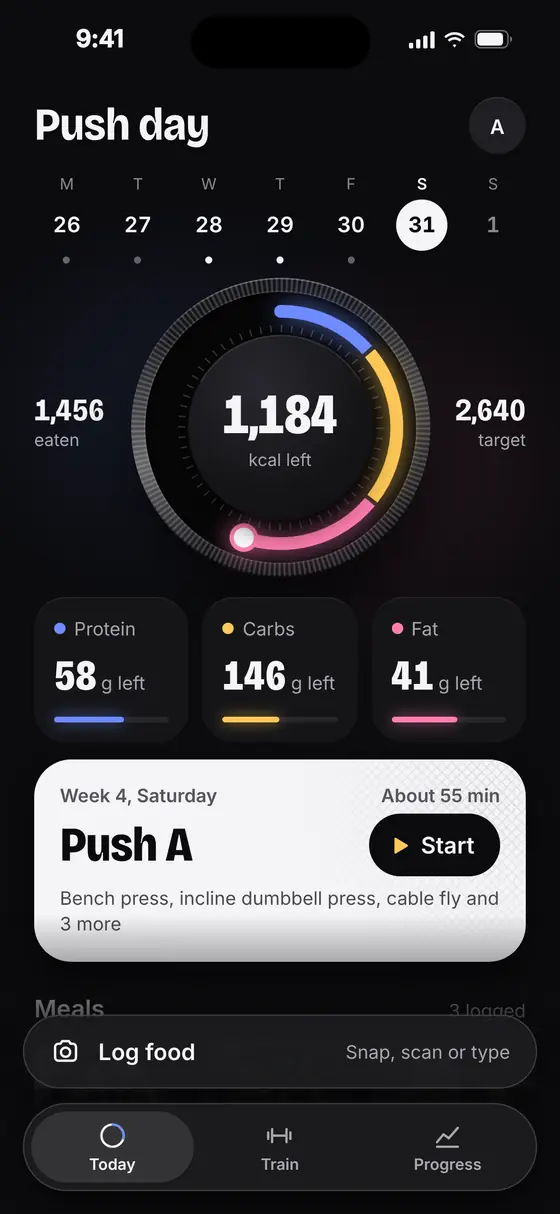
Indar builds your full body week (or the split that fits your days), picks the weight for every set from what you did last time, and moves a missed session later in the week.


On Android? Get it on Google PlayOn iPhone? Get it on the App Store
Scan with your phone's camera to get Indar.
Free to download. Yearly Pro starts with a 7-day free trial.