 Indar
Calorie calculator for lifting
Your daily calories, protein, carbs and fat, worked out from your body, your day, your lifting and any other sport you train. It's the same maths Indar uses to set your targets, and every number shows where it came from.
How the numbers are worked out
Everything you burn in a day (your TDEE) is added up in four parts, then your goal moves the total up or down. The breakdown next to your result shows each part with your own numbers. For the macros on their own, in grams and per meal, use the macro calculator; for the guide behind the numbers, how many calories should I eat.
1. Resting energy
What your body burns doing nothing, from the Mifflin-St Jeor equation, the usual choice for healthy adults. It was built on mostly untrained people, so for anyone who already lifts or trains 3 or more days a week without high body fat (estimated below), we average it with the ten Haaf equation, which was built on recreational athletes who carry more muscle. Used alone, ten Haaf reads high for most gym-goers, so the average sits between the two. "Rather not say" uses the midpoint of the male and female equations.
2. Your day, outside training
Resting energy times a factor for how much you move when you're not training: 1.3 for mostly sitting, 1.45 for some walking, 1.6 for on your feet all day, 1.8 for hard physical work. Training is left out of this on purpose and added separately, so a desk worker who lifts five days a week isn't counted as "very active" all day.
3. Lifting
A whole lifting session, warm-ups and rests included, averages about 4.5 METs in the 2024 Compendium of Physical Activities. Only the part above rest is added (resting energy is already counted), spread over the week: (4.5 − 1) × body weight × hours a week ÷ 7. For an 80 kg lifter training 4 hours a week, that's about 160 kcal a day. Lifting burns less than most people think.
4. Other sport
Running, martial arts, team sport, cycling: counted the same way, at about 5.5 METs for steady work and 7.5 for hard work like sparring, intervals and matches. This is where calculators that only ask "how active are you?" go most wrong. A 70 kg lifter who also does 9 or 10 hours of hard martial arts a week burns about 600 kcal a day more from that alone. The total is capped at 2.5 times resting energy, about the most anyone sustains over weeks.
Stacked bars of daily calories. Woman, 45, 60 kg: 1,620 kcal; Woman, 30, 65 kg: 2,200 kcal; Woman, 25, 70 kg: 2,350 kcal; Man, 55, 85 kg: 2,240 kcal; Man, 30, 80 kg: 2,610 kcal; Man, 25, 90 kg: 3,570 kcal.
Your body fat, estimated
A few limits depend on how much of your weight is fat, and BMI alone can't tell: a muscular 90 kg lifter at 180 cm has a BMI of 28, which reads as overweight, without carrying much fat. So the calculator estimates your body fat from your BMI, age and sex with Deurenberg's formula, which usually lands within about 4 percentage points of a measured body fat. The formula counts all weight above a lean BMI as fat. That holds for most people and fails for lifters, so if you lift, part of your weight above a BMI of 20 counts as muscle instead: more the longer you've lifted, half as much on fewer than 3 lifting days a week (unless other sport adds 3 or more hours), and never more muscle than years of training realistically build. 6 or more hours of other sport a week counts for some muscle on its own.
It's an estimate, not a measurement, so it's never shown as a number, here or in the app. It only sets these limits:
- Protein counts your whole weight, unless your body fat is over a healthy range, which tops out at about 20% for men and 30% for women (Gallagher et al., 2000). Then it counts your estimated lean mass (everything that isn't fat: muscle, bone, organs and water) plus a healthy amount of fat: the weight you'd be with the same lean mass at the top of that range.
- The faster pace is 1% of your weight a week only with high body fat: 25% or more for men and 32% for women, where obesity is commonly set by body fat. Otherwise it's 0.75%.
- The deficit is never more than 40 kcal a day for each kilogram of body fat, so the leaner you are, the smaller it can be.
- Resting energy is averaged with the athlete equation only without high body fat.
"Rather not say" uses the midpoint of the male and female figures.
Your goal
Losing fat: a deficit for a chosen pace, as a share of body weight a week: about 0.25% (steady), 0.5% (moderate) or 0.75% (faster, or 1% with high body fat), at roughly 7,700 kcal per kilogram. The deficit is never more than a quarter of what you burn, never more than 40 kcal a day for each kilogram of body fat, and calories never go below your resting energy or 1,200 (women) or 1,500 (men). If a pace would break one of these limits, it slows instead.
The body fat limit is what keeps a lean body's deficit small: about 600 kcal a day with 15 kg of fat, 400 with 10 kg. 40 kcal is a little over half the most a kilogram of stored fat can supply in a day, about 69 kcal (Alpert, 2005). Past that, more of a deficit comes from muscle, and the leaner you are, the sooner you reach it. Under a healthy weight for your height (a BMI under 18.5), nothing is cut and calories hold your weight. The weight-loss timeline shows how many weeks each pace takes to reach your goal weight.
Building muscle: a small surplus, smaller the longer you've trained, because the rate you can add muscle falls with experience: from about 0.4% of body weight a week for new male lifters (0.3% for women) down to 0.15% (0.1%) after three years. A bigger surplus mostly adds fat.
Recomp: a very small deficit, about 0.1% of body weight a week. It works best for newer lifters and people carrying more fat. For lean, experienced lifters it's slow, and a lean bulk followed by a short cut usually gets there faster.
Getting stronger or staying fit: calories match what you burn.
Protein, carbs and fat
Protein is set per kilogram of body weight, or with body fat over a healthy range, per kilogram of your estimated lean mass plus a healthy amount of fat (above): 2.2 g/kg while losing fat, 1.8 g/kg for building muscle, recomp and strength, and 1.6 g/kg for staying fit, raised to at least 1.8 with 6 or more hours of training a week and 2.0 with 10 or more. The protein calculator shows where those numbers come from in the research and how to split the day's protein over your meals.
Fat is 25% of calories, kept between 20% (or 0.5 g/kg, whichever is higher) and 35%. Carbs are the rest. With a lot of training, if carbs would fall under 3 g/kg, fat drops toward its floor first to fuel the work.
It's a starting point: how to adjust
Every formula is an estimate. Two people with the same numbers can burn a few hundred calories a day apart. The real answer is in your weight over the next few weeks:
- Eat to the target and weigh in on most mornings, after the toilet, before food.
- Ignore day-to-day swings. Water and food in the gut move the scale by a kilogram or more. Look at the trend: the average of the last week against the week before.
- After about three weeks, compare the trend with the rate you chose. Working out what you really burn: average calories eaten minus (weight change in kg a day × 7,700).
- Move the target part of the way toward that, no more than about 200 kcal at once, and give it another two weeks.
This is what Indar does for you each week from your log and your weigh-ins. Nothing changes without your say, and every change shows why.
Who this isn't for
These numbers are for healthy adults. They aren't right for anyone under 18 (growth changes the maths), pregnant or breastfeeding, living with kidney disease or a heart condition, on diabetes or weight-loss medication, or after weight-loss surgery. A GP or an accredited dietitian can set targets that fit. If counting calories has ever been hard on you, it's worth talking to someone first: in the US, the National Alliance for Eating Disorders on (866) 662-1235; in the UK, Beat on 0808 801 0677; in Canada, NEDIC on 1-866-633-4220; in Australia, the Butterfly Foundation on 1800 33 4673; in New Zealand, EDANZ on 0800 233 269; anywhere else, your doctor or a local eating disorder service.
Sources
- Mifflin MD, St Jeor ST, et al. A new predictive equation for resting energy expenditure in healthy individuals. Am J Clin Nutr. 1990.
- ten Haaf T, Weijs PJM. Resting energy expenditure prediction in recreational athletes of 18 to 35 years. PLoS One. 2014.
- Herrmann SD, et al. 2024 Adult Compendium of Physical Activities. J Sport Health Sci. 2024.
- Deurenberg P, Weststrate JA, Seidell JC. Body mass index as a measure of body fatness: age- and sex-specific prediction formulas. Br J Nutr. 1991.
- Gallagher D, Heymsfield SB, Heo M, et al. Healthy percentage body fat ranges: an approach for developing guidelines based on body mass index. Am J Clin Nutr. 2000.
- Alpert SS. A limit on the energy transfer rate from the human fat store in hypophagia. J Theor Biol. 2005.
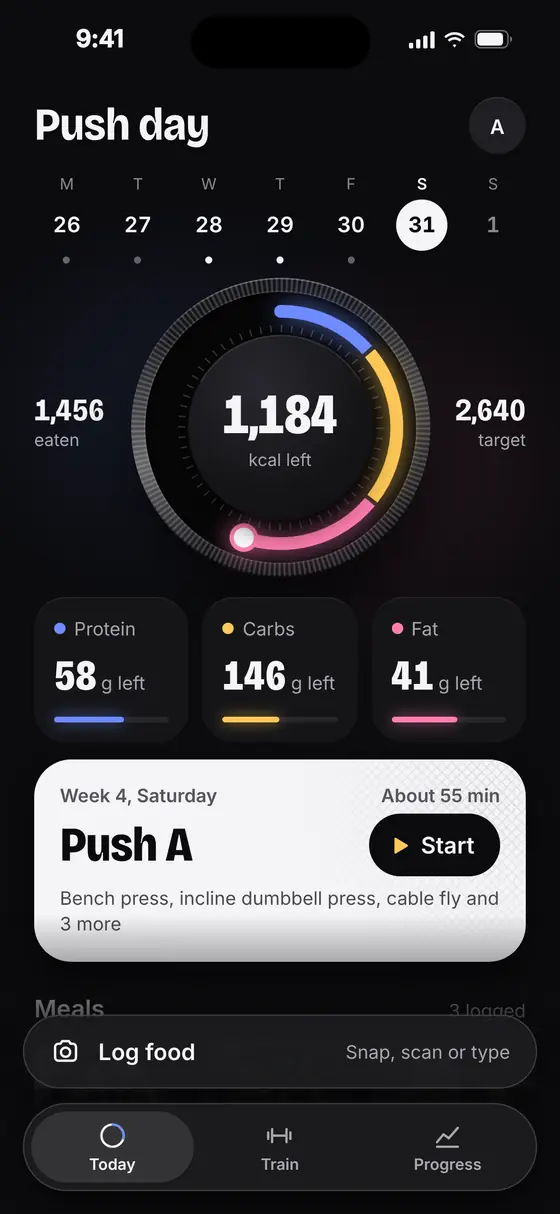

Indar keeps these numbers right for you
It sets your targets the same way, builds your training program around your week, and checks both against your weigh-ins every week. Logging a meal is a photo.


On Android? Get it on Google PlayOn iPhone? Get it on the App Store
Scan with your phone's camera to get Indar.
Free to download. Yearly Pro starts with a 7-day free trial.