 Indar
How much protein should you eat a day?
If you lift, or want to keep the muscle you have, aim for 1.6 to 2.2 g of protein per kilogram of body weight a day (0.7 to 1 g per pound): about 130 to 175 g for an 80 kg person. The 0.8 g per kg in official guidelines is the minimum to avoid a shortfall, not what it takes to build muscle.
Your number
144 g of protein a day
80 kg × 1.8 g per kg, for building muscle. Full protein calculator
The short answer, by goal
- Building muscle or getting stronger: 1.6 to 2.2 g/kg. Indar sets 1.8.
- Losing fat while keeping muscle: toward the top, 2.2 g/kg, because a deficit makes muscle harder to keep.
- Staying fit: 1.4 to 2.0 g/kg. Indar sets 1.6, more if you train 6 or more hours a week.
- Not training at all: 0.8 g/kg covers basic needs; over 65, aim for 1.0 to 1.2.
| Body weight | Staying fit, 1.6 g/kg | Building muscle, 1.8 g/kg | Losing fat, 2.2 g/kg |
|---|---|---|---|
| 55 kg121 lb | 88 g | 99 g | 121 g |
| 65 kg143 lb | 104 g | 117 g | 143 g |
| 75 kg165 lb | 120 g | 135 g | 165 g |
| 85 kg187 lb | 136 g | 153 g | 187 g |
| 95 kg209 lb | 152 g | 171 g | 209 g |
With more body fat than a healthy range (above about 20% for men and 30% for women), count from the weight you'd be at the top of that range, not your whole weight. Extra fat doesn't raise protein needs, and counting it sets a target that's hard to eat for nothing. The protein calculator does this for you.
What do the studies show?
The minimum. The World Health Organization's safe intake for adults is 0.83 g per kg a day (WHO, FAO and UNU, 2007), and most countries' guidelines round it to 0.8. It's set to cover the basic needs of almost every healthy adult. It says nothing about what's best for muscle.
For muscle. A large analysis of protein and lifting pooled 49 trials with 1,863 people. Extra protein kept adding muscle up to about 1.6 g per kg a day on average, and the upper end of the estimate was 2.2 (Morton et al., 2018). Past that, more protein didn't add more muscle. That's where the 1.6 to 2.2 range comes from: 1.6 is the average, and the authors suggest about 2.2 for anyone who wants to be sure of getting the most from training.
For people who exercise. The International Society of Sports Nutrition recommends 1.4 to 2.0 g per kg a day for most people who exercise (Jäger et al., 2017).
While losing fat. In a deficit, lean lifters keep more muscle on higher intakes, which is why a review of the studies suggested 2.3 to 3.1 g per kg of lean mass for them (Helms et al., 2014). In one four-week trial, young men in a hard 40% deficit, training six days a week, gained 1.2 kg of lean mass on 2.4 g/kg of protein and almost none on 1.2 g/kg, and lost more fat (Longland et al., 2016).
Women need the same per kilogram as men; they usually weigh less, so the total in grams is lower (protein for women has the studies done in women, and pregnancy and menopause). Older adults need more than younger ones to keep muscle: an expert group recommends at least 1.0 to 1.2 g per kg a day over 65, and more with exercise (Bauer et al., 2013).
What does 144 g of protein look like?
An 80 kg lifter building muscle needs about 144 g a day. Here's one way to get there with everyday foods, every number from USDA data:
| Meal | Protein | kcal |
|---|---|---|
| 200 g of Greek yogurt, 40 g oats, a cup of milk | 33 g | 418 |
| A drained can of tuna (about 115 g) and a large egg on 2 large slices of bread | 34 g | 330 |
| A cup of cottage cheese | 24 g | 183 |
| 150 g cooked chicken breast, a cup of rice, a cup of broccoli | 53 g | 484 |
| Total | 144 g | 1,415 |
Bar chart: breakfast 33 g, lunch 34 g, snack 24 g, dinner 53 g of protein, 144 g in all.
That's the protein covered in 1,415 kcal, leaving the rest of the day's calories for whatever else you like. Swap freely: three large eggs are 19 g, half a cup of firm tofu 22 g, 85 g of cooked shrimp 20 g.
How much protein per meal?
The daily total matters most. Spreading it helps, but a big dinner doesn't waste it.
Your body uses more than the 20 to 30 g a meal that's often quoted, but spreading protein still helps: about 0.4 g per kg at each of four meals is a good pattern (Schoenfeld and Aragon, 2018). For 80 kg that's about 32 g a meal. Three bigger meals work too. The daily total matters most. How much protein you can use in one meal goes into the studies.
Is that much protein safe?
For healthy kidneys, yes. A meta-analysis of 28 studies found higher protein intakes didn't change kidney function in healthy adults (Devries et al., 2018). With kidney disease it's different: protein often needs to be limited, so talk to your doctor before raising it. More in can you eat too much protein.
Sources
- World Health Organization, FAO, UNU. Protein and amino acid requirements in human nutrition. WHO Technical Report Series 935. 2007.
- Morton RW, et al. A systematic review, meta-analysis and meta-regression of the effect of protein supplementation on resistance training-induced gains in muscle mass and strength. Br J Sports Med. 2018.
- Jäger R, et al. International Society of Sports Nutrition position stand: protein and exercise. J Int Soc Sports Nutr. 2017.
- Helms ER, Zinn C, Rowlands DS, Brown SR. A systematic review of dietary protein during caloric restriction in resistance trained lean athletes: a case for higher intakes. Int J Sport Nutr Exerc Metab. 2014.
- Longland TM, et al. Higher compared with lower dietary protein during an energy deficit combined with intense exercise promotes greater lean mass gain and fat mass loss. Am J Clin Nutr. 2016.
- Schoenfeld BJ, Aragon AA. How much protein can the body use in a single meal for muscle-building? J Int Soc Sports Nutr. 2018.
- Bauer J, et al. Evidence-based recommendations for optimal dietary protein intake in older people: a position paper from the PROT-AGE Study Group. J Am Med Dir Assoc. 2013.
- Devries MC, et al. Changes in kidney function do not differ between healthy adults consuming higher- compared with lower- or normal-protein diets: a systematic review and meta-analysis. J Nutr. 2018.

See your protein left, all day
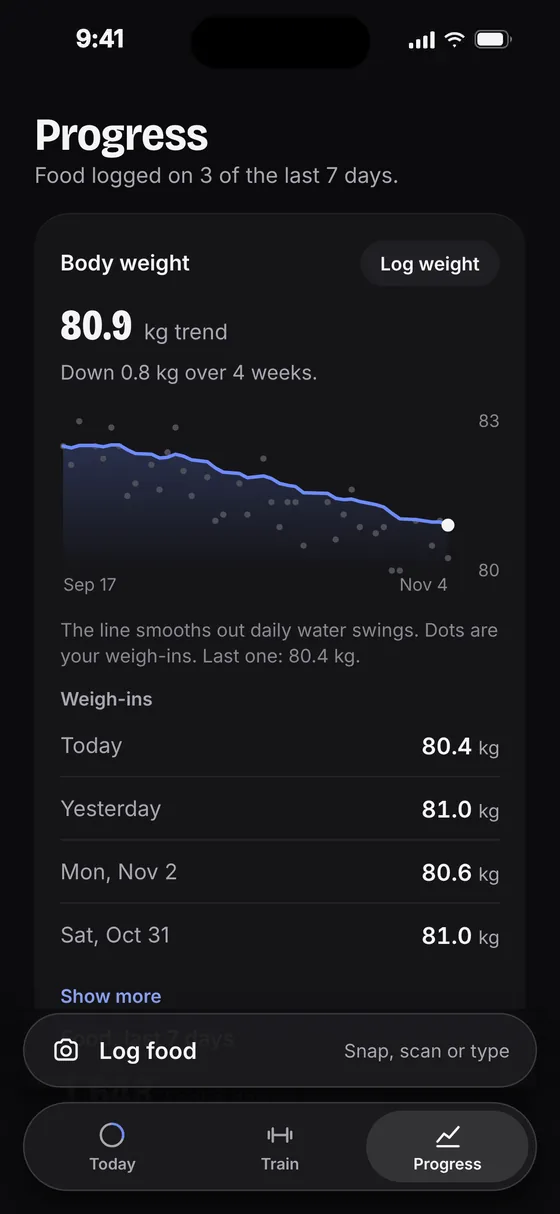
Indar sets your protein target this way and logs a meal from a photo, so you know at a glance how much is left for the day.


On Android? Get it on Google PlayOn iPhone? Get it on the App Store
Scan with your phone's camera to get Indar.
Free to download. Yearly Pro starts with a 7-day free trial.