 Indar
Protein for women: how much a day?
Women need the same protein per kilogram as men: 1.6 to 2.2 g per kg of body weight a day (0.7 to 1 g per lb) if you lift, or want to keep your muscle while you lose fat. That's 96 to 132 g at 60 kg. The 0.8 g per kg in official guidelines (46 g a day for women in the US and Canadian tables) is the minimum to avoid a shortfall, not what it takes to build or keep muscle.
The short answer, by goal
- Building muscle or getting stronger: 1.6 to 2.2 g per kg. Indar sets 1.8.
- Losing fat while keeping muscle: toward the top, 2.2 g per kg, because a deficit makes muscle harder to keep.
- Staying fit: 1.4 to 2.0 g per kg (Jäger et al., 2017). Indar sets 1.6, more if you train 6 or more hours a week.
- Not exercising: 0.8 g per kg covers basic needs; over 65, at least 1.0 to 1.2.
- Pregnant or breastfeeding: more than usual. Your midwife, doctor or dietitian sets the number.
| Body weight | Staying fit, 1.6 g/kg | Building muscle, 1.8 g/kg | Losing fat, 2.2 g/kg |
|---|---|---|---|
| 50 kg110 lb | 80 g | 90 g | 110 g |
| 55 kg121 lb | 88 g | 99 g | 121 g |
| 60 kg132 lb | 96 g | 108 g | 132 g |
| 65 kg143 lb | 104 g | 117 g | 143 g |
| 70 kg154 lb | 112 g | 126 g | 154 g |
| 80 kg176 lb | 128 g | 144 g | 176 g |
The table is for a body fat in a healthy range, up to about 30% for women. Above that, count from the weight you'd be at the top of that range, not your whole weight: extra fat doesn't raise how much protein you need, and counting it sets a target that's hard to eat for nothing. So for heavier women, Indar's number is often lower than the table's.
Here's how Indar does it for a 40-year-old woman, 165 cm (5 ft 5 in) and 90 kg (198 lb), new to lifting, with three 45-minute sessions a week, who wants to lose fat. Indar estimates her body fat from her height, weight, age and training (an estimate, not a measurement) and counts protein from 72.7 kg (160 lb), not 90. So her target is 160 g a day, not the 198 g that 2.2 g per kg of her whole weight would give. The protein calculator does this for you.
Training a lot raises it: Indar sets at least 1.8 g per kg if your lifting and sport add up to 6 or more hours a week, and 2.0 with 10 or more.
What did the studies in women find?
For years, protein advice for people who train came almost entirely from studies of men. That has started to change, and the studies in women point the same way.
How much women's bodies use. A lab method that tracks how the body burns an amino acid (indicator amino acid oxidation) can estimate the intake past which extra protein stops being used to build. In 8 women who lifted, measured over the hours after a full-body session, that point was about 1.5 g per kg a day, and the top of the estimate was about 1.9 (Malowany et al., 2019). In 6 women after a team-sport style running test, the average need was 1.41 g per kg and the amount that covers nearly everyone 1.71, well above the same method's estimates for inactive men, 0.93 and 1.2 (Wooding et al., 2017). These are small lab studies of a single day, but they agree.
The review. A systematic review of 14 studies with 204 women who train, all before menopause, put their average need at 1.28 to 1.63 g per kg a day for endurance training, 1.49 for lifting and 1.41 for stop-start sport, for sessions of about 60 to 90 minutes (Mercer et al., 2020). An average need is the middle, not a target: to cover most women you eat above it, and the two lab studies above put that amount at about 1.7 and 1.9 g per kg.
A trial in the gym. 17 young women training for physique competitions lifted for 8 weeks on either 2.5 or 0.9 g of protein per kg a day. The high-protein group gained 2.1 kg of fat-free mass and lost about 1 kg of fat; the low-protein group gained 0.6 kg and its fat didn't change significantly. Strength rose the same in both (Campbell et al., 2018). That's a small trial, and one of few done in women.
Where gains level off. A large analysis of protein and lifting, 49 trials with 1,863 adults, found extra protein stopped adding lean mass at about 1.6 g per kg a day on average (Morton et al., 2018). And women grow at a similar rate to men on the same program: in a meta-analysis of 10 studies, muscle growth didn't differ by sex (Roberts et al., 2020). So there's no reason to set a woman's protein lower per kilogram.
Your cycle and the pill. The review looked for differences between phases of the menstrual cycle and with hormonal contraception, and couldn't find enough evidence either way (Mercer, above). There's no reason to change your protein through the month.
How much protein when pregnant or breastfeeding?
You need more protein while pregnant or breastfeeding, and the official numbers are a floor to discuss with your midwife, doctor or dietitian, not a target to set for yourself:
- The US and Canadian tables: 1.1 g per kg a day in the second half of pregnancy (the first half is the same as before pregnancy), and 1.3 g per kg while breastfeeding (Health Canada, Dietary Reference Intakes).
- Europe's: on top of the usual 0.83 g per kg, an extra 1 g, 9 g and 28 g a day in the first, second and third trimesters, and 19 g a day in the first six months of breastfeeding, 13 g after (EFSA, 2012).
- Newer measurements with the same lab method as above put needs higher: about 1.2 g per kg at around 16 weeks of pregnancy and 1.52 at around 36 (Elango and Ball, 2016), and, in early results from 11 women who were exclusively breastfeeding, about 1.7 to 1.9 (Rasmussen et al., 2020). These are small studies, not guidelines yet.
- Shakes and supplements: if you're pregnant, ask your midwife or doctor before adding protein shakes or supplements.
If you tell Indar you're pregnant or breastfeeding, it doesn't set calorie or protein targets at all: it logs what you eat and shows the totals, so the numbers can come from the people looking after you. In pregnancy it also asks for a clinician's go-ahead before workouts start.
How much protein after menopause?
No official guideline gives menopause its own protein number. Two things are clear. Older adults use protein less well, so an expert group recommends at least 1.0 to 1.2 g per kg a day over 65, and 1.2 or more for anyone exercising (Bauer et al., 2013). And lifting is what builds the muscle.
The trials in postmenopausal women are small and point both ways. In one, 23 women lifted three times a week for 10 weeks, eating about 0.9 or 1.2 g of protein per kg: lean mass rose about 1.2 to 1.3 kg in both groups, with no difference (Rossato et al., 2017). In another, 70 older women started lifting, and those who already ate more than about 1.0 g per kg gained more muscle and strength than those who ate least, though they weren't assigned their intakes at random (Nabuco et al., 2019). Timing didn't matter in a third: 30 g of whey right after training or in the afternoon gave the same gains in 34 women over 8 weeks (de Branco et al., 2020).
So the practical answer at any age: lift, and eat at least 1.2 g per kg. At a healthy body fat, Indar's lowest setting, 1.6 for staying fit, is above that. With a lot of body fat Indar counts from a lower weight, so over 65, check your number with your doctor or a dietitian.
What does 108 g of protein look like?
A 60 kg (132 lb) woman building muscle needs about 108 g a day (60 × 1.8). Here are two ways to get there, one with meat and fish and one without, every number from USDA data.
With meat and fish
| Meal | Protein | kcal |
|---|---|---|
| A 170 g pot of nonfat Greek yogurt, 40 g oats, a medium banana | 24 g | 357 |
| A drained can of tuna (about 115 g) on 2 large slices of bread, a cup of broccoli | 30 g | 289 |
| A cup of low-fat cottage cheese | 24 g | 183 |
| A chicken breast fillet (86 g cooked), a cup of rice, a cup of broccoli | 33 g | 378 |
| Total | 111 g | 1,207 |
Vegetarian, with eggs and dairy
| Meal | Protein | kcal |
|---|---|---|
| A 170 g pot of nonfat Greek yogurt, 40 g oats, a medium banana | 24 g | 357 |
| 2 large eggs on 2 large slices of bread | 18 g | 303 |
| A cup of shelled edamame | 18 g | 188 |
| 150 g firm tofu, a cup of cooked lentils, a cup of broccoli | 46 g | 477 |
| Total | 106 g | 1,325 |
Both land within a few grams of 108, in about 1,210 and 1,320 kcal, which leaves the rest of the day's calories for whatever else you eat. A 30 g scoop of whey protein adds about 23 g if you're short. Products sold as protein "for women" are the same nutrient: compare the grams of protein per serving, not the label.
How much protein per meal?
About 0.4 g per kg at each of four meals is a good pattern (Schoenfeld and Aragon, 2018): 24 g a meal at 60 kg, close to the first day above. In the studies of women who train, 0.32 to 0.38 g per kg before and after exercise helped (Mercer, above). But the daily total matters most: if three bigger meals suit you better, they work too.
Is that much protein safe?
For healthy kidneys, yes. A meta-analysis of 28 studies found higher protein intakes didn't change kidney function in healthy adults (Devries et al., 2018). With kidney disease it's different: protein often needs to be limited, so talk to your doctor before raising it. More in can you eat too much protein.
Common questions
How much protein should a woman eat a day?
If you lift or want to keep muscle while losing fat, 1.6 to 2.2 g per kg of body weight a day (0.7 to 1 g per lb): 96 to 132 g at 60 kg. If you don't exercise, the official amount is about 0.8 g per kg: 48 g at 60 kg, or the 46 g a day often quoted for women. With a lot of body fat, count from a healthy weight rather than your whole weight.
Do women need less protein than men?
Not per kilogram. Studies that measured it in women who train found needs in the same range as men's, and in a meta-analysis of 10 studies women built muscle at a similar rate to men on the same program. Women usually weigh less, so the total in grams is lower.
How much protein do you need when pregnant or breastfeeding?
More than usual. The US and Canadian tables give 1.1 g per kg a day in the second half of pregnancy and 1.3 g per kg while breastfeeding; Europe's adds 1, 9 and 28 g a day in the three trimesters and 19 g a day in the first six months of breastfeeding. Small newer studies suggest needs may be higher still. Your midwife, doctor or dietitian should set your number.
Do women need more protein after menopause?
No official guideline gives menopause its own number. Over 65, an expert group recommends at least 1.0 to 1.2 g per kg a day, and 1.2 or more if you exercise. The few trials in postmenopausal women are small and mixed, so lift, and eat at least 1.2 g per kg.
Will eating more protein make me bulky?
No. Protein doesn't build muscle by itself: training does, and protein adds a little to it. In 49 trials, extra protein added about 0.3 kg of lean mass on average over what lifting built alone. How much muscle you build is set by how you train and how much you eat overall, both in your hands.
Who this isn't for
This guide is for healthy adults. Its numbers aren't for anyone under 18, during pregnancy or breastfeeding (your midwife, doctor or dietitian sets those), or for anyone with kidney disease, where protein often needs limiting. If tracking food has ever been hard on you, it's worth talking to someone first: in the US, the National Alliance for Eating Disorders on (866) 662-1235; in the UK, Beat on 0808 801 0677; in Canada, NEDIC on 1-866-633-4220; in Australia, the Butterfly Foundation on 1800 33 4673; in New Zealand, EDANZ on 0800 233 269; anywhere else, your doctor or a local eating disorder service.
Sources
- Malowany JM, West DWD, Williamson E, et al. Protein to maximize whole-body anabolism in resistance-trained females after exercise. Med Sci Sports Exerc. 2019.
- Wooding DJ, Packer JE, Kato H, et al. Increased protein requirements in female athletes after variable-intensity exercise. Med Sci Sports Exerc. 2017.
- Mercer D, Convit L, Condo D, et al. Protein requirements of pre-menopausal female athletes: systematic literature review. Nutrients. 2020.
- Campbell BI, Aguilar D, Conlin L, et al. Effects of high versus low protein intake on body composition and maximal strength in aspiring female physique athletes engaging in an 8-week resistance training program. Int J Sport Nutr Exerc Metab. 2018.
- Morton RW, Murphy KT, McKellar SR, et al. A systematic review, meta-analysis and meta-regression of the effect of protein supplementation on resistance training-induced gains in muscle mass and strength in healthy adults. Br J Sports Med. 2018.
- Roberts BM, Nuckols G, Krieger JW. Sex differences in resistance training: a systematic review and meta-analysis. J Strength Cond Res. 2020.
- Jäger R, Kerksick CM, Campbell BI, et al. International Society of Sports Nutrition position stand: protein and exercise. J Int Soc Sports Nutr. 2017.
- Health Canada. Dietary reference intakes tables: reference values for macronutrients.
- European Food Safety Authority. EFSA sets population reference intakes for protein. 2012.
- Elango R, Ball RO. Protein and amino acid requirements during pregnancy. Adv Nutr. 2016.
- Rasmussen B, Ennis M, Pencharz P, et al. Protein requirements of healthy lactating women are higher than the current recommendations. Curr Dev Nutr. 2020 (conference abstract).
- Bauer J, et al. Evidence-based recommendations for optimal dietary protein intake in older people: a position paper from the PROT-AGE Study Group. J Am Med Dir Assoc. 2013.
- Rossato LT, Nahas PC, de Branco FMS, et al. Higher protein intake does not improve lean mass gain when compared with RDA recommendation in postmenopausal women following resistance exercise protocol: a randomized clinical trial. Nutrients. 2017.
- Nabuco HC, Tomeleri CM, Junior PS, et al. Effects of higher habitual protein intake on resistance-training-induced changes in body composition and muscular strength in untrained older women: a clinical trial study. Nutr Health. 2019.
- de Branco FMS, Carneiro MAS, Rossato LT, et al. Protein timing has no effect on lean mass, strength and functional capacity gains induced by resistance exercise in postmenopausal women: a randomized clinical trial. Clin Nutr. 2020.
- Schoenfeld BJ, Aragon AA. How much protein can the body use in a single meal for muscle-building? Implications for daily protein distribution. J Int Soc Sports Nutr. 2018.
- Devries MC, et al. Changes in kidney function do not differ between healthy adults consuming higher- compared with lower- or normal-protein diets: a systematic review and meta-analysis. J Nutr. 2018.
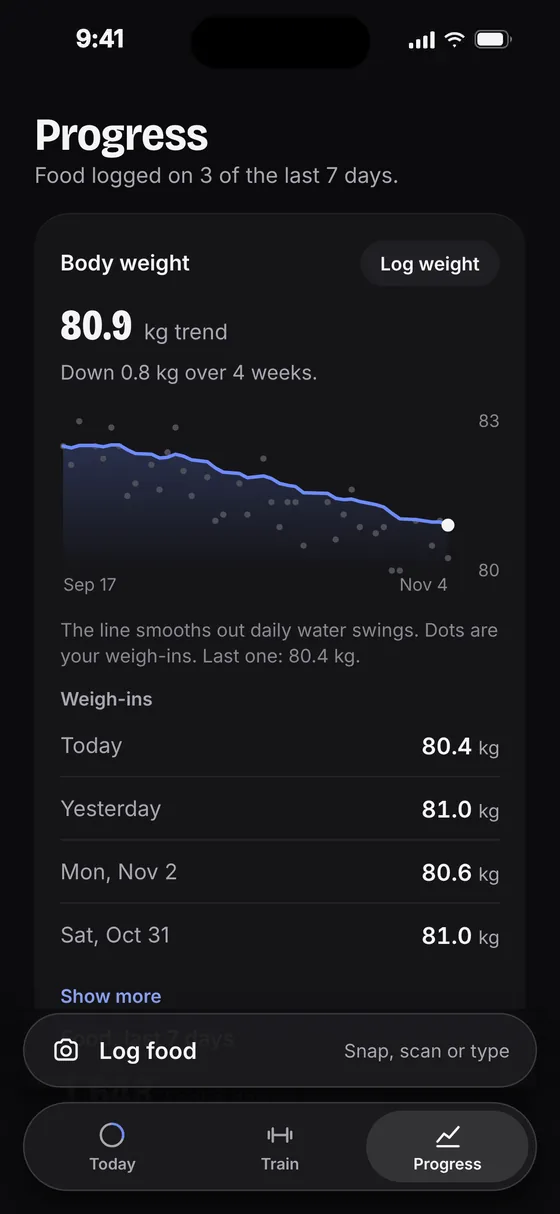

See your protein left, all day
Indar sets your protein from your weight, goal and training, and logs a meal from a photo, so you know at a glance how much is left for the day.


On Android? Get it on Google PlayOn iPhone? Get it on the App Store
Scan with your phone's camera to get Indar.
Free to download. Yearly Pro starts with a 7-day free trial.