 Indar
How to build muscle fast
To build muscle as fast as your body allows, train each muscle at least twice a week with hard sets, about 5 to 10 a week to start and more as you get trained, stopping each set a rep or three short of failure and adding weight or reps over time. Eat about 1.6 to 1.8 g of protein per kg of body weight (0.7 to 0.8 g per lb) with a small calorie surplus, and sleep. Even then it's slow: Indar plans a new male lifter's gain at about 1.4 kg (3 lb) a month at 80 kg, and some of that is fat.
What builds muscle fastest
- Enough hard sets: about 5 to 10 a week aimed at each muscle to start, building toward 10 to 20 as you get trained.
- Each muscle twice a week or more: three or four full-body or upper and lower days do it.
- Hard sets, not failure: stop with 1 to 3 reps left in you.
- Progress: add a rep, then weight, and write it down so you know what to beat (how, session by session).
- Protein and a small surplus: about 1.8 g per kg a day, and 100 to 400 kcal over maintenance.
- Sleep: one night without it cut muscle protein synthesis by 18% the next afternoon in a 13-person trial.
How fast does muscle really grow?
Slower than most articles promise. A meta-analysis pooled 111 studies of lifting programs with 1,927 healthy men: on average, training added about 1.5 kg of lean mass over the length of each study. Age, height and weight didn't explain who gained more. The one training detail that did was sets per workout, and too many sets in one session went with smaller gains (Benito et al., 2020).
The rate also falls the longer you've trained. A review of off-season nutrition for natural bodybuilders suggests gaining about 0.25 to 0.5% of body weight a week for novice and intermediate lifters, and less for advanced ones (Iraki et al., 2019). Indar plans weight gain inside and just below that:
- Under 6 months of lifting, or back after a break: 0.4% of body weight a week for men, 0.3% for women. At 80 kg that's 0.32 kg (0.7 lb) a week, about 1.4 kg (3 lb) a month.
- 6 months to 3 years: 0.25% for men, 0.2% for women.
- Over 3 years: 0.15% for men, 0.1% for women. At 80 kg, 0.12 kg (0.26 lb) a week.
That's scale weight, not pure muscle: some of any gain is fat and water. Going faster than this mostly adds fat (more on that below). The lean bulk guide has the surplus behind each rate.
How to tell it's working: your weekly average weight rises at about that rate, and your lifts keep going up. Check every three to four weeks: gaining faster than your rate, take off about 100 kcal a day; not gaining, add about 100.
Man, 80 kg (176 lb), Under 6 months: 1.4 kg (3.1 lb) a month, +350 kcal; Man, 80 kg (176 lb), 6 months to 3 years: 0.9 kg (2.0 lb) a month, +220 kcal; Man, 80 kg (176 lb), Over 3 years: 0.5 kg (1.1 lb) a month, +130 kcal; Woman, 65 kg (143 lb), Under 6 months: 0.8 kg (1.8 lb) a month, +210 kcal; Woman, 65 kg (143 lb), 6 months to 3 years: 0.6 kg (1.3 lb) a month, +140 kcal; Woman, 65 kg (143 lb), Over 3 years: 0.3 kg (0.7 lb) a month, +70 kcal
How should you train to build muscle fast?
Volume: enough hard sets. Across 15 studies, every extra weekly set for a muscle went with a little more growth, about 0.37 percentage points more gain per set, and higher volumes beat lower ones (Schoenfeld et al., 2017). Piling sets into one session works against you, though (Benito, above), so spread them over the week. Indar caps each muscle at 10 hard sets a week in your first months, 16 after six months of steady training, and 20 after three years.
Frequency: each muscle twice a week. With the same weekly sets, training a muscle twice a week grew it more than once a week; whether three times beats two isn't settled (Schoenfeld et al., 2016). Three full-body days (the full body workout guide has that week for a trained lifter), or four days of upper and lower, cover it.
Effort: close to failure, not at it. In 15 studies, going all the way to the point where you can't do another rep showed no clear advantage for growth over stopping short of it (Refalo et al., 2023). Every set should still be hard: Indar's plans stop new lifters 3 reps short on the big lifts and 2 on small ones, and trained lifters 2 and 1.
Load: heavy or light both work. Across 21 studies where every set went to failure, light weights (60% of your one-rep max or less) grew muscle as well as heavy ones, though heavy loads built more maximal strength (Schoenfeld et al., 2017). In those studies every set went to failure, so light sets have to be taken very close to it, which means many reps. Indar uses mostly 6 to 12 reps on the big lifts and 10 to 20 on small ones.
Progression: beat last time. Keep the weight and add a rep. When your first set reaches the top of its range and the rest are within two reps of it, add the smallest step: 2.5 kg (5 lb) on a barbell, the next dumbbell, a pin on a machine. A log makes this possible, because you can't beat a number you don't remember.
A beginner's week, from Indar's plan engine
This is what Indar's program engine gives someone new to lifting, or back after a break, who wants muscle, with three 60-minute sessions a week in a gym. The days alternate heavy and volume work, and every major muscle is trained on at least two of the three days. "In reserve" is how many reps you'd still have when you stop. Rest is between sets; the two exercises of a superset are done one set each, back to back. Counting only exercises aimed at it, each muscle gets 5 to 10 hard sets across the week; presses, rows and squats add more on top.
Day 1: full body, heavy
| Exercise | Sets × reps | In reserve |
|---|---|---|
| Back squatrest 3 min | 3 × 6 to 8 | 3 |
| Bench pressrest 2½ min | 2 × 8 to 10 | 3 |
| Lat pulldownrest 2½ min | 2 × 8 to 10 | 3 |
| Romanian deadliftrest 2½ min | 2 × 8 to 10 | 3 |
| Lateral raiserest 75 s | 2 × 12 to 20 | 2 |
| Dumbbell curlsuperset with pushdowns | 2 × 12 to 20 | 2 |
| Triceps pushdown | 2 × 10 to 15 | 2 |
| Seated leg curlrest 75 s | 2 × 10 to 15 | 2 |
Day 2: full body, volume
| Exercise | Sets × reps | In reserve |
|---|---|---|
| Dumbbell Romanian deadliftrest 2½ min | 3 × 8 to 12 | 3 |
| Incline dumbbell pressrest 2 min | 2 × 10 to 12 | 3 |
| Chest-supported rowrest 2 min | 2 × 10 to 12 | 3 |
| Bulgarian split squatrest 2 min | 2 × 10 to 12 | 3 |
| Face pullsuperset with raises | 3 × 12 to 15 | 2 |
| Cable lateral raise | 3 × 12 to 20 | 2 |
| Overhead triceps extensionrest 1 min | 3 × 12 to 15 | 2 |
| Standing calf raiserest 1 min | 3 × 12 to 15 | 2 |
| Cable crunchrest 1 min | 2 × 12 to 15 | 2 |
Day 3: full body, heavy
| Exercise | Sets × reps | In reserve |
|---|---|---|
| Hack squatrest 3 min | 3 × 6 to 8 | 3 |
| Overhead pressrest 2½ min | 2 × 8 to 10 | 3 |
| Barbell rowrest 2½ min | 2 × 8 to 10 | 3 |
| Lying leg curlrest 75 s | 3 × 10 to 15 | 2 |
| Cable flyrest 75 s | 3 × 10 to 15 | 2 |
| Cable curlrest 75 s | 3 × 10 to 15 | 2 |
| Seated calf raiserest 75 s | 3 × 10 to 15 | 2 |
Starting out, it's 2 or 3 sets an exercise, stopping well short of failure, so you learn the lifts before you push them. When the plan steps up, each exercise moves a rep closer to failure, and gets a third set where the session has time for it (in this 60-minute week it doesn't). For someone with more than six months of steady training and four days a week, the same engine builds upper and lower days with mostly 3 or 4 sets an exercise. With six days, it builds push pull legs. The workout plan generator builds yours from your days, minutes and equipment.
What should you eat to build muscle?
Protein: about 1.6 to 1.8 g per kg a day. In 49 trials with 1,863 people, extra protein added to the gains from lifting, but past a total of about 1.6 g per kg a day it added no more lean mass on average (Morton et al., 2018). That's an average, so Indar sets 1.8 to cover more people, counted from a healthy weight if you carry a lot of fat:
- 60 kg (132 lb): 108 g a day
- 80 kg (176 lb): 144 g a day
- 100 kg (220 lb): 180 g a day
Spread it out: about 0.4 g per kg a meal over at least four meals, which is 32 g a meal at 80 kg (Schoenfeld and Aragon, 2018). In a lab study of 24 trained men (8 a group), 20 g of whey every 3 hours after lifting raised muscle protein synthesis over 12 hours more than the same 80 g as two big doses or eight small ones (Areta et al., 2013). The protein guide shows what a day of it looks like in food, and protein for women covers the studies done in women.
Calories: a small surplus. In a trial of trained lifters given maintenance, a 5% surplus or a 15% surplus for eight weeks, faster weight gain mostly added fat measured by skinfolds, not muscle thickness or squat strength, though the biggest surplus raised the bench press more (Helms et al., 2023). It was a small trial (17 people finished), but it points the same way as the rest: eat just enough to gain at the rates above. For most people that's 100 to 400 kcal (about 420 to 1,670 kJ) a day over maintenance. The macro calculator works out yours on Build muscle.
Already carrying a lot of fat? Don't bulk. New lifters can often build muscle while losing fat; the recomposition guide covers when that works and how to run it.
Does sleep affect muscle growth?
In a crossover trial of 13 young adults, one night without sleep cut muscle protein building the next afternoon by 18%, raised cortisol by 21% and lowered testosterone by 24% (Lamon et al., 2021). That's one night of none at all, not a short night, and it measured a day, not months of growth. But it's a reason to treat sleep as part of training: a regular bedtime and enough hours that you wake without a fight.
Is creatine worth it?
It's the best-studied supplement for lifting. The International Society of Sports Nutrition's review finds creatine raises the creatine stored in muscle, which may explain the better high-intensity performance and training gains seen with it, and that it's safe and well tolerated in healthy people (Kreider et al., 2017). The usual dose is 3 to 5 g of creatine monohydrate a day (Iraki et al., 2019). It helps the training do its job; it doesn't replace it. If you have kidney disease or take regular medicines, ask your doctor first.
What doesn't speed it up?
- A dirty bulk: eating as much as you can gains weight faster, but the extra is mostly fat (Helms, above).
- Protein far past 1.6 g per kg: no more muscle on average (Morton, above), and fewer calories left for the carbs that fuel training.
- Endless sets in one session: past a point, more sets in one workout went with smaller gains (Benito, above). Spread them over the week.
- Failure on every set: no clear extra growth (Refalo, above).
- Switching programs every week: you can't add weight to a lift you rarely repeat. Keep the same main lifts for a few months and beat them.
Common questions
How fast can you build muscle?
New lifters gain fastest. Indar plans weight gain of 0.4% of body weight a week for new male lifters, about 1.4 kg (3 lb) a month at 80 kg, and 0.3% for women, falling to 0.15% and 0.1% after three years. Some of that is fat. Across 111 training studies of healthy men, lifting added about 1.5 kg of lean mass on average over the length of each study.
How many sets per muscle should I do to build muscle?
Start with about 5 to 10 hard sets a week aimed at each muscle, spread over at least two sessions. Higher weekly volumes built more muscle in the studies, so build up as you get trained: Indar allows up to 10 in your first months, 16 after six months of steady training and 20 after three years.
Do I need to bulk to build muscle?
Reviews advise a small surplus, about 100 to 400 kcal a day over maintenance for most people. In the one trial here that compared surplus sizes (17 people), faster gain mostly added fat, with no clear difference in muscle. If you're new to lifting and carry a lot of fat, you can often build muscle while losing fat instead.
How much protein do I need to build muscle?
About 1.6 to 1.8 g per kg of body weight a day (0.7 to 0.8 g per lb), spread over at least four meals. In a meta-analysis of 49 trials, protein beyond about 1.6 g per kg added no more lean mass on average.
Do women build muscle as fast as men?
About as fast for their size. In a meta-analysis of 10 studies that gave men and women the same program, muscle growth was similar between the sexes. Women usually start with less muscle, so the same growth is fewer kilograms, and Indar plans a slightly slower weight gain for them.
Who this isn't for
This guide is for healthy adults. Its numbers aren't for anyone under 18 (growth changes the maths), breastfeeding, or living with kidney disease (protein often needs limiting). If you have a heart condition, chest pain or fainting with exercise, or you've been told not to exercise, a doctor needs to clear you first. If you're pregnant, check with your doctor or midwife before starting a program. Lifting with pain or an injury is a job for a physiotherapist, who can tell you what to swap.
Sources
- Benito PJ, Cupeiro R, Ramos-Campo DJ, Alcaraz PE, Rubio-Arias JÁ. A systematic review with meta-analysis of the effect of resistance training on whole-body muscle growth in healthy adult males. Int J Environ Res Public Health. 2020.
- Iraki J, Fitschen P, Espinar S, Helms E. Nutrition recommendations for bodybuilders in the off-season: a narrative review. Sports. 2019.
- Schoenfeld BJ, Ogborn D, Krieger JW. Dose-response relationship between weekly resistance training volume and increases in muscle mass: a systematic review and meta-analysis. J Sports Sci. 2017.
- Schoenfeld BJ, Ogborn D, Krieger JW. Effects of resistance training frequency on measures of muscle hypertrophy: a systematic review and meta-analysis. Sports Med. 2016.
- Refalo MC, Helms ER, Trexler ET, Hamilton DL, Fyfe JJ. Influence of resistance training proximity-to-failure on skeletal muscle hypertrophy: a systematic review with meta-analysis. Sports Med. 2023.
- Schoenfeld BJ, Grgic J, Ogborn D, Krieger JW. Strength and hypertrophy adaptations between low- vs. high-load resistance training: a systematic review and meta-analysis. J Strength Cond Res. 2017.
- Morton RW, Murphy KT, McKellar SR, et al. A systematic review, meta-analysis and meta-regression of the effect of protein supplementation on resistance training-induced gains in muscle mass and strength in healthy adults. Br J Sports Med. 2018.
- Schoenfeld BJ, Aragon AA. How much protein can the body use in a single meal for muscle-building? Implications for daily protein distribution. J Int Soc Sports Nutr. 2018.
- Areta JL, Burke LM, Ross ML, et al. Timing and distribution of protein ingestion during prolonged recovery from resistance exercise alters myofibrillar protein synthesis. J Physiol. 2013.
- Helms ER, Spence AJ, Sousa C, et al. Effect of small and large energy surpluses on strength, muscle, and skinfold thickness in resistance-trained individuals: a parallel groups design. Sports Med Open. 2023.
- Lamon S, Morabito A, Arentson-Lantz E, et al. The effect of acute sleep deprivation on skeletal muscle protein synthesis and the hormonal environment. Physiol Rep. 2021.
- Kreider RB, Kalman DS, Antonio J, et al. International Society of Sports Nutrition position stand: safety and efficacy of creatine supplementation in exercise, sport, and medicine. J Int Soc Sports Nutr. 2017.
- Roberts BM, Nuckols G, Krieger JW. Sex differences in resistance training: a systematic review and meta-analysis. J Strength Cond Res. 2020.

Train for it, eat for it
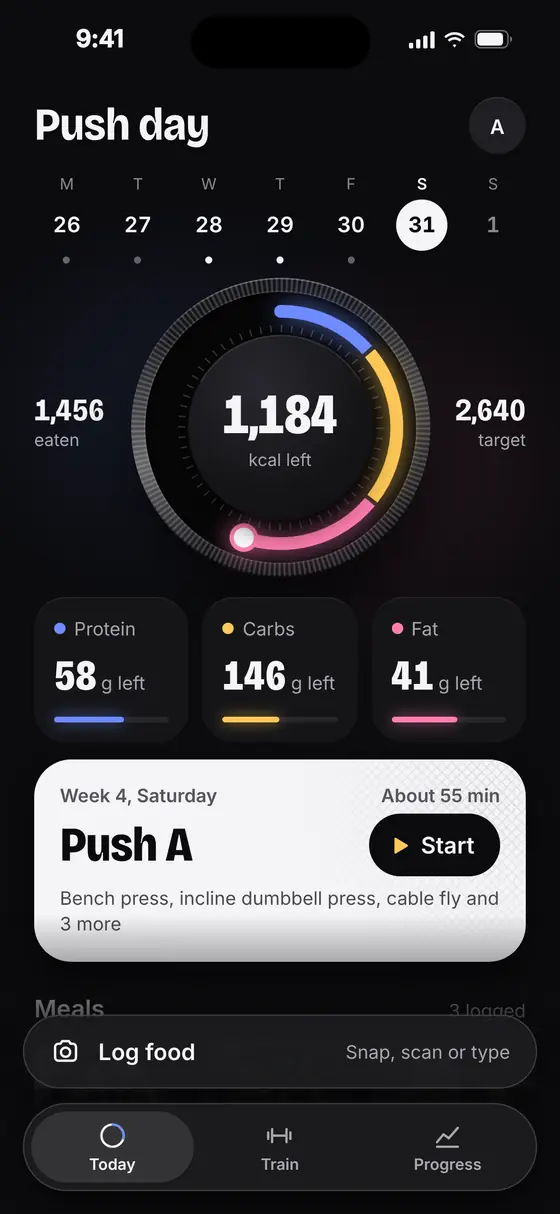
Indar builds your week and picks the weight for every set from what you did last time, then sets your calories and protein for building muscle and logs a meal from a photo.


On Android? Get it on Google PlayOn iPhone? Get it on the App Store
Scan with your phone's camera to get Indar.
Free to download. Yearly Pro starts with a 7-day free trial.