 Indar
Push pull legs: the six-day split, done properly
Push pull legs (PPL) splits your training into three workouts: push (chest, shoulders, triceps), pull (back, biceps, rear shoulders) and legs. Run it over six days, each workout twice a week, so every muscle is trained twice; done over three days, each muscle gets one session a week, and three full-body days spread the same work more evenly. Below is a full six-day week from Indar's plan engine, with the sets, reps, effort and rest for every exercise.
The short answer
- Push: chest, shoulders and triceps. Bench press, incline press, overhead press, flyes, raises, pushdowns.
- Pull: back, biceps and rear shoulders. Pulldowns, rows, face pulls, curls.
- Legs: quads, hamstrings, glutes and calves. Squats, Romanian deadlifts, lunges, hip thrusts, leg curls, calf raises.
- Six days, each workout twice: a heavy version and a volume version, with one rest day.
- Fewer days? Three days: train full body. Four: upper and lower. Five: push, pull, legs, then upper and lower (every split by days a week).
- Every set hard: stop 1 or 2 reps short of failure, add a rep each time, then weight.
How many days a week is push pull legs?
Push pull legs only trains each muscle twice a week if you train six days. That matters for two reasons.
Twice a week is the safer bet. In a meta-analysis of 10 studies, training a muscle twice a week grew it more than once a week; whether three times beats two wasn't settled (Schoenfeld et al., 2016). A later analysis of 25 studies found that when the weekly sets were the same, how often you trained made no meaningful difference (Schoenfeld et al., 2019). So the gain from frequency is mostly that it lets you do more sets, and do them well.
One long session isn't the same as two. Across 111 studies of healthy men, the one training detail that explained who grew less was too many sets in one workout (Benito et al., 2020). A three-day push pull legs puts a muscle's whole week into one session, so either the sets are few or the late ones are done tired. In a trial of 20 trained men, three full-body days a week grew the muscles at the front of the upper arm more than a split that trained each muscle once a week, but not the triceps or thighs, and with no difference in strength (Schoenfeld et al., 2015).
The split itself isn't magic either way. A meta-analysis of 14 studies with 392 people found split and full-body routines built the same strength and muscle when the weekly sets matched (Ramos-Campo et al., 2024). Pick the one that fits your week. That's why Indar's plan engine only builds push pull legs for five or six days:
| Days a week | Split | Chest, back and thighs |
|---|---|---|
| 3 | Full body, three different days | 2 or 3 times a week |
| 4 | Upper, lower, upper, lower | twice or more a week |
| 5 | Push, pull, legs, upper, lower | twice or more a week |
| 6 | Push, pull, legs, twice over | twice or more a week |
What does a six-day push pull legs week look like?
This is the week Indar's plan engine builds for someone with six months to three years of steady training who wants muscle, training six days for up to an hour in a full gym. The first push, pull and leg days are heavy (the main lift at 6 to 8 reps); the second three are volume days (the first lift at 8 to 12). Some movements switch to the next exercise on the engine's list when they come back (Legs A's back squat is Legs B's hack squat); others, like the lat pulldown, stay and change rep range. "In reserve" is how many reps you'd still have when you stop. Rest is between sets; the two exercises of a superset are done one set each, back to back. The minutes include warm-up sets.
Day 1: Push A, heavy (about 62 minutes)
| Exercise | Sets × reps | In reserve |
|---|---|---|
| Bench pressrest 3 min | 3 × 6 to 8 | 2 |
| Incline dumbbell pressrest 2½ min | 3 × 8 to 10 | 2 |
| Overhead pressrest 2½ min | 2 × 8 to 10 | 2 |
| Cable flyrest 75 s | 3 × 10 to 15 | 1 |
| Lateral raiserest 75 s | 2 × 12 to 20 | 1 |
| Triceps pushdownrest 75 s | 3 × 10 to 15 | 1 |
| Dead bugrest 75 s | 3 × 12 to 20 | 1 |
Day 2: Pull A, heavy (about 49 minutes)
| Exercise | Sets × reps | In reserve |
|---|---|---|
| Lat pulldownrest 3 min | 3 × 6 to 8 | 2 |
| Chest-supported rowrest 2½ min | 2 × 8 to 10 | 2 |
| Straight-arm pulldownrest 75 s | 2 × 10 to 15 | 1 |
| Face pullsuperset with cable lateral raise | 2 × 10 to 15 | 1 |
| Cable lateral raise1 min after each round | 2 × 12 to 20 | 1 |
| Dumbbell curlrest 75 s | 3 × 12 to 20 | 1 |
| Hammer curlrest 75 s | 2 × 12 to 20 | 1 |
| Standing calf raiserest 75 s | 2 × 10 to 15 | 1 |
Day 3: Legs A, heavy (about 60 minutes)
| Exercise | Sets × reps | In reserve |
|---|---|---|
| Back squatrest 3 min | 3 × 6 to 8 | 2 |
| Romanian deadliftrest 2½ min | 3 × 8 to 10 | 2 |
| Bulgarian split squatrest 2½ min | 3 × 8 to 12 | 2 |
| Hip thrustrest 2½ min | 3 × 8 to 10 | 2 |
| Lying leg curlsuperset with standing calf raise | 2 × 10 to 15 | 1 |
| Standing calf raise1 min after each round | 2 × 10 to 15 | 1 |
Day 4: Push B, volume (about 50 minutes)
| Exercise | Sets × reps | In reserve |
|---|---|---|
| Dumbbell bench pressrest 2½ min | 3 × 8 to 12 | 2 |
| Incline bench pressrest 2 min | 2 × 10 to 12 | 2 |
| Dumbbell shoulder pressrest 2 min | 2 × 10 to 12 | 2 |
| Pec deckrest 1 min | 2 × 12 to 15 | 1 |
| Lateral raiserest 1 min | 2 × 12 to 20 | 1 |
| Overhead triceps extensionrest 1 min | 3 × 12 to 15 | 1 |
| Dumbbell overhead triceps extensionrest 1 min | 2 × 12 to 20 | 1 |
Day 5: Pull B, volume (about 46 minutes)
| Exercise | Sets × reps | In reserve |
|---|---|---|
| Lat pulldownrest 2½ min | 3 × 8 to 12 | 2 |
| Barbell rowrest 2 min | 2 × 10 to 12 | 2 |
| Dumbbell pulloverrest 1 min | 2 × 12 to 20 | 1 |
| Rear delt flysuperset with cable lateral raise | 2 × 12 to 15 | 1 |
| Cable lateral raise1 min after each round | 2 × 12 to 20 | 1 |
| Cable curlrest 1 min | 3 × 12 to 15 | 1 |
| Dumbbell calf raiserest 1 min | 2 × 12 to 20 | 1 |
Day 6: Legs B, volume (about 61 minutes)
| Exercise | Sets × reps | In reserve |
|---|---|---|
| Hack squatrest 2½ min | 3 × 8 to 12 | 2 |
| Deadliftrest 2 min | 2 × 5 to 8 | 2 |
| Walking lungerest 2 min | 3 × 10 to 12 | 2 |
| Hip thrustrest 2 min | 3 × 10 to 12 | 2 |
| Seated leg curlsuperset with seated calf raise | 3 × 12 to 15 | 1 |
| Seated calf raise1 min after each round | 3 × 12 to 15 | 1 |
| Hanging leg raiserest 1 min | 3 × 8 to 15 | 1 |
What the week adds up to. Counting each exercise toward the muscle it's aimed at, here are the hard sets a week, beside the three-day full-body week the same engine builds for the same person:
| Muscle | Push pull legs, 6 days | Full body, 3 days |
|---|---|---|
| Chest | 16 | 9 |
| Back | 16 | 13 |
| Shoulders | 16 | 10 |
| Quads | 12 | 10 |
| Hamstrings | 8 | 6 |
| Biceps | 8 | 6 |
| Triceps | 8 | 6 |
| Calves | 9 | 6 |
| Glutes | 6 | none aimed at them |
| Core | 6 | 2 |
| Time in the gym | about 5½ hours | about 3 hours |
Presses, rows and squats train more than the muscle they're counted for, so most muscles get more work than their line shows. Chest, back and shoulders sit at 16 because that's Indar's ceiling after six months of steady training: across 15 studies, more weekly sets went with more growth (Schoenfeld et al., 2017). Indar stops there so the sets stay ones you can recover from six days a week. So push pull legs buys more work for each muscle, at nearly twice the time. If you have the six days and like shorter sessions with fewer muscles in each, it's a good split. If you don't, three full-body days aren't a lesser choice.
Warm-ups. The minutes above count them. Before the day's first barbell lift for the upper or lower body: the empty bar, then about 40, 60 and 80% of your work weight. Before a later barbell lift for the same half, just the 60 and 80% sets. Before the first dumbbell or machine lift for a half, one light set. Small exercises go straight in.
Five days, dumbbells, or new to lifting
Five days. The engine builds push, pull and legs, then an upper and a lower day, which still trains chest, back and thighs twice. Same person, 60 minutes, a full gym:
| Day | Exercises, sets × reps |
|---|---|
| Pushheavy, about 60 minutes | Bench press: 4 × 6 to 8 Incline dumbbell press: 3 × 8 to 10 Overhead press: 2 × 8 to 10 Cable fly: 3 × 10 to 15 Lateral raise: 3 × 12 to 20 Triceps pushdown: 3 × 10 to 15 |
| Pullheavy, about 61 minutes | Lat pulldown: 3 × 6 to 8 Chest-supported row: 3 × 8 to 10 Straight-arm pulldown: 2 × 10 to 15 Face pull: 3 × 10 to 15, superset with cable lateral raise Cable lateral raise: 3 × 12 to 20 Dumbbell curl: 3 × 12 to 20, superset with dumbbell calf raise Dumbbell calf raise: 3 × 12 to 20 Dead bug: 3 × 12 to 20 Hammer curl: 2 × 12 to 20 |
| Legsheavy, about 60 minutes | Back squat: 3 × 6 to 8 Romanian deadlift: 3 × 8 to 10 Bulgarian split squat: 3 × 8 to 12 Hip thrust: 3 × 8 to 10 Lying leg curl: 2 × 10 to 15, superset with standing calf raise Standing calf raise: 2 × 10 to 15 |
| Uppervolume, about 61 minutes | Dumbbell bench press: 4 × 8 to 12 Barbell row: 3 × 10 to 12 Dumbbell shoulder press: 2 × 10 to 12 Lat pulldown: 2 × 10 to 12 Lateral raise: 3 × 12 to 20, superset with standing calf raise Standing calf raise: 3 × 12 to 15 Cable curl: 3 × 12 to 15, superset with overhead triceps extension Overhead triceps extension: 3 × 12 to 15 |
| Lowervolume, about 61 minutes | Deadlift: 3 × 5 to 8 Hack squat: 3 × 10 to 12 Walking lunge: 3 × 10 to 12 Hip thrust: 3 × 10 to 12 Seated leg curl: 3 × 12 to 15, superset with seated calf raise Seated calf raise: 3 × 12 to 15 Hanging leg raise: 2 × 8 to 15 |
Dumbbells and a bench only. The same six days at home, for the same person:
| Day | Exercises, sets × reps |
|---|---|
| Push Aheavy, about 48 minutes | Dumbbell bench press: 3 × 6 to 8 Incline dumbbell press: 3 × 8 to 10 Dumbbell shoulder press: 2 × 8 to 10 Dumbbell fly: 3 × 12 to 20 Lateral raise: 2 × 12 to 20 Dumbbell overhead triceps extension: 3 × 12 to 20 |
| Pull Aheavy, about 44 minutes | One-arm dumbbell row: 4 × 6 to 8 Dumbbell pullover: 3 × 12 to 20 Dumbbell rear delt fly: 2 × 12 to 20, superset with lateral raise Lateral raise: 2 × 12 to 20 Dumbbell curl: 3 × 12 to 20 Dumbbell calf raise: 2 × 12 to 20 |
| Legs Aheavy, about 61 minutes | Goblet squat: 3 × 8 to 12 Dumbbell Romanian deadlift: 3 × 8 to 12 Bulgarian split squat: 3 × 8 to 12 Glute bridge: 3 × 12 to 20 Dumbbell leg curl: 3 × 12 to 20, superset with dumbbell calf raise Dumbbell calf raise: 3 × 12 to 20 Dead bug: 3 × 12 to 20 |
| Push Bvolume, about 41 minutes | Dumbbell bench press: 3 × 8 to 12 Incline dumbbell press: 2 × 10 to 12 Dumbbell shoulder press: 2 × 10 to 12 Dumbbell fly: 2 × 12 to 20 Lateral raise: 2 × 12 to 20 Dumbbell overhead triceps extension: 3 × 12 to 20 |
| Pull Bvolume, about 41 minutes | Chest-supported dumbbell row: 4 × 8 to 12 Dumbbell pullover: 3 × 12 to 20 Dumbbell rear delt fly: 2 × 12 to 20, superset with lateral raise Lateral raise: 2 × 12 to 20 Hammer curl: 3 × 12 to 20 Dumbbell curl: 2 × 12 to 20 |
| Legs Bvolume, about 62 minutes | Goblet squat: 3 × 8 to 12 Dumbbell Romanian deadlift: 3 × 10 to 12 Walking lunge: 3 × 10 to 12 Glute bridge: 3 × 12 to 20 Dumbbell leg curl: 3 × 12 to 20 Dumbbell calf raise: 3 × 12 to 20 Dead bug: 3 × 12 to 20 |
New to lifting. The same six days get mostly 2 sets an exercise and up to 10 hard sets a muscle, and sessions of about 30 to 60 minutes. See that week. After three years, with 75 minutes a session, chest, back and shoulders go up to 20 sets.
Only three days? Train full body (the full body workout guide): the three-day week trains chest, back, shoulders and quads three times each, and the beginner's three-day week is printed in full. The workout plan generator opens on the six-day week above and rebuilds it for your days, minutes and equipment, bands included.
How do you run push pull legs?
Order and rest days. Push, pull, legs, push, pull, legs, then a rest day. The workouts take turns, so chest is the focus on days 1 and 4, back on 2 and 5, legs on 3 and 6: each gets two days off in between (the deadlift on Legs B works the back too). Side shoulders and calves come up more often, a few sets at a time. Any six days of the week work. If you miss a day, pick up with the workout you missed rather than skipping it.
Effort: close to failure, not at it. In this week, big lifts stop with 2 reps left and small ones with 1. Across 15 studies, going all the way to failure showed at most a trivial advantage for growth over stopping short of it (Refalo et al., 2023), and six days a week is a lot of sets to recover from.
Weights: heavy or light both build muscle. Across 21 studies where every set went to failure, light loads (60% of your one-rep max or less) grew muscle as well as heavy ones, though heavy loads built more maximal strength (Schoenfeld et al., 2017). That's why heavy days keep the main lift at 6 to 8 reps and small exercises go up to 20.
Progress: add a rep, then weight. Keep the weight and add a rep each session. When your first set reaches the top of its range and the rest are within two reps of it, add the smallest step: 2.5 kg on most barbell lifts and 5 kg on deadlifts (5 lb on any bar if you lift in pounds), the next dumbbell, a pin on a machine. In an eight-week leg training trial of 43 trained lifters, adding reps at the same weight built muscle and strength about as well as adding weight (Plotkin et al., 2022), so either counts as progress.
When it stalls. Indar's rules: if you fall short of the bottom of the range three sessions running, the weight comes down about 10% and you build back up. On a big lift, six sessions at the same weight without getting stronger means 5% off. After three weeks or more away from a lift, start about 10% lighter (20% after six weeks). The progressive overload guide works these rules through session by session.
What are the common mistakes?
- Three days of push pull legs to save time: each muscle gets one session a week. Three full-body days take the same time and train everything two or three times.
- Every exercise for a muscle in one session: past a point, more sets in one workout went with smaller gains (Benito, above). Split the work over the two days.
- Forgetting the rear shoulders and hamstrings: pull days need a face pull or rear delt fly, and leg days need a hinge and a leg curl, not only squats.
- Failure on every set, six days a week: at most a trivial extra growth (Refalo, above), and much more to recover from.
- A new program every few weeks: you can't add weight to a lift you rarely repeat. Keep the same main lifts for a few months and beat them.
Common questions
Is push pull legs good for beginners?
It works, but you don't need six days to start. In your first months, Indar's three full-body days train every major muscle two or three times a week in about two thirds of the gym time (about 3 hours a week against 4½). If you can train six days and want to, Indar builds beginners a six-day push pull legs week with mostly 2 sets an exercise and up to 10 hard sets a muscle.
Is a 3-day push pull legs split enough?
It trains each muscle once a week. One analysis of 10 studies found twice a week built more muscle than once; a later one of 25 found no difference when the weekly sets matched. So the gain is mostly that two sessions fit more sets without very long workouts, and on three days a full-body routine does that. Indar doesn't build push pull legs on three days.
Is push pull legs better than full body or upper lower?
Not by itself. In a meta-analysis of 14 studies, split and full-body routines built the same muscle and strength when the weekly sets matched. Pick the split that fits your days: full body for three, upper and lower for four, push pull legs for six.
How many sets should I do on push pull legs?
Indar plans up to 10 hard sets a week for a muscle in your first months, 16 after six months of steady training and 20 after three years, spread over its two sessions. The six-day week on this page gives chest, back and shoulders 16 each and the arms and hamstrings 8, with presses, rows and squats adding more.
How many rest days on push pull legs?
One a week on the six-day version. The workouts take turns, so the main muscles of each one get two days off before they're the focus again. If six days is too much to keep up, train five or three days on a split built for them rather than skipping days of this one.
Who this isn't for
This guide is for healthy adults. If you have a heart condition, chest pain or fainting with exercise, or you've been told not to exercise, a doctor needs to clear you first. If you're pregnant, check with your doctor or midwife before starting a program. Lifting with pain or an injury is a job for a physiotherapist, who can tell you what to swap.
Sources
- Schoenfeld BJ, Ogborn D, Krieger JW. Effects of resistance training frequency on measures of muscle hypertrophy: a systematic review and meta-analysis. Sports Med. 2016.
- Schoenfeld BJ, Grgic J, Krieger J. How many times per week should a muscle be trained to maximize muscle hypertrophy? A systematic review and meta-analysis of studies examining the effects of resistance training frequency. J Sports Sci. 2019.
- Benito PJ, Cupeiro R, Ramos-Campo DJ, Alcaraz PE, Rubio-Arias JÁ. A systematic review with meta-analysis of the effect of resistance training on whole-body muscle growth in healthy adult males. Int J Environ Res Public Health. 2020.
- Schoenfeld BJ, Ratamess NA, Peterson MD, Contreras B, Tiryaki-Sonmez G. Influence of resistance training frequency on muscular adaptations in well-trained men. J Strength Cond Res. 2015.
- Ramos-Campo DJ, Benito-Peinado PJ, Andreu-Caravaca L, Rojo-Tirado MA, Rubio-Arias JÁ. Efficacy of split versus full-body resistance training on strength and muscle growth: a systematic review with meta-analysis. J Strength Cond Res. 2024.
- Schoenfeld BJ, Ogborn D, Krieger JW. Dose-response relationship between weekly resistance training volume and increases in muscle mass: a systematic review and meta-analysis. J Sports Sci. 2017.
- Refalo MC, Helms ER, Trexler ET, Hamilton DL, Fyfe JJ. Influence of resistance training proximity-to-failure on skeletal muscle hypertrophy: a systematic review with meta-analysis. Sports Med. 2023.
- Schoenfeld BJ, Grgic J, Ogborn D, Krieger JW. Strength and hypertrophy adaptations between low- vs. high-load resistance training: a systematic review and meta-analysis. J Strength Cond Res. 2017.
- Plotkin D, Coleman M, Van Every D, et al. Progressive overload without progressing load? The effects of load or repetition progression on muscular adaptations. PeerJ. 2022.

Six days, planned for you
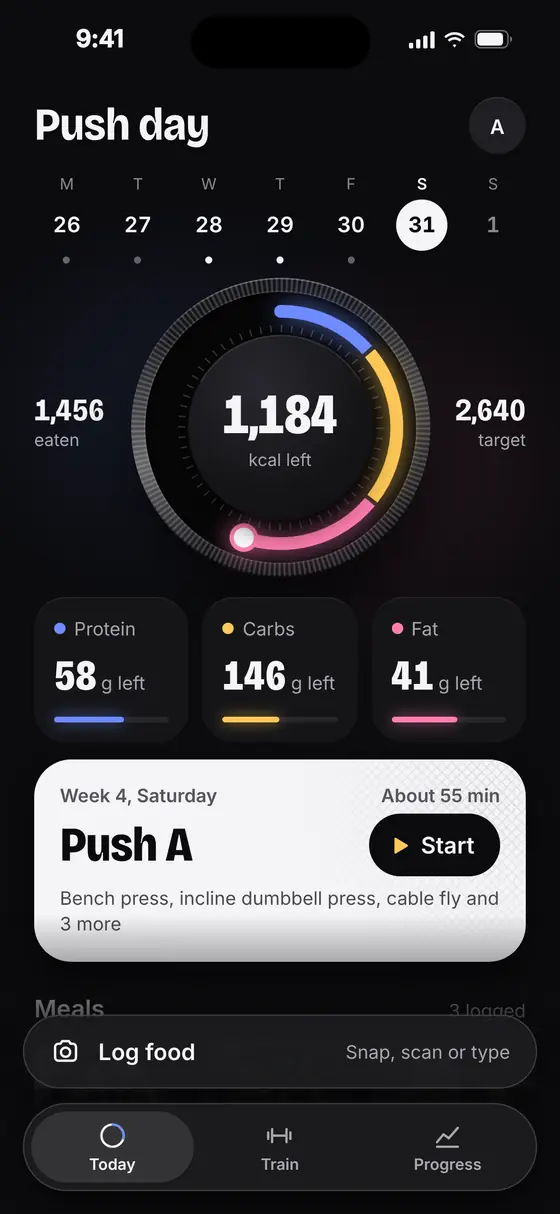
Indar builds your push pull legs week (or the split that fits your days), picks the weight for every set from what you did last time, and moves a missed session later in the week.


On Android? Get it on Google PlayOn iPhone? Get it on the App Store
Scan with your phone's camera to get Indar.
Free to download. Yearly Pro starts with a 7-day free trial.