 Indar
Plate calculator
What to put on each side of the bar for any weight, in kilos or pounds, on your bar and with the plates you have, and the warm-up sets before it. Below it, your one-rep max from any set, and what to lift at each percentage. It's the maths from Indar's workout screen.
One-rep max calculator
Your estimated one-rep max from any set: the weight, the reps, and how many more you could have done. Then what to lift at each percentage of it, rounded to weights you can load.
What to lift at each percentage, bar included
| % | Total, with the bar | Reps, about | Load it |
|---|
How the plates are worked out
Take the bar off the total and halve what's left: that's each side. Then load the heaviest plate that fits, then the next heaviest, until the side is made. 100 kg on a 20 kg bar is 40 kg a side: a 25 and a 15. 225 lb on a 45 lb bar is 90 lb a side: two 45s. This is how Indar's workout screen shows each set, and how most people load a bar, heaviest plates on first.
If you leave plates out, heaviest-first can miss: with only 25s and 20s, 40 kg a side is two 20s, but a 25 first leaves 15 that nothing makes. So when heaviest-first can't make the weight, or would pile on small plates, the calculator finds the mix with the fewest plates instead. When the weight can't be made at all, it offers the nearest weights below and above that can.
The warm-up is the app's ramp before a heavy barbell lift: the empty bar for 10, then about 40% of the work weight for 8, 60% for 5 and 80% for 3, each rounded to 5 kg (10 lb in pounds) and skipped if it would land on the step before. A light work weight gets fewer steps.
How the one-rep max is estimated
From the Epley formula: one-rep max = weight × (1 + reps ÷ 30). It's the estimate Indar's progress screen uses. Reps you had left count as reps you could have done: 100 kg for 5 with 2 left is treated like 100 kg for 7 to failure, so a set you stopped short of failure still gives a fair estimate. This is the reps in reserve idea from Zourdos et al., 2016. A single to failure is your max as it is.
Past 12 reps the estimate stops climbing: a set that long says more about endurance than about the most you can lift once, and every formula gets less reliable there. For the best estimate, use a hard set of 3 to 8 reps.
The percentage table turns the formula around. At 85% of your max, Epley says about 5 reps to failure; at 75%, about 10. Each weight is rounded to the nearest one you can load with the bar and plates above, and the button loads it into the plate calculator.
Testing a max safely
You don't need to test a true one-rep max to train well. If you do, use a spotter or set the safety bars, warm up with the ramp above, and leave it for after your first months of lifting, when your technique holds up under a heavy weight. Stop if you feel sharp pain, and see a physiotherapist about pain that stays.
Common questions
How much does a barbell weigh?
Most Olympic bars are 20 kg, or 45 lb in pound gyms. There's also a 15 kg bar, or 35 lb, a little shorter with a thinner grip. Training and technique bars are lighter and vary, so check the end of the bar or weigh it.
Do collars count toward the weight?
Spring clips weigh a few hundred grams and most people leave them out. Competition collars weigh 2.5 kg each, so with those on, the bar and collars together are 25 kg.
How accurate is a one-rep max calculator?
Close enough to plan with when the set was hard and had 10 reps or fewer. The more reps in the set, the further the estimate can drift from what you'd actually lift once, and it differs between people and lifts.
Do I need to test my one-rep max?
No. An estimate from a hard set of 3 to 8 reps is close and much less risky, and you can redo it every few weeks from your normal training. Test a true single only with a spotter or safety bars, and not in your first months of lifting.
Sources
- Epley B. Poundage chart. In: Boyd Epley Workout. Lincoln, NE: Body Enterprises; 1985.
- LeSuer DA, McCormick JH, Mayhew JL, Wasserstein RL, Arnold MD. The accuracy of prediction equations for estimating 1-RM performance in the bench press, squat, and deadlift. J Strength Cond Res. 1997;11(4):211-213.
- Zourdos MC, et al. Novel resistance training-specific rating of perceived exertion scale measuring repetitions in reserve. J Strength Cond Res. 2016.
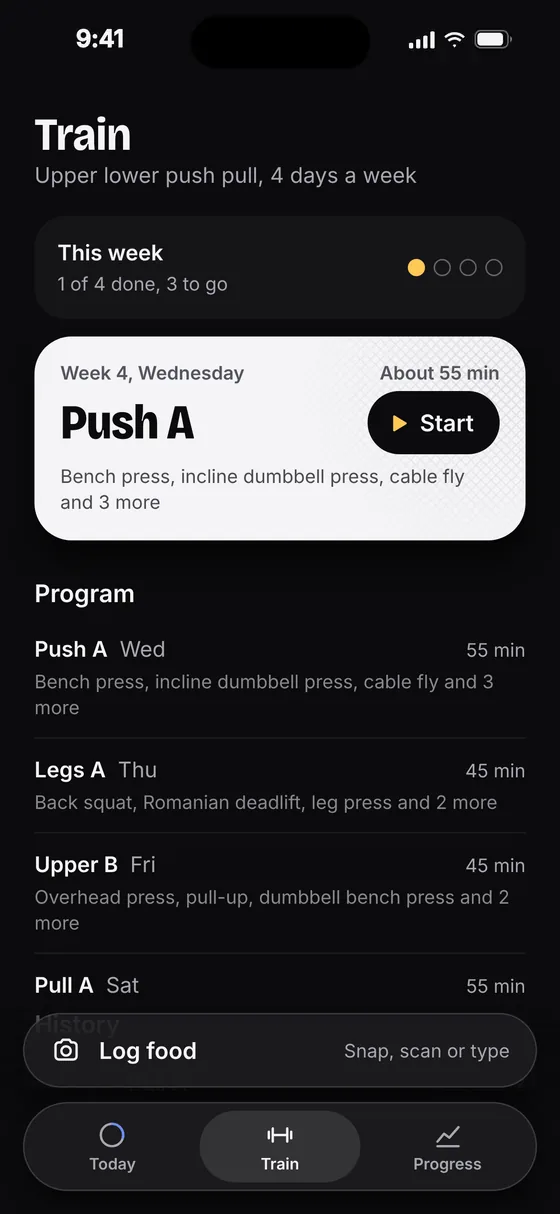

Indar loads the bar for you
In a workout, Indar picks the weight for every set from your last session, shows the plates for each side and the warm-up before it, and moves you up when you're ready.


On Android? Get it on Google PlayOn iPhone? Get it on the App Store
Scan with your phone's camera to get Indar.
Free to download. Yearly Pro starts with a 7-day free trial.