 Indar
Protein calculator
This protein calculator works out how many grams of protein to eat a day from your weight, goal and training. For adults who lift, this calculator sets 1.6 to 2.2 g of protein per kg of body weight a day (0.7 to 1 g per lb): 1.8 g per kg (0.8 g per lb) to build muscle and 2.2 g per kg (1 g per lb) while losing fat. A protein target is the grams of protein you aim to eat each day, and Indar sets yours with this same rule.
How much protein do I need a day?
If you lift, aim for 1.6 to 2.2 g of protein per kg of body weight a day (0.7 to 1 g per lb), more while losing fat than while building. This calculator picks your number inside that range from your goal and how much you train, and the calorie calculator and the Indar app use the same rule:
- Building muscle, recomp or getting stronger: 1.8 g per kg (0.8 g per lb). A large, widely cited meta-analysis of protein and lifting found extra protein stopped adding muscle at about 1.6 g per kg on average, with the upper end of its range at 2.2 (Morton et al., 2018). 1.8 sits just above the average, so most people are covered without eating protein that does nothing.
- Losing fat: 2.2 g per kg (1 g per lb). Eating less makes muscle harder to keep, and lean, trained people in a deficit keep more of it on higher intakes (Helms et al., 2014). The top of the range protects what you've built.
- Staying fit: 1.6 g per kg (0.7 g per lb), the point where gains level off on average, and inside the 1.4 to 2.0 g per kg the International Society of Sports Nutrition recommends for people who exercise (Jäger et al., 2017).
- A lot of training raises it: to at least 1.8 g per kg with 6 or more hours a week of lifting and other sport together, and 2.0 g per kg (0.9 g per lb) with 10 or more, for recovery. Lifting hours are your days a week times your minutes a session, divided by 60.
With the calculator's opening numbers, a 28-year-old man of 78 kg (172 lb) and 178 cm (5 ft 10 in) who has lifted for 6 months to 3 years, four days a week for an hour, needs 140 g of protein a day to build muscle and 172 g a day while losing fat.
Why isn't protein counted from my whole weight?
With more body fat than a healthy range, this calculator counts your protein from your estimated lean mass (everything that isn't fat: muscle, bone, organs and water) plus a healthy amount of fat. Carrying more body fat doesn't add to how much protein you need, so a target from your whole weight would ask you to eat more for nothing. A healthy range tops out at about 20% body fat for men and 30% for women (Gallagher et al., 2000; the midpoint, 25%, with Rather not say). Above it, your protein is counted from the weight you'd be with the same lean mass at the top of that range. It never goes above 3 g per kg of your actual weight. At or below the top of that range, your whole weight counts.
Your body fat is estimated from your BMI, age and sex with Deurenberg's formula, which usually lands within about 4 percentage points of a measured body fat. The formula counts all weight above a lean BMI as fat, which is wrong for people who lift, so for lifters part of the weight above a BMI of 20 counts as muscle: more the longer you've lifted and the more days you lift. A muscular lifter keeps their whole weight. The estimate isn't a measurement, so the calculator doesn't show it as a number. The calorie calculator explains it in full.
Four people, worked out
This calculator gives these four people 140 to 190 g of protein a day, each worked out with Indar's own rule.
| Person | Protein | Counted as |
|---|---|---|
| Man, 2878 kg (172 lb), 178 cm (5 ft 10 in); build muscle, 6 months to 3 years lifting, 4 × 60 min | 140 g | 1.8 g/kg of 78 kg |
| Woman, 3465 kg (143 lb), 165 cm (5 ft 5 in); lose fat, 6 months to 3 years lifting, 3 × 45 min | 143 g | 2.2 g/kg of 65 kg |
| Man, 45110 kg (243 lb), 175 cm (5 ft 9 in); lose fat, new to lifting, 3 × 60 min | 190 g | 2.2 g/kg of 86 kg |
| Man, 2485 kg (187 lb), 183 cm (6 ft 0 in); build muscle, over 3 years lifting, 5 × 90 min plus 3.5 h of sport | 170 g | 2.0 g/kg of 85 kg |
The 45-year-old man carries more body fat than a healthy range, so his 190 g is counted from 86 kg (190 lb), not the 242 g his whole weight would give. The 24-year-old man trains 11 hours a week, lifting and sport together, which raises his rate for building muscle from 1.8 to 2.0 g per kg.
Is 0.8 g per kg or 1 g per pound right?
Both numbers are right for different people: 0.8 g per kg (0.36 g per lb) is the minimum for basic needs if you don't train, and 1 g per pound (2.2 g per kg) is this calculator's rate for lifters losing fat. The 0.8 comes from the World Health Organization, whose safe intake for adults is 0.83 g per kg a day (WHO, FAO and UNU, 2007): about 65 g for the 78 kg man above, set to prevent a shortfall rather than to build muscle. Over 65, the PROT-AGE group advises at least 1.0 to 1.2 g per kg a day, even without training (Bauer et al., 2013). For building muscle, this calculator's 1.8 g per kg is enough for most lifters, so the gym rule of 1 g per pound is more than they need. The guide to how much protein a day goes through the studies, and how much protein is too much covers the upper end.
How do I split my protein over meals?
Divide your daily number by the meals you eat: the calculator shows it over three, four and five meals, and the 78 kg man's 140 g is 47 g over three meals, 35 g over four or 28 g over five. Four meals of about 0.4 g per kg each is the split a review of the meal studies suggests (Schoenfeld and Aragon, 2018), but three bigger meals work too, and hitting the day's total matters more than how you split it.
What does 35 g of protein look like?
A breakfast of a 170 g pot of plain nonfat Greek yogurt, two large eggs (about 100 g) and 40 g of dry oats is about one of the 35 g meals in the 78 kg man's four-meal split, worked out below. Every number is from the food's USDA record on its food page (USDA FoodData Central); labels vary, so check yours.
- 170 g plain nonfat Greek yogurt: 100 kcal, 17 g protein
- 100 g egg: 143 kcal, 13 g protein
- 40 g dry oats: 152 kcal, 5.3 g protein
395 kcal (1,652 kJ), 35 g protein, 34 g carbs, 13 g fat.
For other foods, the food pages give the protein in a portion, and the high-protein meal prep plan puts a whole week of boxes together.
Who this isn't for
These targets are for healthy adults who train. With kidney disease, protein often needs to be limited, so don't raise it without your doctor or a dietitian. They aren't set for anyone under 18, or for pregnancy or breastfeeding, when needs change (what the guidelines say). If you have a medical condition that affects how you eat, a GP or an accredited dietitian can set a target that fits. If tracking food has ever been hard on you, it's worth talking to someone first: in the US, the National Alliance for Eating Disorders on (866) 662-1235; in the UK, Beat on 0808 801 0677; in Canada, NEDIC on 1-866-633-4220; in Australia, the Butterfly Foundation on 1800 33 4673; in New Zealand, EDANZ on 0800 233 269; anywhere else, your doctor or a local eating disorder service.
Common questions
How much protein do I need to build muscle?
About 1.6 g per kg of body weight a day (0.7 g per lb) is where extra protein stopped adding muscle on average in a large meta-analysis of lifters, and its range ran up to 2.2 g per kg (1 g per lb). This calculator sets 1.8 g per kg (0.8 g per lb) to build muscle, and 2.0 g per kg (0.9 g per lb) with 10 or more hours of training a week.
Do I need more protein when losing fat?
Yes: this calculator sets 2.2 g per kg of body weight (1 g per lb) while losing fat, against 1.8 to build muscle. Eating less makes it harder to keep muscle, and more protein helps hold on to it.
How do I calculate my protein intake by hand?
Multiply your weight in kg by 1.6 to stay fit, 1.8 to build muscle or 2.2 to lose fat, or your weight in pounds by 0.73, 0.82 or 1.0. A 78 kg person building muscle needs 78 × 1.8 = 140 g a day. With 6 or more hours of training a week use at least 1.8 g per kg, and with 10 or more 2.0; with a lot of body fat, use the weight you'd be at a healthy body fat with the same lean mass, which this calculator estimates for you.
Should overweight people count protein from their whole weight?
No: with more body fat than a healthy range, this calculator counts protein from your lean mass plus a healthy amount of fat, because extra body fat doesn't raise protein needs. A 45-year-old man of 110 kg (243 lb) and 175 cm losing fat gets 190 g a day, counted from 86 kg (190 lb), instead of 242 g from his whole weight.
Is a high-protein diet bad for your kidneys?
For healthy kidneys, intakes of 1.6 to 2.2 g of protein per kg have not been shown to cause harm: across a meta-analysis of 28 studies, healthy adults' kidney function changed no differently on higher protein than on lower. With kidney disease it's different: protein often needs to be limited, so ask your doctor or a dietitian before raising it.
How much protein can your body use in one meal?
More than the 20 to 25 g often quoted: protein above that is still used, just more slowly. Four or more meals of about 0.4 g per kg each, or three bigger ones, is a sensible way to reach the total.
Sources
- Morton RW, et al. A systematic review, meta-analysis and meta-regression of the effect of protein supplementation on resistance training-induced gains in muscle mass and strength. Br J Sports Med. 2018.
- Helms ER, Zinn C, Rowlands DS, Brown SR. A systematic review of dietary protein during caloric restriction in resistance trained lean athletes: a case for higher intakes. Int J Sport Nutr Exerc Metab. 2014.
- Jäger R, et al. International Society of Sports Nutrition position stand: protein and exercise. J Int Soc Sports Nutr. 2017.
- Gallagher D, Heymsfield SB, Heo M, et al. Healthy percentage body fat ranges: an approach for developing guidelines based on body mass index. Am J Clin Nutr. 2000.
- Deurenberg P, Weststrate JA, Seidell JC. Body mass index as a measure of body fatness: age- and sex-specific prediction formulas. Br J Nutr. 1991.
- WHO, FAO and UNU. Protein and amino acid requirements in human nutrition. WHO Technical Report Series 935. 2007.
- Bauer J, et al. Evidence-based recommendations for optimal dietary protein intake in older people: a position paper from the PROT-AGE Study Group. J Am Med Dir Assoc. 2013.
- Devries MC, et al. Changes in kidney function do not differ between healthy adults consuming higher- compared with lower- or normal-protein diets: a systematic review and meta-analysis. J Nutr. 2018.
- Schoenfeld BJ, Aragon AA. How much protein can the body use in a single meal for muscle-building? Implications for daily protein distribution. J Int Soc Sports Nutr. 2018.
- U.S. Department of Agriculture. FoodData Central.
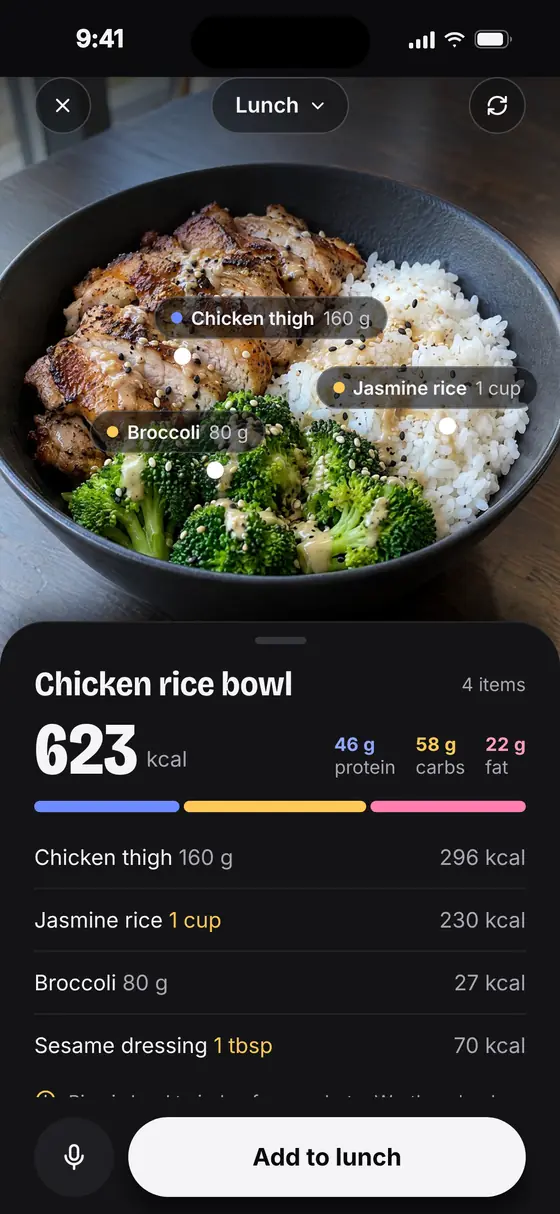

Hit your protein without the maths
Indar sets your protein and calorie targets this way, then logs a meal from a photo, so you see how much protein is left for the day at a glance.


On Android? Get it on Google PlayOn iPhone? Get it on the App Store
Scan with your phone's camera to get Indar.
Free to download. Yearly Pro starts with a 7-day free trial.