 Indar
How long to reach your goal weight
The weeks to your goal weight and the date you'd get there, at a pace set to protect your muscle, with the daily deficit behind it and how the three paces compare. It's the maths Indar uses when you choose a fat-loss pace.
How it's worked out
Each week you lose a set share of what you weigh that week. That share is the pace you pick:
- Steady: 0.25% of your weight a week. The smallest deficit, for when you're close to where you want to be or would rather take your time.
- Moderate: 0.5% a week. The low end of the range recommended for people who lift.
- Faster: 0.75% a week, or 1% with high body fat. Quicker, but harder to hold, and the leaner you are, the more it can cost in muscle.
Indar works your targets out again from your current weight as it comes off, so the timeline does the same: week by week, each week's loss is that share of the weight you start the week at. At 0.5%, 90 kg loses 0.45 kg in the first week, and by 80 kg it's 0.40 kg. That's why the loss slows and the last kilograms take longer than the first. 90 kg to 80 kg at 0.5% takes 24 weeks: after 23 weeks you're at 80.2 kg, and week 24 takes you past 80.
Two limits from the app are counted too, both set by an estimate of your body fat. Faster is 1% only while your body fat is high, then drops to 0.75%. And the daily deficit is never more than 40 kcal for each kilogram of body fat, to protect muscle and energy: about 600 kcal a day with 15 kg of fat, 400 with 10 kg. So the leaner you are, the lower the cap, and it falls as you lose. When a limit changes your timeline, the result says so.
Your body fat is estimated from your BMI, age and sex with Deurenberg's formula, which usually lands within about 4 percentage points of a measured body fat. The formula counts all weight above a lean BMI as fat, which is wrong for people who lift, so for lifters part of the weight above a BMI of 20 counts as muscle: more the longer you've lifted and the more days you lift. High body fat means 25% or more for men and 32% for women (28.5% with Rather not say), where obesity is commonly set by body fat. It's an estimate, not a measurement, so it isn't shown as a number. The calorie calculator explains it in full.
Why these paces
Losing weight more slowly tends to keep more muscle. In a trial in elite athletes, the group that lost weight at the slower of two rates kept more lean mass than the faster group (Garthe et al., 2011). The evidence-based recommendations for natural bodybuilders getting lean for a contest, who want to lose fat and keep as much muscle as they can, put the pace at 0.5 to 1% of body weight a week (Helms et al., 2014). Moderate and Faster sit in that range. Steady sits under it, for anyone who'd rather go easier.
Faster is 0.75%, not 1%, unless your body fat is high. The leaner you are, the more of a fast loss tends to come from muscle, so the top of the range is kept for people with more fat to lose. With high body fat, 1% a week is still inside the recommendation.
The deficit cap works the same way. 40 kcal a day for each kilogram of body fat is a little over half the most a kilogram of stored fat can supply in a day, about 69 kcal (Alpert, 2005). Past that, more of a deficit comes from muscle, and the leaner you are, the sooner you reach it.
The daily deficit, and why it's only a starting point
The deficit is how much less you eat than you burn, on average, each day. Indar counts 7,700 kcal for each kilogram lost (about 3,500 kcal per pound), so the first week's deficit is the first week's loss × 7,700 ÷ 7 days. 0.5% of 90 kg is 0.45 kg, 3,465 kcal in the week, about 495 kcal a day.
That rule is a fair average for the first weeks, but it gets less accurate over months. As you get lighter you burn less, so eating the same amount loses weight more slowly than the fixed rule predicts (Thomas et al., 2014). So the deficit here is an average to start from, not a promise. In the app, Indar checks it against your real weigh-ins every week and adjusts your calories when your weight moves differently from the plan.
Indar also never sets a deficit bigger than a quarter of what you burn, or calories under your resting energy, 1,200 a day for women or 1,500 for men. For a smaller or less active body that can make the pace slower than this page shows. The calorie calculator works out what you burn and the daily target for your pace.
Your weight won't follow the line exactly. Water and food in your gut move the scale by a kilogram or more from day to day. Weigh in on most mornings and compare each week's average with the week before: that's the number to hold up against the timeline.
Who this isn't for
This timeline is for healthy adults. It won't plan a goal under a healthy weight for your height (a BMI under 18.5), or any weight loss when you're already under it. It isn't for anyone under 18, when growth changes the maths and eating less can hold it back, or for pregnancy or breastfeeding. With a medical condition that affects how you eat or what you weigh, such as kidney disease, a heart condition, diabetes or weight-loss medication, a GP or an accredited dietitian can set a goal and a pace that fit. If tracking food or your weight has ever been hard on you, it's worth talking to someone first: in the US, the National Alliance for Eating Disorders on (866) 662-1235; in the UK, Beat on 0808 801 0677; in Canada, NEDIC on 1-866-633-4220; in Australia, the Butterfly Foundation on 1800 33 4673; in New Zealand, EDANZ on 0800 233 269; anywhere else, your doctor or a local eating disorder service.
Common questions
How long does it take to lose 10 kg?
At 0.5% of your body weight a week, about 24 weeks from 90 kg and about 27 weeks from 80 kg, so close to six months either way. At 0.25% a week it takes about twice as long. Each week's loss is a share of what you weigh, so the lighter you start, the longer the same 10 kg takes.
How fast can I lose weight without losing muscle?
For people who lift, the usual advice is 0.5 to 1% of body weight a week, and slower losses have kept more lean mass in trained athletes. Lifting through the diet and eating enough protein matter as much as the pace.
Why does weight loss slow down near the end?
The same share of a lighter body is less: at 0.5% a week, 90 kg loses 0.45 kg and 80 kg loses 0.40 kg. You also burn less as you get lighter, so the calories that started the loss won't keep it going at the same rate. That's why the targets need checking against your weight as you go.
How big a calorie deficit do I need to lose 0.5 kg a week?
About 550 kcal a day: 0.5 kg × 7,700 kcal per kilogram, over 7 days. For 1 lb a week it's about 500 kcal a day. Indar keeps a deficit to 40 kcal a day for each kg of body fat, so with less than about 14 kg of fat (550 ÷ 40) it sets a smaller one and the loss is slower. Treat it as a starting point and adjust from your weekly average weight after about three weeks.
Sources
- Garthe I, Raastad T, Refsnes PE, Koivisto A, Sundgot-Borgen J. Effect of two different weight-loss rates on body composition and strength and power-related performance in elite athletes. Int J Sport Nutr Exerc Metab. 2011.
- Helms ER, Aragon AA, Fitschen PJ. Evidence-based recommendations for natural bodybuilding contest preparation: nutrition and supplementation. J Int Soc Sports Nutr. 2014.
- Deurenberg P, Weststrate JA, Seidell JC. Body mass index as a measure of body fatness: age- and sex-specific prediction formulas. Br J Nutr. 1991.
- Alpert SS. A limit on the energy transfer rate from the human fat store in hypophagia. J Theor Biol. 2005.
- Thomas DM, Gonzalez MC, Pereira AZ, Redman LM, Heymsfield SB. Time to correctly predict the amount of weight loss with dieting. J Acad Nutr Diet. 2014.
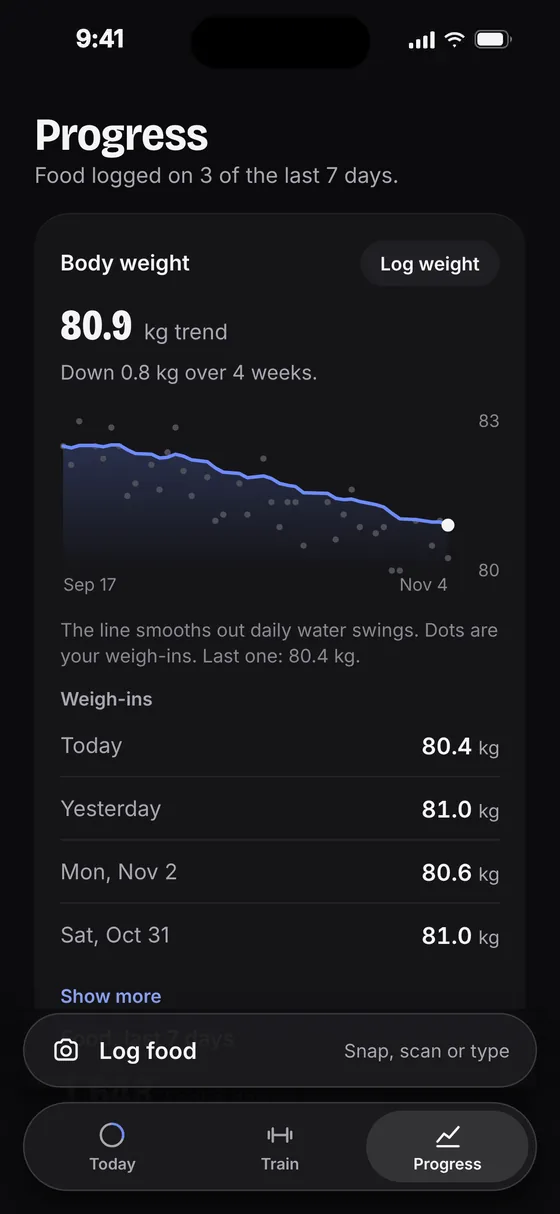

Indar keeps you on pace
It sets your calories for the pace you pick, logs a meal from a photo, and checks your weigh-ins every week, adjusting your targets when your weight moves differently from the plan.


On Android? Get it on Google PlayOn iPhone? Get it on the App Store
Scan with your phone's camera to get Indar.
Free to download. Yearly Pro starts with a 7-day free trial.