 Indar
Can you eat too much protein?
For healthy people, not at the amounts lifters eat: a meta-analysis of 28 studies found no change in kidney function on high protein, and a year-long trial of 2.5 to 3.3 g per kg a day found no harm to kidneys, liver or blood fats. And the idea that your body can only use 30 g at a meal is wrong: protein above that is still absorbed and used, just more slowly, so the daily total matters far more than the size of any one meal.
In short
- How much you need: 1.6 to 2.2 g per kg of body weight a day if you lift (why).
- Safe for healthy kidneys: intakes well above that, in the studies we have.
- Per meal: about 0.4 g per kg, four times a day, is a good pattern; bigger meals aren't wasted.
- Indar's ceiling: 3 g per kg of your actual weight. Past that, the calories do more good as carbs.
Is a high protein diet bad for your kidneys?
The worry comes from kidney disease, where high protein can speed up damage, so people with it are often told to limit protein. In healthy kidneys the evidence says otherwise. A meta-analysis of 28 studies found that higher protein intakes (1.5 g per kg a day or more, at least 20% of calories, or at least 100 g a day) didn't change kidney function compared with normal intakes (Devries et al., 2018). In a year-long crossover trial, 14 resistance-trained men eating about 2.5 to 3.3 g per kg a day had no harmful changes in kidney or liver function or blood fats (Antonio et al., 2016).
If you have kidney disease, diabetes with kidney problems, or have been told your kidney function is low, don't raise your protein without your doctor.
Does extra protein make you fat?
Less than any other macro. In an 8-week trial, resistance-trained people eating 4.4 g of protein per kg a day took in about 800 kcal a day more than before the study, nearly all of it from protein, and didn't gain fat (Antonio et al., 2014). That's a high-protein diet many times what anyone needs, and it's one short trial, so don't read it as free calories. But protein is the hardest macro to overeat into fat, and it fills you up.
Is there an upper limit?
Not a firm one for healthy people. An older review put a sensible maximum at about 25% of calories, roughly 2 to 2.5 g per kg a day, based on how fast the liver can clear the nitrogen from protein (Bilsborough and Mann, 2006). Newer trials in lifters have gone well past that without harm. The practical limit is what you lose: every 100 g of protein above your needs is 400 kcal you could have eaten as carbs to fuel training, or fat to make meals enjoyable. That's why Indar sets protein at 1.6 to 2.2 g per kg and never more than 3.
How much protein can you use in one meal?
Bar chart: breakfast 33 g, lunch 34 g, snack 24 g, dinner 53 g of protein, 144 g in all.
The "30 g a meal" rule comes from early studies that measured muscle building for a few hours after a single dose, where the response seemed to level off at about 20 to 25 g. But a few hours isn't the whole story.
- Spread beats lopsided. Over 12 hours after training, 80 g of protein given as four doses of 20 g built more muscle protein than eight doses of 10 g or two of 40 g (Areta et al., 2013).
- But big doses aren't wasted. In a 2023 trial, 100 g of protein after whole-body training built more muscle protein than 25 g, and kept doing it for longer, past 12 hours (Trommelen et al., 2023). The body handles a big meal by taking longer, not by throwing the rest away.
So the practical answer: aim for about 0.4 g per kg at each of four meals, about 32 g each for 80 kg (Schoenfeld and Aragon, 2018). If your day only fits two or three bigger meals, that's fine. The daily total does most of the work.
Common questions
Can you eat too much protein?
In healthy people, not at the amounts lifters eat. A year-long trial of 2.5 to 3.3 g per kg a day in lifters found no harm to kidney or liver function or blood fats. Very high intakes mostly crowd out other food. With kidney disease it's different: ask your doctor.
How much protein can your body absorb at once?
Nearly all of it: protein is absorbed, just more slowly in a big meal. The 20 to 30 g limit comes from early studies of muscle building over a few hours. A 2023 trial found 100 g after training built more muscle protein, for longer, than 25 g.
Is 200 g of protein a day too much?
For a 90 kg lifter losing fat, 200 g is about 2.2 g per kg, right where the research points. For a 60 kg person it's 3.3 g per kg: not harmful for healthy people, but more than muscle can use, and those calories could go to carbs for training.
Does extra protein turn into fat?
Rarely. Protein is the hardest macro for the body to store as fat, and in one trial lifters who added about 800 kcal a day, nearly all from protein, for 8 weeks gained no fat. Extra calories from any source still count toward your total.
Sources
- Devries MC, et al. Changes in kidney function do not differ between healthy adults consuming higher- compared with lower- or normal-protein diets: a systematic review and meta-analysis. J Nutr. 2018.
- Antonio J, Ellerbroek A, Silver T, et al. A high protein diet has no harmful effects: a one-year crossover study in resistance-trained males. J Nutr Metab. 2016.
- Antonio J, Peacock CA, Ellerbroek A, et al. The effects of consuming a high protein diet (4.4 g/kg/d) on body composition in resistance-trained individuals. J Int Soc Sports Nutr. 2014.
- Bilsborough S, Mann N. A review of issues of dietary protein intake in humans. Int J Sport Nutr Exerc Metab. 2006.
- Areta JL, et al. Timing and distribution of protein ingestion during prolonged recovery from resistance exercise alters myofibrillar protein synthesis. J Physiol. 2013.
- Trommelen J, et al. The anabolic response to protein ingestion during recovery from exercise has no upper limit in magnitude and duration in vivo in humans. Cell Rep Med. 2023.
- Schoenfeld BJ, Aragon AA. How much protein can the body use in a single meal for muscle-building? J Int Soc Sports Nutr. 2018.

Your protein, without the guesswork
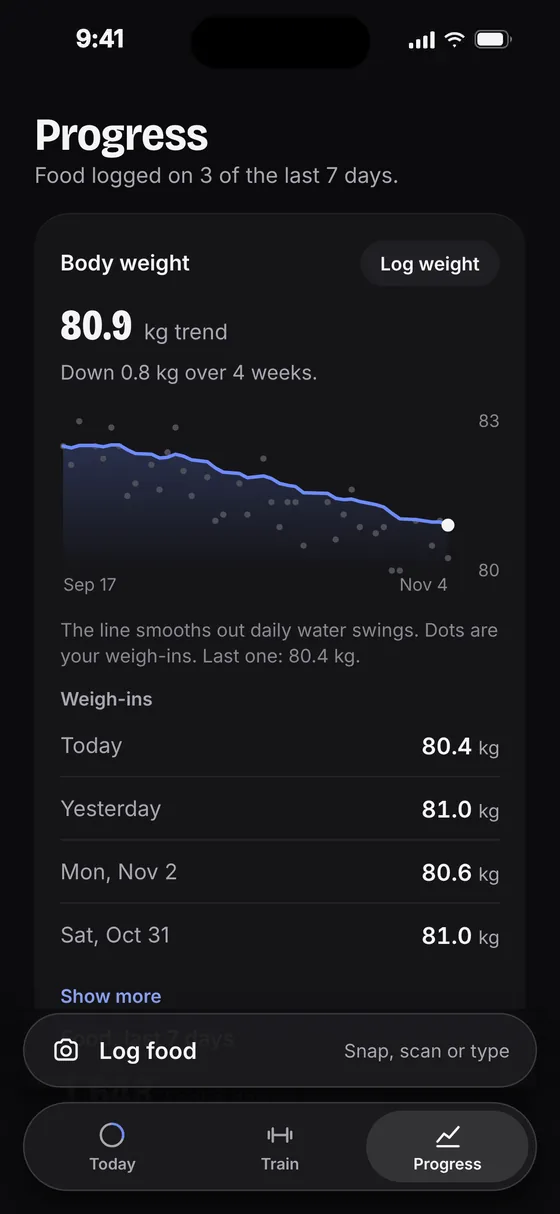
Indar sets your protein target, shows how much is left as you log, and logs a meal from a photo, item by item.


On Android? Get it on Google PlayOn iPhone? Get it on the App Store
Scan with your phone's camera to get Indar.
Free to download. Yearly Pro starts with a 7-day free trial.