 Indar
Progressive overload: add a rep, then weight
Progressive overload means doing a little more than last time: one more rep at the same weight, or the same reps with a little more weight. The simplest way to run it is to add a rep each session until you reach the top of your rep range, then add the smallest weight step (2.5 kg or 5 lb on most barbell lifts) and build the reps back up. Below is that rule worked through session by session, with what to do on small dumbbells, when you stall and after a break.
The short answer
- Pick a rep range for each exercise, like 6 to 8 on a big lift or 12 to 20 on a small one.
- Add a rep each session at the same weight.
- At the top of the range, add the smallest step: 2.5 kg or 5 lb on most barbell lifts, the next dumbbell, a pin on a machine.
- Start again from the bottom of the range at the new weight.
- Keep sets hard: stop with 1 to 3 reps left in you, and keep the same form and depth so the numbers mean something.
- Write it down. You can only beat last time if you know what it was.
What is progressive overload?
Progressive overload is raising the demand on a muscle a little at a time, so there's always a reason for it to keep adapting. A set that was hard a month ago gets easier as you get stronger, and if you keep doing it unchanged, it stops asking your muscles for more.
The largest summary of the evidence backs it. The American College of Sports Medicine's 2026 position stand pooled 137 systematic reviews covering more than 30,000 people and concluded that healthy adults should do progressive resistance training. It also found that many details people argue about, like training to failure, machines or free weights, and periodization, didn't consistently change the results (Currier et al., 2026). Its 2009 position stand gave a simple rule: when you can do one or two reps more than your target with a weight, add 2 to 10% (ACSM, 2009).
There are a few ways to do more: more reps, more weight, more sets, or a harder version of the exercise. This guide counts reps and weight done with the same form, depth and rest each time, because that's what you can compare from one session to the next.
Double progression, worked through
Adding reps first, then weight, is called double progression. It's what Indar uses for every loaded lift. Indar's rule for when the weight goes up: your first set reaches the top of the range and every other set is within two reps of it (later sets always drop a little from fatigue). After a jump, the reps it aims for are worked out from your estimated one-rep max, so they match your strength at the new weight.
Here's what that looks like for a bench press planned at 3 sets of 6 to 8 reps, stopping 2 reps short of failure. The reps are an example lifter's; what to do next is Indar's progression engine's answer to each session.
| Session | Weight | Reps done | Next time |
|---|---|---|---|
| 1 | 60 kg or 135 lb | 7, 6, 6 | same weight, aim for 8 |
| 2 | 60 kg or 135 lb | 8, 7, 6 | 62.5 kg or 140 lb, aim for 6 |
| 3 | 62.5 kg or 140 lb | 7, 6, 6 | same weight, aim for 8 |
| 4 | 62.5 kg or 140 lb | 8, 7, 7 | 65 kg or 145 lb, aim for 6 |
| 5 | 65 kg or 145 lb | 6, 6, 5 | same weight, aim for 7 |
| 6 | 65 kg or 145 lb | 7, 6, 6 | same weight, aim for 8 |
| 7 | 65 kg or 145 lb | 8, 7, 6 | 67.5 kg or 150 lb, aim for 6 |
Three things to notice. The weight went up three times in seven sessions, each time by only about 4%, inside the 2 to 10% the ACSM suggests. Session 2's 8, 7 and 6 counted as reaching the top: only the first set has to hit 8, and the others just need to be within two reps of it. And session 5 fell a rep short of the range on the last set, which is normal straight after a jump: the rule just keeps the weight until the reps come back.
Some beginner programs add weight every session on the main lifts instead (linear progression). Double progression is another way to do it, without a fixed schedule: when the reps come quickly, the weight goes up often; when they come slowly, it waits, so a missed target never forces a jump.
The pound weights in the table are a pound lifter's own run, not a conversion of the kilograms: pound users get pound steps (135, 140, 145 lb). Deadlifts go up 5 kg at a time in kilograms, and 5 lb in pounds like every other bar.
Reps or weight: which matters more?
For muscle, both work. In an 8-week trial, 43 lifters with at least a year of training did four lower-body exercises twice a week. One group added weight and kept the reps the same; the other kept the weight and added reps. Muscle growth, strength and endurance came out about the same: growth in one thigh muscle leaned slightly towards adding reps, and Smith machine squat strength slightly towards adding weight, by amounts of questionable practical size (Plotkin et al., 2022). In a 10-week trial of 39 untrained young men and women, each person trained one leg by adding weight and the other by adding reps on the leg extension. Both legs gained the same strength and size (Chaves et al., 2024). Both trials trained only the legs, so the evidence for upper-body lifts is indirect.
That fits what's known about load. Across 21 studies where every set went to failure, light loads (60% of a one-rep max or less) grew muscle as well as heavy ones, but heavy loads built more one-rep max strength (Schoenfeld et al., 2017). The 2026 position stand found the same: strength gains were bigger with loads of 80% of your one-rep max or more (Currier et al., 2026).
So you don't have to choose. Adding reps keeps you progressing between weight jumps; adding weight stops the reps climbing forever. Double progression does both. If strength is your main goal, keep your main lift's range low (3 to 5 or 5 to 8) so the weight stays heavy.
What if the next weight is a big jump?
On a barbell, 2.5 kg is a small step. On small exercises it often isn't. Going from 8 to 9 kg dumbbells on a lateral raise is 12.5% heavier, and from 17.5 to 20 lb is 14%: you lose several reps. From 8 to 10 kg is 25%, enough for the sets to fall under the range.
The fix is to go further past the top of the range before you jump. Indar lets reps run up to five past the top on small, one-joint exercises, and two past on big lifts (never past 8 on a deadlift). It steps a lateral raise 1 kg (2.5 lb) at a time. Planned at 3 sets of 12 to 20, with 8 kg dumbbells it waits for a session of 21, 19 and 18, then moves to 9 kg for about 15 reps; with 17.5 lb dumbbells it moves to 20 lb for about 14 after the same session. The bigger the jump, the longer the same rule waits: with 2 kg steps (the step Indar uses for a dumbbell exercise you add yourself) (8 to 10 kg, 25% heavier) it holds the 8 kg until a session of 24, 22 and 21, then aims for about 13 reps at 10 kg. That's why Indar's ranges for small exercises are wide, like 12 to 20: there's room to progress by reps for a while at one weight.
Other ways around a big jump: use a cable or machine with smaller steps, clip small plates onto a dumbbell or weight stack if your gym has them, or switch to a version of the exercise that suits the weights you have.
How hard should each set be?
Progress only counts if the sets are hard enough to need it. The usual way to judge effort is reps in reserve: how many more reps you could have done when you stopped. In a study of 29 squatters, effort ratings built on it tracked how fast the bar moved, and the authors concluded it's a practical way to set daily training loads (Zourdos et al., 2016).
You don't need to go to failure. Across 15 studies, training to failure showed at most a trivial advantage for growth over stopping short of it, and no advantage when failure meant the point where you couldn't complete another rep (Refalo et al., 2023). Indar usually plans big lifts with 2 or 3 reps in reserve and small ones with 1 or 2. If you log a last set with two or more reps more in reserve than planned, and every set was in the range, it counts as done and the weight goes up, even if you didn't reach the top of the range.
Adding sets is the other kind of overload, and it works on a longer clock. Across 15 studies, more weekly sets went with more growth (Schoenfeld et al., 2017), and the 2026 position stand found muscle grew more with 10 or more sets a muscle a week. Indar doesn't add sets every week. It caps each muscle at 10 hard sets a week if you've lifted for under 6 months or are coming back after 3 months or more off, 16 up to 3 years and 20 beyond that, and moves you from 10 up to 16 after 8 steady weeks (4 if you're returning).
What should you do when progress stops?
Everyone stalls on a lift sooner or later. Before changing the plan, check the boring things: sleep, enough food and protein, and that you're not grinding every set to failure.
Then take a step back to go forward. Indar's rules, for each exercise:
- Short of the range three sessions running (the first set under the bottom of the range, or any set three or more under it): about 10% off, to the nearest step, and build back up. In the engine, three bench sessions at 70 kg of 5, 5 and 4 reps on a 6 to 8 range bring the weight to 62.5 kg, aiming for 8. At 155 lb, the same sessions bring it to 140 lb.
- Six sessions at one weight without getting stronger (big lifts only): about 5% off, to the nearest step. Six bench sessions at 70 kg stuck at 7, 6 and 6 (or 5) bring it to 67.5 kg, aiming for 7; at 155 lb, to 145 lb. Small exercises with big steps can sit at one weight for a while and still be adding reps, so they don't reset for that.
Some lifters also vary their reps and weights over the weeks (periodization). The 2026 position stand found it didn't consistently change results. One meta-analysis of 35 studies with the same volume found a small overall edge for one-rep max strength and none for muscle; changing reps and weights day to day or week to week beat changing them slowly only in trained lifters (Moesgaard et al., 2022).
What is a deload, and do you need one?
A deload is a planned easier stretch, which a panel of strength and physique coaches defined as "a period of reduced training stress designed to mitigate physiological and psychological fatigue, promote recovery, and enhance preparedness for subsequent training" (Bell et al., 2023). That's expert opinion, not proof that you need one on a schedule. In one trial, 39 trained young adults did a 9-week program, and one group took a full week off in the middle. Leg muscle growth, power and endurance came out the same, but the group that kept training gained more leg strength (Coleman et al., 2024).
In untrained men, short breaks cost little. Two small trials put untrained young men on the bench press. In the first, a 3-week break after 6 weeks of training lost no significant muscle or strength. In both, over 15 and 24 weeks, the men who took 3-week breaks ended up with similar gains to those who trained straight through (Ogasawara et al., 2011; Ogasawara et al., 2013).
So a deload should be a lighter week, not a week off. In a survey of 246 competitive strength and physique athletes, the typical deload lasted about a week and came every 5.6 weeks; they kept their training days and exercises and cut sets and reps, leaving more reps in the tank (Rogerson et al., 2024). Indar plans one the same way: after 5 hard weeks if you're experienced, 6 with some experience and 7 if you're new (one sooner on 5 or 6 days a week or with a lot of other sport), it keeps your days, exercises and weights and halves the sets. A week off, or a lift that just had to drop back, counts as recovery and pushes it back, so two easy weeks never come in a row, and you can skip it if you feel fresh. It doesn't plan one on 1 or 2 days a week.
Otherwise, take an easier week when you're worn down, ill or travelling. Coming back, start a little lighter: Indar takes 10% off a lift after three weeks away from it, and 20% after six. After three weeks off, a 70 kg bench comes back at 62.5 kg, and a 155 lb one at 140 lb (55 kg or 125 lb after six).
How do you progress without weights?
Without weights to add, reps and harder versions do the job. Indar lets bodyweight reps climb past the top of the range (up to 10 past, and never more than 30), and once you've been at the top for two sessions running, moves you to the harder version of the exercise: from push-ups to feet-elevated push-ups, from a glute bridge to a single-leg one, from band-assisted pull-ups to the real thing. Pull-ups and dips, once you reach the top of their range, take weight on a belt. With bands, a stronger band or slower reps take the place of the next version. The ACSM's summary of its 2026 position stand says bands, bodyweight and home routines bring marked gains in strength and muscle too (ACSM, 2026).
Common mistakes
- Adding weight every session no matter what: let the reps tell you when. If your reps keep falling under the range, the weight went up too soon.
- Shortening the range of motion to beat the number: half reps at a heavier weight aren't progress. The 2026 position stand found a full range of motion built more strength.
- Changing exercises every week: you can't beat a lift you rarely repeat. A review of 8 studies found that some planned variation can help, but frequent, random rotation may hold gains back (Kassiano et al., 2022). Keep your main lifts for a few months.
- Not writing it down: it's easy to misremember last week's reps. A log, on paper or in an app (workout apps compared), tells you exactly what to beat.
- Treating a bad day as a stall: one session down is noise. Indar only takes weight off after three short sessions running, six without getting stronger on a big lift, or three weeks away.
Common questions
How often should you increase the weight?
Whenever you reach the top of your rep range, not on a schedule. With Indar's rule, that's when your first set hits the top of the range and the others are within two reps of it. In the bench press example on this page, that was every two or three sessions. It slows down as you get stronger, and adding a rep in between still counts as progress.
Is adding reps progressive overload?
Yes. In two trials, one of 43 trained lifters over 8 weeks and one of 39 untrained young adults over 10 weeks, adding reps at the same weight built muscle and strength about as well as adding weight. For the most strength, heavier loads matter, so add the weight once the reps are there.
What if I can't add weight or reps any more?
Check sleep, food and that you're not at failure on every set first. Then take a little weight off and build back up: Indar takes about 10% off after three sessions running below the bottom of the range, and about 5% off a big lift after six sessions at one weight without getting stronger.
Do I need a deload week?
A lighter week every few hard weeks helps, but not a week off. Strength and physique athletes take one about every 5 to 6 weeks, cutting sets and reps rather than stopping, and in a trial of 39 trained adults a full week off mid-program cost leg strength. Indar plans one after 5 to 7 hard weeks, by experience: half the sets at your usual weights.
How do you progressively overload with bodyweight or at home?
Add reps past the top of the range, then move to a harder version of the exercise: from push-ups to feet-elevated push-ups, from a band-assisted pull-up to the real thing. Pull-ups and dips can take weight on a belt once you reach the top of their range. With dumbbells that jump a lot, go further past the top of the range before moving up.
Who this isn't for
This guide is for healthy adults. If you have a heart condition, chest pain or fainting with exercise, or you've been told not to exercise, a doctor needs to clear you first. If you're pregnant, check with your doctor or midwife before you push the weights up. Pain that gets worse as the weight goes up is a reason to stop and see a physiotherapist (physical therapist), not to push through.
Sources
- Currier BS, D'Souza AC, Singh MAF, et al. American College of Sports Medicine position stand. Resistance training prescription for muscle function, hypertrophy, and physical performance in healthy adults: an overview of reviews. Med Sci Sports Exerc. 2026.
- American College of Sports Medicine. ACSM unveils landmark 2026 resistance training guidelines, first update in 17 years. News release, 17 March 2026.
- American College of Sports Medicine. American College of Sports Medicine position stand. Progression models in resistance training for healthy adults. Med Sci Sports Exerc. 2009.
- Plotkin D, Coleman M, Van Every D, et al. Progressive overload without progressing load? The effects of load or repetition progression on muscular adaptations. PeerJ. 2022.
- Chaves TS, Scarpelli MC, Bergamasco JGA, et al. Effects of resistance training overload progression protocols on strength and muscle mass. Int J Sports Med. 2024.
- Schoenfeld BJ, Grgic J, Ogborn D, Krieger JW. Strength and hypertrophy adaptations between low- vs. high-load resistance training: a systematic review and meta-analysis. J Strength Cond Res. 2017.
- Zourdos MC, Klemp A, Dolan C, et al. Novel resistance training-specific rating of perceived exertion scale measuring repetitions in reserve. J Strength Cond Res. 2016.
- Refalo MC, Helms ER, Trexler ET, Hamilton DL, Fyfe JJ. Influence of resistance training proximity-to-failure on skeletal muscle hypertrophy: a systematic review with meta-analysis. Sports Med. 2023.
- Schoenfeld BJ, Ogborn D, Krieger JW. Dose-response relationship between weekly resistance training volume and increases in muscle mass: a systematic review and meta-analysis. J Sports Sci. 2017.
- Moesgaard L, Beck MM, Christiansen L, Aagaard P, Lundbye-Jensen J. Effects of periodization on strength and muscle hypertrophy in volume-equated resistance training programs: a systematic review and meta-analysis. Sports Med. 2022.
- Bell L, Strafford BW, Coleman M, Androulakis Korakakis P, Nolan D. Integrating deloading into strength and physique sports training programmes: an international Delphi consensus approach. Sports Med Open. 2023.
- Coleman M, Burke R, Augustin F, et al. Gaining more from doing less? The effects of a one-week deload period during supervised resistance training on muscular adaptations. PeerJ. 2024.
- Ogasawara R, Yasuda T, Sakamaki M, Ozaki H, Abe T. Effects of periodic and continued resistance training on muscle CSA and strength in previously untrained men. Clin Physiol Funct Imaging. 2011.
- Ogasawara R, Yasuda T, Ishii N, Abe T. Comparison of muscle hypertrophy following 6-month of continuous and periodic strength training. Eur J Appl Physiol. 2013.
- Rogerson D, Nolan D, Androulakis Korakakis P, Immonen V, Wolf M, Bell L. Deloading practices in strength and physique sports: a cross-sectional survey. Sports Med Open. 2024.
- Kassiano W, Nunes JP, Costa B, Ribeiro AS, Schoenfeld BJ, Cyrino ES. Does varying resistance exercises promote superior muscle hypertrophy and strength gains? A systematic review. J Strength Cond Res. 2022.
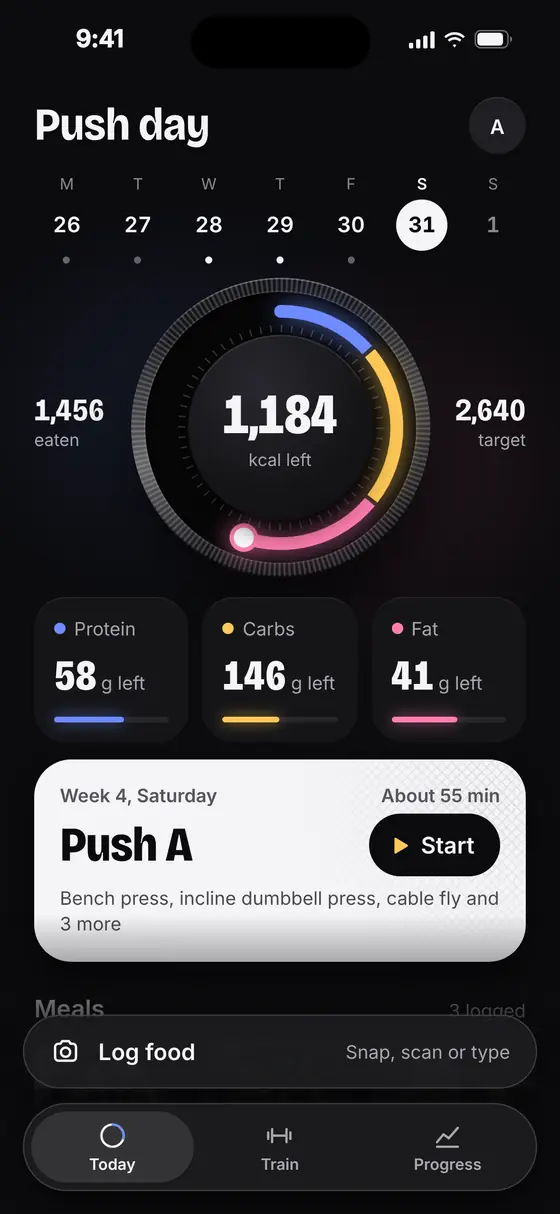

Your next weight, worked out
Indar shows last time's sets beside every set you do, and picks the weight and reps to beat from them: a rep more, the next step up, or a little off after a stall or a break.


On Android? Get it on Google PlayOn iPhone? Get it on the App Store
Scan with your phone's camera to get Indar.
Free to download. Yearly Pro starts with a 7-day free trial.