 Indar
Skinny fat: how to fix it
Skinny fat means your weight is normal for your height but you carry little muscle and a fair amount of fat, often around the middle. The fix isn't dieting or bulking: it's lifting hard with plenty of protein while eating at or just under maintenance, so you build muscle and lose fat at the same time. That's called body recomposition, and it works best for exactly the people who are skinny fat: newer lifters.
The plan
- Lift three or four times a week, whole body or upper and lower, adding weight or reps every week you can.
- Eat about maintenance, or just under: Indar sets about 0.1% of body weight a week below, close to 80 kcal a day for most people.
- Protein at about 1.8 g per kg of body weight a day.
- Judge it by your waist, your lifts and photos, not the scale, which may barely move.
What is skinny fat?
Skinny fat is a normal weight for your height with little muscle and a high share of body fat. BMI only knows your weight and height. Two people at 72 kg and 178 cm, a BMI of 23, can look completely different: one muscular and lean, one with thin arms and a soft belly. The second is what people call skinny fat. In research it's called normal-weight obesity: a normal BMI with high body fat. It isn't just about looks: in a study of 6,171 US adults with a normal BMI, those with the most body fat (over 23% for men, 33% for women) had metabolic syndrome about four times as often, and worse blood fats, as those with the least (Romero-Corral et al., 2010).
It usually comes from little or no strength training: muscle is lost or never built, and fat takes its place, even at a steady weight.
Why not just diet, or bulk?
- Dieting first makes you smaller but not more muscular. Without much muscle to start with, you end up lighter and still soft, and the deficit makes muscle harder to build.
- Bulking first adds muscle, but a big surplus on a body that already carries a fair amount of fat adds plenty more fat. You end up having to diet it off.
- Recomp uses the one advantage newer lifters have: muscle comes fast in the first year or two, fast enough to grow even at maintenance, while a small deficit takes fat off.
Does recomposition really work?
Yes, and it's most reliable in newer lifters and people with more fat to lose. A review of the studies found trained people can do it too, more slowly, with high protein and hard training (Barakat et al., 2020). Protein is the lever. In a 4-week trial, young men in a hard deficit who trained six days a week gained 1.2 kg of lean mass on 2.4 g of protein per kg a day and lost 4.8 kg of fat; on 1.2 g per kg they gained almost no lean mass (Longland et al., 2016). That deficit was far bigger than a recomp uses: with enough protein and hard training, muscle grew anyway.
An example
A 28-year-old man, 178 cm and 72 kg, new to lifting, desk job, three hour-long sessions a week. By Indar's maths:
| What | A day |
|---|---|
| Maintenance | 2,310 kcal |
| Recomp target, about 0.1% a week under | 2,240 kcal |
| Protein, 1.8 g per kg | 130 g |
| Carbs | 291 g |
| Fat | 62 g |
His weight should barely move: maybe a kilogram over three months. What changes is the shape: a smaller waist, bigger arms and shoulders, and every lift going up.
How should you train if you're skinny fat?
- Three or four days a week, each muscle trained at least twice.
- The big lifts, or machine versions: squats or leg press, a hinge like Romanian deadlifts, presses, rows and pull-downs.
- About 10 hard sets per muscle a week to start, each one ending one to three reps short of failure.
- Progress: add a rep or a little weight whenever you can. That's what tells your body to build.
The workout plan generator builds a week like this from your days, time and equipment. What each part of the training does, and what doesn't help, is in how to build muscle fast.
How do you tell it's working?
The scale may barely move. Your waist, your lifts and your photos will.
- Waist: measured at the same spot once a week. Going down while your weight holds means fat is going and muscle is coming. Aim for under half your height (why that line).
- Lifts: going up most weeks for the first months.
- Photos: same light, same spot, every four weeks.
- Weight: roughly flat. If it climbs fast, you're eating more than maintenance; if it drops fast, you're cutting, not recomping.
When should you switch to a bulk?
Once you're clearly leaner, after several months or a year, recomp slows down: you've used up the beginner's head start. Then a lean bulk adds muscle faster, with short cuts in between. If you started with more fat than you'd like, a proper deficit while you keep lifting works too.
Sources
- Romero-Corral A, Somers VK, Sierra-Johnson J, et al. Normal weight obesity: a risk factor for cardiometabolic dysregulation and cardiovascular mortality. Eur Heart J. 2010.
- Barakat C, Pearson J, Escalante G, Campbell B, De Souza EO. Body recomposition: can trained individuals build muscle and lose fat at the same time? Strength Cond J. 2020.
- Longland TM, et al. Higher compared with lower dietary protein during an energy deficit combined with intense exercise promotes greater lean mass gain and fat mass loss. Am J Clin Nutr. 2016.
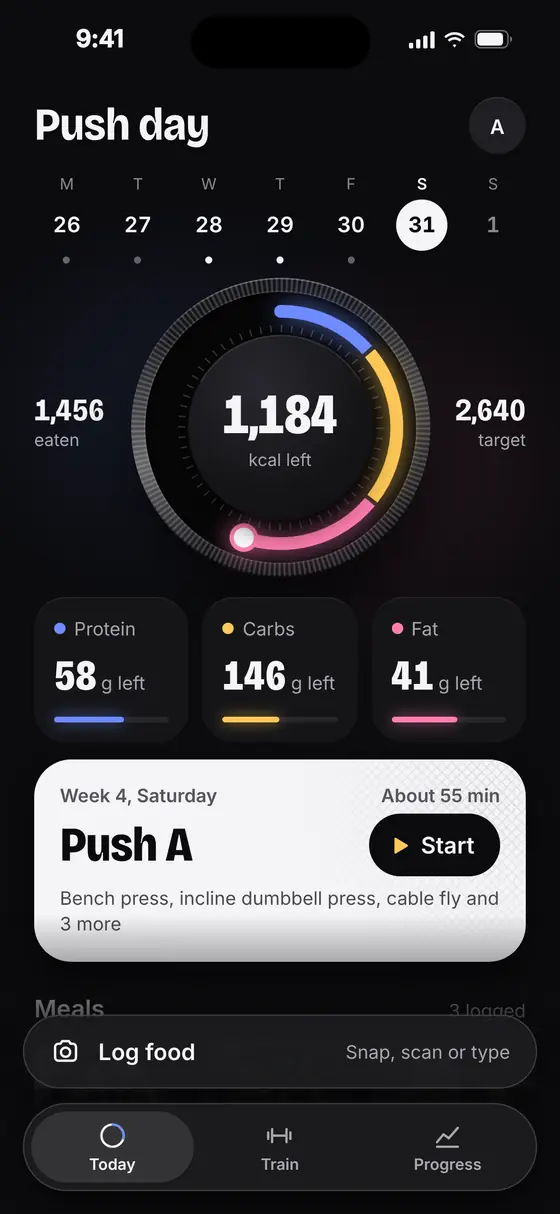

Recomp, planned for you
Indar builds your lifting program, sets recomp targets for your body, picks the weight for every set, and logs a meal from a photo.


On Android? Get it on Google PlayOn iPhone? Get it on the App Store
Scan with your phone's camera to get Indar.
Free to download. Yearly Pro starts with a 7-day free trial.