 Indar
Macro calculator
Your daily protein, carbs and fat in grams, for losing fat, building muscle or recomp. Protein is set from your body weight first, then fat, then carbs fill the rest. It's how Indar sets your macros, and every number shows where it came from.
How your macros are set
Calories come first, from what you burn and your goal, worked out like the calorie calculator and the TDEE calculator. Then the macros are set in this order, because protein matters most for what you're after and carbs are the most flexible:
- Protein, per kg of body weight: 2.2 g/kg while losing fat, 1.8 g/kg for building muscle, recomp and strength, 1.6 g/kg for staying fit, raised to at least 1.8 with 6 or more hours of training a week and 2.0 with 10 or more. With more body fat than a healthy range, it's counted from your estimated lean mass plus a healthy amount of fat, not your whole weight. The protein guide goes through the research.
- Fat, about a quarter of your calories: kept between 20% (or 0.5 g/kg, whichever is higher) and 35%.
- Carbs, the rest. With a lot of training, if carbs would fall under 3 g/kg, fat drops toward its floor first to fuel the work.
For a 30-year-old man, 180 cm and 80 kg, who sits at work and lifts four hours a week, that's 2,170 kcal while losing fat at a moderate pace: 176 g protein, 241 g carbs, 56 g fat. Building muscle, it's 2,830 kcal: 144 g protein, 386 g carbs, 79 g fat. Protein is higher while losing because a deficit makes muscle harder to keep (Helms et al., 2014); in a surplus, 1.8 g/kg is above the point where extra protein stopped adding muscle on average (Morton et al., 2018).
Why grams, not a percentage split
A fixed split like 40/30/30 ties protein to calories, not to your body. 30% of 1,800 kcal is 135 g of protein; 30% of 3,200 kcal is 240 g. Neither follows from how much muscle you have to keep or build. Setting protein in grams per kilogram first, then fitting fat and carbs around it, gets each person the protein they need with the calories they have.
Carbs or fat?
For fat loss, it matters much less than people think. In a year-long trial of 609 adults, a healthy low-fat diet and a healthy low-carb diet lost about the same weight, 5.3 kg against 6.0 kg (Gardner et al., 2018). Calories and protein do the work. Carbs fuel hard training, which is why they fill the rest here, but if you feel better with more fat and fewer carbs, swap them gram for calorie: 1 g of fat is worth 2.25 g of carbs.
Splitting it over the day
Protein spread over at least three or four meals, about 0.4 g per kg each, uses it well for muscle (Schoenfeld and Aragon, 2018). The per-meal figures above are an even split; what matters most is the daily total.
Common questions
What's the best macro split for losing fat?
High protein, enough fat, and carbs filling the rest. In a year-long trial of 609 adults, low-carb and low-fat diets lost about the same weight, so the split that works is the one you'll keep to. Protein is the one macro worth being strict about, at about 2.2 g per kg while losing fat.
Should macros be percentages or grams?
Grams, set from your body weight. A fixed split like 40/30/30 gives a 55 kg person and a 110 kg person the same share of protein, which is too much for one or too little for the other. This calculator sets protein in grams per kg first, then fat, then carbs.
Do I need to hit my macros exactly?
No. Getting calories and protein close most days does nearly all the work. Within about 10 g of protein and 100 kcal is plenty, and carbs and fat can swap with each other from day to day.
How do I count macros?
Log what you eat in an app that shows protein, carbs and fat, weighing foods where you can for the first few weeks. Most people learn their usual portions quickly, and after that a photo or a barcode is enough.
Who this isn't for
These numbers are for healthy adults. They aren't right for anyone under 18, pregnant or breastfeeding, living with kidney disease (protein often needs limiting), on diabetes or weight-loss medication, or after weight-loss surgery. A GP or an accredited dietitian can set targets that fit. If counting food has ever been hard on you, it's worth talking to someone first: in the US, the National Alliance for Eating Disorders on (866) 662-1235; in the UK, Beat on 0808 801 0677; in Canada, NEDIC on 1-866-633-4220; in Australia, the Butterfly Foundation on 1800 33 4673; in New Zealand, EDANZ on 0800 233 269; anywhere else, your doctor or a local eating disorder service.
Sources
- Morton RW, et al. A systematic review, meta-analysis and meta-regression of the effect of protein supplementation on resistance training-induced gains in muscle mass and strength. Br J Sports Med. 2018.
- Helms ER, Zinn C, Rowlands DS, Brown SR. A systematic review of dietary protein during caloric restriction in resistance trained lean athletes: a case for higher intakes. Int J Sport Nutr Exerc Metab. 2014.
- Gardner CD, et al. Effect of low-fat vs low-carbohydrate diet on 12-month weight loss in overweight adults (DIETFITS). JAMA. 2018.
- Schoenfeld BJ, Aragon AA. How much protein can the body use in a single meal for muscle-building? J Int Soc Sports Nutr. 2018.
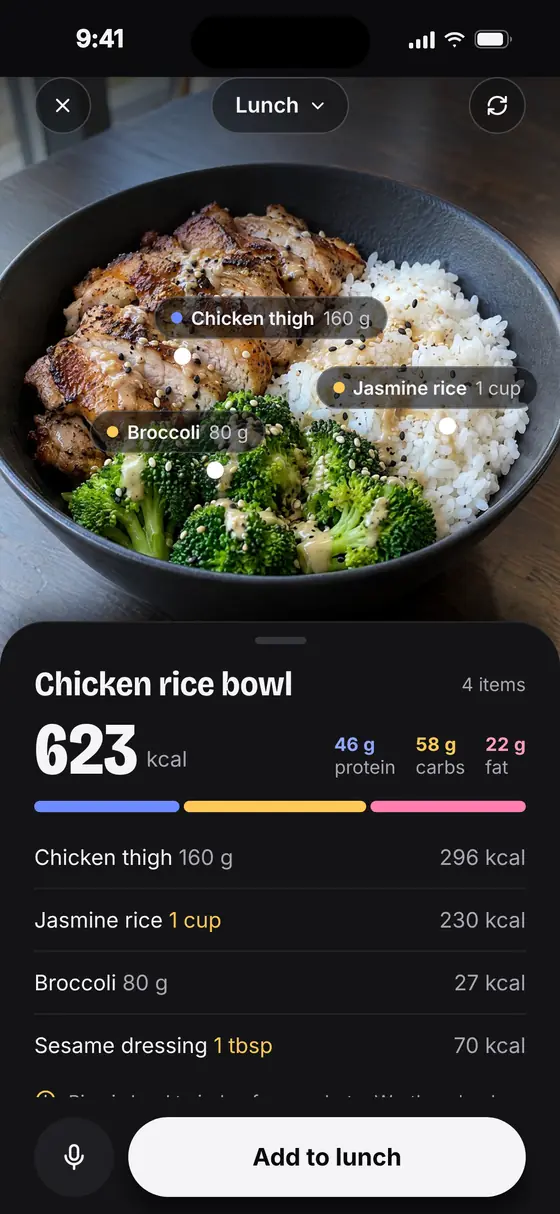

Your macros, counted for you
Indar sets these targets, shows what's left of each as you log, and logs a meal from a photo, item by item, so you can see where the protein came from.


On Android? Get it on Google PlayOn iPhone? Get it on the App Store
Scan with your phone's camera to get Indar.
Free to download. Yearly Pro starts with a 7-day free trial.