 Indar
Maintenance calorie calculator
Your maintenance calories are what you'd eat to keep your weight where it is. Start with the estimate from your body and your week, then, once you've logged a few weeks, turn it into a measurement with the second calculator.
Your real maintenance, from your own numbers
After two to three weeks of logging what you eat and weighing in, this works out what you actually burn. It's the sum Indar's weekly check-in makes.
How both numbers are worked out
The estimate
Resting energy from the Mifflin-St Jeor equation (averaged with the ten Haaf equation for people who already train 3 or more days a week without high body fat), times a factor for your day outside training (1.3 sitting to 1.8 hard physical work), plus your lifting and other sport at their METs above rest from the 2024 Compendium of Physical Activities. The TDEE calculator explains each part. It's the same number, TDEE and maintenance: two names for what you burn.
For a 30-year-old woman, 165 cm and 65 kg, who walks part of the day and lifts three hour-long sessions a week, that's about 2,200 kcal a day.
The measurement
A kilogram of body weight lost or gained is about 7,700 kcal (about 3,500 kcal a pound). That's a fair guide over a few weeks. Over months the body adapts, which is why the simple sum overestimates long-term loss (Hall et al., 2011) and why measuring again every few weeks beats predicting once. So if you ate 2,000 kcal a day for three weeks and your weekly average fell from 65.4 to 65.0 kg, you lost 0.4 kg in 21 days, about 0.019 kg a day, which is 147 kcal a day you didn't eat. Your maintenance is about 2,150.
- Log every day you can, including the days that went off plan. Under-counting that's the same every week cancels out; skipping the bad days doesn't.
- Weigh in on most mornings, after the toilet, before food, and use each week's average.
- Two weeks is the least that works, and three or more is better. The first week of a new diet or training plan often moves water, not fat.
Indar runs this every week from your log and weigh-ins, with a few safeguards: days with less than half your target logged are left out, the target moves only part of the way and never more than 200 kcal at once, and nothing changes without your say.
Who this isn't for
These numbers are for healthy adults. They aren't right for anyone under 18, pregnant or breastfeeding, or with a medical condition that changes how you burn or store energy. If counting calories has ever been hard on you, it's worth talking to someone first: in the US, the National Alliance for Eating Disorders on (866) 662-1235; in the UK, Beat on 0808 801 0677; in Canada, NEDIC on 1-866-633-4220; in Australia, the Butterfly Foundation on 1800 33 4673; in New Zealand, EDANZ on 0800 233 269; anywhere else, your doctor or a local eating disorder service.
Sources
- Mifflin MD, St Jeor ST, et al. A new predictive equation for resting energy expenditure in healthy individuals. Am J Clin Nutr. 1990.
- ten Haaf T, Weijs PJM. Resting energy expenditure prediction in recreational athletes of 18 to 35 years. PLoS One. 2014.
- Herrmann SD, et al. 2024 Adult Compendium of Physical Activities. J Sport Health Sci. 2024.
- Hall KD, Sacks G, Chandramohan D, et al. Quantification of the effect of energy imbalance on bodyweight. Lancet. 2011.
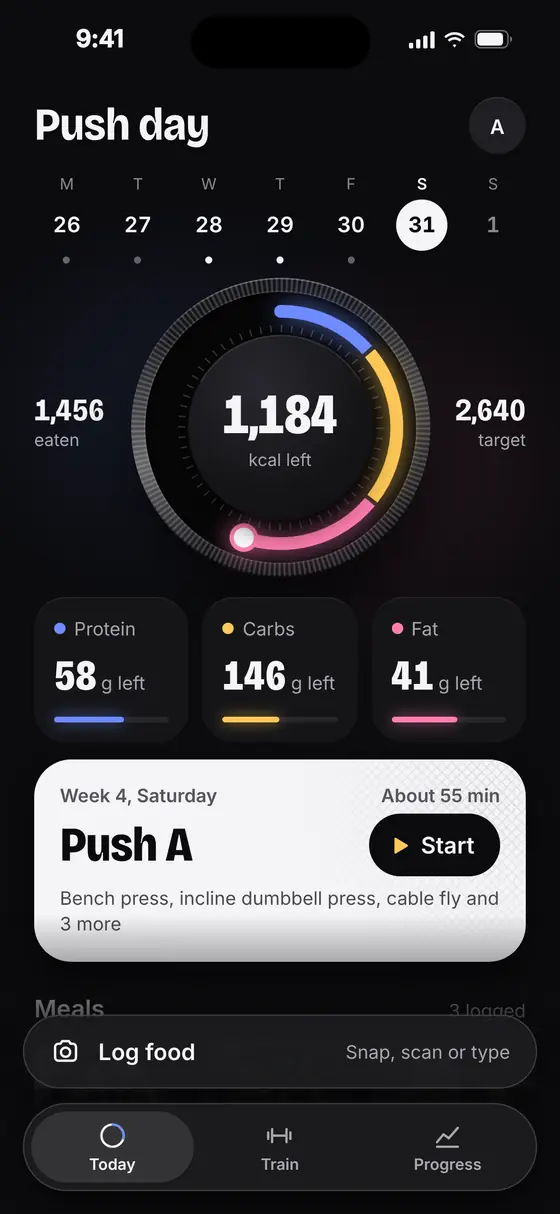

Let the weekly check-in do this
Indar logs a meal from a photo, keeps your weigh-ins, and works out your real maintenance every week, so your targets follow your body instead of a formula.


On Android? Get it on Google PlayOn iPhone? Get it on the App Store
Scan with your phone's camera to get Indar.
Free to download. Yearly Pro starts with a 7-day free trial.