 Indar
Calorie deficit calculator
This calorie deficit calculator works out how many calories a day to eat to lose weight: what you burn in a day (your TDEE) minus a deficit sized to lose 0.25% to 0.75% of your body weight a week (up to 1% with high body fat). For a 30-year-old man of 80 kg (176 lb) and 180 cm (5 ft 11 in) with a desk job, who has lifted for 6 months to 3 years and lifts four hours a week, the calculator sets 2,170 kcal a day (9,079 kJ), a deficit of 440 kcal, for about 0.4 kg (0.88 lb) a week. A calorie deficit is eating fewer calories than your body burns, so it makes up the gap mostly from stored fat. The calculator uses the same rule as the Indar app, with the largest deficit your body can take before it starts coming out of muscle.
How do I calculate my calorie deficit?
Work out what you burn in a day, pick a weekly loss as a share of your body weight, turn that loss into calories a day at 7,700 kcal per kg (3,500 kcal per lb), and take it off what you burn. This calculator does the same four steps, then checks the answer against three limits. With its opening numbers, a 30-year-old man of 80 kg (176 lb) and 180 cm (5 ft 11 in) with a desk job, who has lifted for 6 months to 3 years and lifts four days a week for an hour:
- What you burn a day (TDEE): 2,610 kcal. His resting energy, 1,885 kcal, × 1.3 for a desk job = 2,450, plus 160 kcal a day for four hours of lifting averaged over the week = 2,610, the way the TDEE calculator works it out.
- The weekly loss: 0.4 kg (0.88 lb). The moderate pace is 0.5% of body weight a week, and 0.5% of 80 kg is 0.4 kg.
- The deficit: 440 kcal a day. 0.4 kg × 7,700 kcal ÷ 7 days = 440, or in pounds 0.88 × 3,500 ÷ 7 = 440.
- The target: 2,170 kcal a day (9,079 kJ). 2,610 − 440 = 2,170.
Then the limits. His largest deficit is 578 kcal a day (40 kcal for each kilogram of his estimated 14.46 kg of body fat, which is less than a quarter of 2,610), and his lowest target is 1,885 kcal, his resting energy. 440 and 2,170 are inside both, so they stand. In 12 weeks that is about 4.8 kg (10.6 lb), if what he burns stayed the same; it doesn't, as the section on why a deficit shrinks below explains.
How big a calorie deficit do I need to lose weight?
A deficit that loses 0.25% to 0.75% of your body weight a week, or up to 1% with high body fat: for the five people worked out below, from 170 kcal a day (the 28-year-old woman at the steady pace) to 680 (the 45-year-old man at the faster pace). The pace you pick sets it:
- Steady: about 0.25% of your body weight a week. For the 80 kg man, 0.2 kg (0.44 lb) a week and a deficit of 220 kcal a day.
- Moderate: about 0.5% a week: 0.4 kg (0.88 lb) and 440 kcal a day for him.
- Faster: about 0.75% a week, or 1% with high body fat (25% or more for men, 32% for women). For him 0.75% would need 660 kcal a day, past his 578 kcal limit, so the calculator holds it at that limit (a 580 kcal gap once the target is rounded to the nearest 10 kcal) and about 0.53 kg (1.17 lb) a week.
A share of body weight, not a fixed 500 kcal, because the same deficit means very different things to a 60 kg and a 120 kg person. In a trial of 24 elite athletes who lifted four times a week while losing weight, those set to lose 0.7% of their weight a week gained lean mass, and those set to lose 1.4% a week didn't (Garthe et al., 2011).
The limits
Then three limits, the ones Indar holds to at the start and at every weekly check-in. If a pace breaks one, it slows instead:
- Never more than a quarter of what you burn. A bigger cut is harder to keep up and costs training performance and energy.
- Never more than 40 kcal a day for each kilogram of body fat. Stored fat can only release so much energy a day, about 69 kcal per kilogram by one estimate (Alpert, 2005), and past that the rest of a deficit comes from muscle. 40 is a little over half of that. So the leaner you are, the smaller your deficit: about 600 kcal a day with 15 kg of fat, 400 with 10 kg. Your body fat is estimated from your BMI, age, sex and training (how), and the calculator never shows yours as a number.
- Never below your resting energy, or 1,200 kcal for women and 1,500 for men. If a goal needs less, the pace slows.
Under a healthy weight for your height (a BMI under 18.5), nothing is cut and calories hold your weight. The guide to a safe calorie deficit goes through the research behind these limits, and what happens to muscle in a deficit.
Five people, worked out
This calculator gives these five people deficits of 330 to 600 kcal a day at the moderate pace, each worked out with Indar's own rule.
| Person | Burns | Moderate | Faster | Largest deficit |
|---|---|---|---|---|
| Man, 3080 kg (176 lb), 180 cm (5 ft 11 in); desk job, 6 months to 3 years lifting, 4 × 60 min | 2,610 | 2,170−440 | 2,030−580 | 578body fat |
| Woman, 3570 kg (154 lb), 165 cm (5 ft 5 in); some walking, new to lifting, 3 × 45 min | 2,100 | 1,720−380 | 1,580−520 | 525a quarter |
| Man, 45110 kg (243 lb), 175 cm (5 ft 9 in); desk job, new to lifting, 3 × 60 min | 2,730 | 2,130−600 | 2,050−680 | 683a quarter |
| Woman, 2860 kg (132 lb), 168 cm (5 ft 6 in); desk job, 6 months to 3 years lifting, 4 × 60 min | 1,980 | 1,650−330 | 1,480−500 | 495a quarter |
| Woman, 5085 kg (187 lb), 160 cm (5 ft 3 in); desk job, doesn't lift | 1,870 | 1,440−430 | 1,440−430 | 468a quarter |
All figures are kcal a day. The 50-year-old woman's resting energy is about 1,440 kcal, so no target goes under it: her moderate and faster paces both stop at 1,440 kcal, a deficit of 430 and about 0.39 kg (0.86 lb) a week. Rounding the target to the nearest 10 kcal can put a gap up to 5 kcal past a limit, as with the 28-year-old woman's 500 against her 495.
Why does my calorie deficit get smaller as I lose weight?
Your deficit gets smaller because a lighter body burns less, so the same calories leave a smaller gap each week. If the 80 kg man keeps eating 2,170 kcal, by 72 kg (159 lb) he burns about 2,480 kcal a day and his deficit has fallen from 440 to 310 kcal. Put 72 kg into the calculator and it sets 2,080 kcal, a deficit of 400, at the same moderate pace.
This is why the 3,500 kcal per pound rule, used as a fixed daily deficit, predicts more loss than people get, and never a plateau: it treats the starting deficit as if it never changed (Hall and Chow, 2013). In a model of adult metabolism, the weight change from a lasting change in what you eat takes years to play out, with a half time of about a year (Hall et al., 2011). So work your numbers out again every few kilograms, or let the weekly check-in do it. The weight-loss timeline works out the weeks to a goal with the deficit falling as you go.
How do I know my calorie deficit is working?
Compare the average of a week's weigh-ins with the week before, and give it three weeks: the trend then shows the rate you are really losing at. The first week or two bounce as water and food in the gut change. If the trend is slower than the calculator's rate, you burn less than it estimated, or eat more than you log; the maintenance calorie calculator works out what you really burn from your own log and weigh-ins.
What you really burn is your average daily calories plus your weekly loss in kg × 7,700 ÷ 7 (in lb × 3,500 ÷ 7). Eating 2,170 kcal a day and losing 0.3 kg (0.66 lb) a week means you burn about 2,170 + 330 = 2,500 kcal, so a 440 kcal deficit needs 2,060.
Common questions
How big should my calorie deficit be?
Big enough to lose about 0.5% of your body weight a week, which for the five people on this page is 330 to 600 kcal a day under what they burn. Indar never goes past a quarter of what you burn, or 40 kcal a day for each kilogram of body fat, whichever is smaller.
Is a 500 calorie deficit enough to lose weight?
Yes: by the usual rule of 7,700 kcal per kg (3,500 per lb), a 500 kcal deficit loses about 0.45 kg (1 lb) a week at first, and less as you get lighter. For a 50-year-old woman of 85 kg (187 lb) who doesn't lift and burns 1,870 kcal a day it is more than this calculator allows: a quarter of what she burns is 468 kcal, and her resting energy holds her at 430.
Is a 1,000 calorie deficit safe?
For most people it's more than is safe for their muscle. By Indar's limits, a 1,000 kcal deficit needs you to burn 4,000 kcal a day and carry at least 25 kg of body fat. Lean people reach the point where extra deficit comes out of muscle much sooner.
Why is my deficit smaller than other calculators say?
Most calculators take a fixed 500 or 1,000 kcal off for everyone, and this one sizes the deficit to your body. The leaner you are, the less fat there is to draw on each day, so the smaller the deficit that comes from fat and not muscle.
Should I eat back the calories I burn exercising?
No, not with this calculator: your lifting and other sport are already counted in what you burn a day, averaged over the week. Eating them back on training days would count them twice and shrink your deficit by the same amount.
How fast will I see results?
In about three weeks: compare weekly averages, because the scale bounces for the first week or two with water and food in the gut. After three weeks the trend shows your real rate, and that tells you whether to change the target.
Who this isn't for
These numbers are for healthy adults. They aren't right for anyone under 18 (growth changes the maths), pregnant or breastfeeding, living with kidney disease or a heart condition, on diabetes or weight-loss medication, or after weight-loss surgery. A GP or an accredited dietitian can set targets that fit. If counting calories has ever been hard on you, it's worth talking to someone first: in the US, the National Alliance for Eating Disorders on (866) 662-1235; in the UK, Beat on 0808 801 0677; in Canada, NEDIC on 1-866-633-4220; in Australia, the Butterfly Foundation on 1800 33 4673; in New Zealand, EDANZ on 0800 233 269; anywhere else, your doctor or a local eating disorder service.
Sources
- Garthe I, Raastad T, Refsnes PE, Koivisto A, Sundgot-Borgen J. Effect of two different weight-loss rates on body composition and strength and power-related performance in elite athletes. Int J Sport Nutr Exerc Metab. 2011.
- Alpert SS. A limit on the energy transfer rate from the human fat store in hypophagia. J Theor Biol. 2005.
- Hall KD, Chow CC. Why is the 3500 kcal per pound weight loss rule wrong? Int J Obes. 2013.
- Hall KD, Sacks G, Chandramohan D, et al. Quantification of the effect of energy imbalance on bodyweight. Lancet. 2011.
- Mifflin MD, St Jeor ST, et al. A new predictive equation for resting energy expenditure in healthy individuals. Am J Clin Nutr. 1990.
- Herrmann SD, et al. 2024 Adult Compendium of Physical Activities. J Sport Health Sci. 2024.

A deficit that adjusts as you go
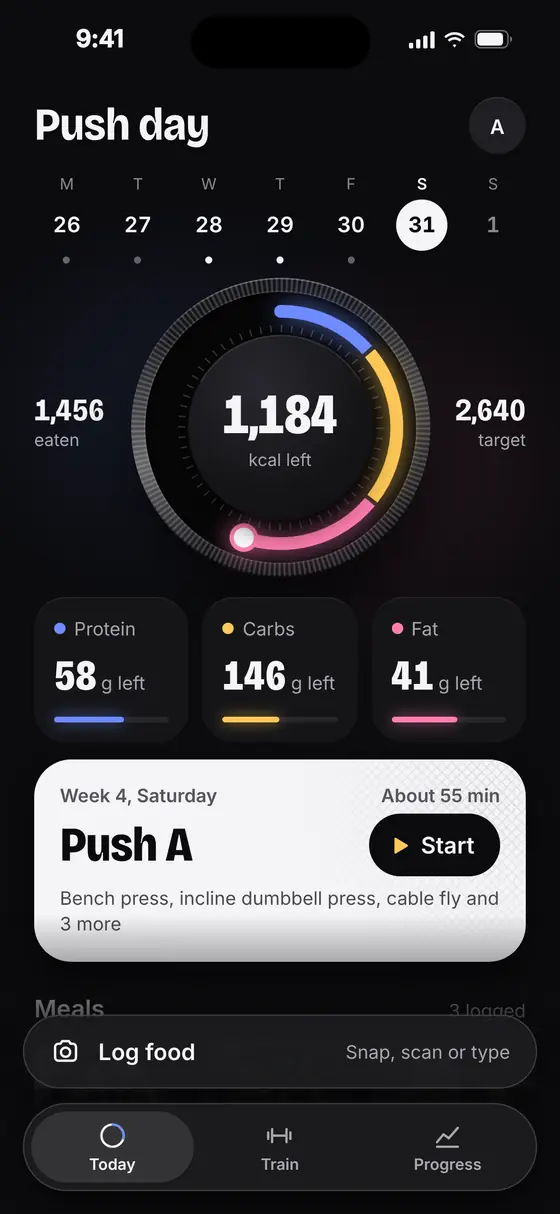
Indar sets this deficit, checks it against your weigh-ins every week, and makes it smaller as you get leaner, so the weight that comes off is fat. Logging a meal is a photo.


On Android? Get it on Google PlayOn iPhone? Get it on the App Store
Scan with your phone's camera to get Indar.
Free to download. Yearly Pro starts with a 7-day free trial.