 Indar
TDEE calculator
Your TDEE, total daily energy expenditure, is everything you burn in a day. This works it out the way Indar does when it sets your targets: resting energy, your day outside the gym, your lifting and any other sport, each counted on its own.
How your TDEE is worked out
TDEE is four things added up: what your body burns at rest, what your day burns outside training, your lifting, and any other sport. Digesting food is part of the everyday figure. The breakdown next to your result shows each part with your own numbers.
Take a 30-year-old man, 180 cm and 80 kg, with a desk job, who lifts four hour-long sessions a week: resting energy 1,885 kcal, everyday movement 565, lifting 160. His TDEE is about 2,610 kcal a day. Change his day to on his feet all day and it's about 3,180: the job moves the total far more than the gym does.
1. Resting energy (BMR)
What your body burns doing nothing, from the Mifflin-St Jeor equation: 10 × weight in kg + 6.25 × height in cm − 5 × age, then + 5 for men or − 161 for women. A systematic review found it the most reliable of the common equations, landing within 10% of measured resting energy for more people than any other (Frankenfield et al., 2005). It was built on mostly untrained people, so for anyone who already lifts or trains 3 or more days a week without high body fat, it's averaged with the ten Haaf equation, built on recreational athletes who carry more muscle. "Rather not say" uses the midpoint of the male and female equations.
2. Your day, outside training
Resting energy times a factor for how much you move when you're not training: 1.3 for mostly sitting, 1.45 for some walking, 1.6 for on your feet all day, 1.8 for hard physical work. Most TDEE calculators fold training into one "activity level", which counts a desk worker who lifts five days a week as "very active" all day. Here training is added on its own instead.
3. Lifting
A whole lifting session, warm-ups and rests included, averages about 4.5 METs in the 2024 Compendium of Physical Activities. Only the part above rest is added: (4.5 − 1) × body weight × hours a week ÷ 7. For an 80 kg lifter training 4 hours a week, that's 160 kcal a day. Lifting burns less than most people think.
4. Other sport
Running, martial arts, team sport, cycling: counted the same way, at about 5.5 METs for steady work and 7.5 for hard work like sparring, intervals and matches. The total is capped at 2.5 times resting energy, about the most anyone keeps up for weeks (Thurber et al., 2019).
Stacked bars of daily calories. Woman, 45, 60 kg: 1,620 kcal; Woman, 30, 65 kg: 2,200 kcal; Woman, 25, 70 kg: 2,350 kcal; Man, 55, 85 kg: 2,240 kcal; Man, 30, 80 kg: 2,610 kcal; Man, 25, 90 kg: 3,570 kcal.
Using your TDEE
- To hold your weight, eat your TDEE, averaged over the week. That's your maintenance calories.
- To lose fat, eat less than it. Indar's paces take 0.25% to 1% of your body weight a week, never more than a quarter of your TDEE: the calorie deficit calculator shows each one for you.
- To build muscle, eat a little more: the lean bulk guide explains how much, and the macro calculator splits it into protein, carbs and fat.
Every formula is an estimate, and two people with the same numbers can burn a few hundred calories a day apart. Eat to your estimate for three weeks, weigh in most mornings, and compare the weekly averages. Indar does that check for you each week.
Common questions
What's the difference between TDEE and BMR?
BMR, or resting energy, is what your body burns doing nothing. TDEE is everything you burn in a day: resting energy plus moving about, training and digesting food. For most people TDEE is about 1.3 to 1.8 times their BMR before any training is added.
Is TDEE the same as maintenance calories?
Yes. If you eat your TDEE, averaged over the week, your weight holds. A calculator gives an estimate; your food log and your weigh-ins over two to three weeks tell you your real number.
Should I eat more on training days?
You don't need to. This TDEE averages your training over the week, so eating the same every day matches it. A lifting session adds less than most people think, often 150 to 300 kcal, so the difference between days is small.
How accurate is a TDEE calculator?
Close enough to start from, not to trust for months. The best resting-energy equations land within about 10% for most people and miss by more for some, and everyday movement varies a lot. Weigh in for three weeks while eating a steady amount, then adjust.
Who this isn't for
These numbers are for healthy adults. They aren't right for anyone under 18, pregnant or breastfeeding, or with a medical condition that changes how you burn or store energy. A GP or an accredited dietitian can help. If counting calories has ever been hard on you, it's worth talking to someone first: in the US, the National Alliance for Eating Disorders on (866) 662-1235; in the UK, Beat on 0808 801 0677; in Canada, NEDIC on 1-866-633-4220; in Australia, the Butterfly Foundation on 1800 33 4673; in New Zealand, EDANZ on 0800 233 269; anywhere else, your doctor or a local eating disorder service.
Sources
- Mifflin MD, St Jeor ST, et al. A new predictive equation for resting energy expenditure in healthy individuals. Am J Clin Nutr. 1990.
- Frankenfield D, Roth-Yousey L, Compher C. Comparison of predictive equations for resting metabolic rate in healthy nonobese and obese adults: a systematic review. J Am Diet Assoc. 2005.
- ten Haaf T, Weijs PJM. Resting energy expenditure prediction in recreational athletes of 18 to 35 years. PLoS One. 2014.
- Herrmann SD, et al. 2024 Adult Compendium of Physical Activities. J Sport Health Sci. 2024.
- Thurber C, Dugas LR, Ocobock C, Carlson B, Speakman JR, Pontzer H. Extreme events reveal an alimentary limit on sustained maximal human energy expenditure. Sci Adv. 2019.

Indar keeps this number honest
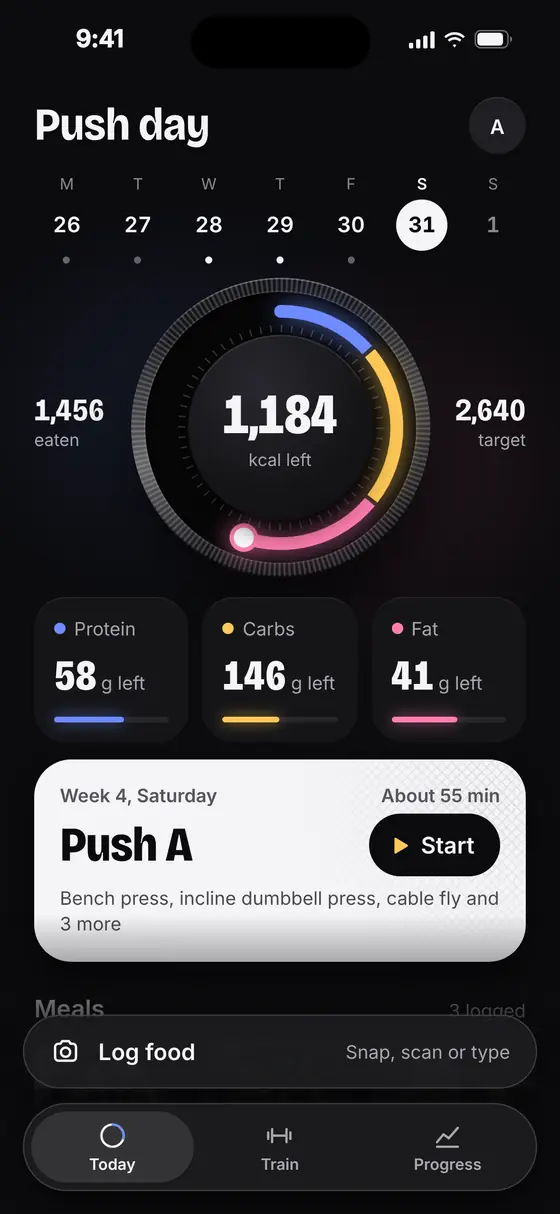
It starts your targets from this estimate, then checks it against your food log and weigh-ins every week and tells you when it's off. Logging a meal is a photo.


On Android? Get it on Google PlayOn iPhone? Get it on the App Store
Scan with your phone's camera to get Indar.
Free to download. Yearly Pro starts with a 7-day free trial.