 Indar
Lean bulk: how big a surplus?
A lean bulk is a small calorie surplus, just enough to gain weight about as fast as you can add muscle: for most lifters, 100 to 400 kcal a day over maintenance. New lifters can go toward the top of that; after a few years of training it's closer to 70 to 150, because muscle comes slower and the rest of a surplus is stored as fat.
How big a surplus for a lean bulk?
| Lifting for | Men: gain a week | Women: gain a week |
|---|---|---|
| Under 6 months, or back after a break | 0.4% of body weightabout 350 kcal a day at 80 kg | 0.3%about 215 kcal a day at 65 kg |
| 6 months to 3 years | 0.25%about 220 kcal a day at 80 kg | 0.2%about 145 kcal a day at 65 kg |
| Over 3 years | 0.15%about 130 kcal a day at 80 kg | 0.1%about 70 kcal a day at 65 kg |
Protein: about 1.8 g per kg of body weight a day. Fat about a quarter of your calories, carbs the rest.
Why keep the surplus small?
You can only build muscle so fast, and the rate falls the longer you've trained. Extra calories beyond what that muscle needs don't build more of it: they're stored as fat, which you then have to diet off. A review of off-season nutrition for bodybuilders, the people who care most about this, suggests gaining about 0.25 to 0.5% of body weight a week, with newer lifters at the faster end (Iraki et al., 2019). Indar's rates sit in and just below that range, lower for women, who add muscle more slowly in absolute terms, and lower again with experience.
In practice, at 80 kg with a year or two of training, 0.25% a week is 0.2 kg: under a kilogram a month. That feels slow. It's meant to.
The maths
Man, 80 kg (176 lb), Under 6 months: 1.4 kg (3.1 lb) a month, +350 kcal; Man, 80 kg (176 lb), 6 months to 3 years: 0.9 kg (2.0 lb) a month, +220 kcal; Man, 80 kg (176 lb), Over 3 years: 0.5 kg (1.1 lb) a month, +130 kcal; Woman, 65 kg (143 lb), Under 6 months: 0.8 kg (1.8 lb) a month, +210 kcal; Woman, 65 kg (143 lb), 6 months to 3 years: 0.6 kg (1.3 lb) a month, +140 kcal; Woman, 65 kg (143 lb), Over 3 years: 0.3 kg (0.7 lb) a month, +70 kcal
Indar counts a kilogram gained as about 7,700 kcal (3,500 kcal a pound), the same as one lost. That's a simplification: muscle holds less energy than fat, so the real figure depends on what you gain, which is why you check the scale. The daily surplus is: weekly gain in kg × 7,700 ÷ 7.
- 80 kg man, 6 months to 3 years of lifting: 0.25% × 80 = 0.2 kg a week. 0.2 × 7,700 ÷ 7 = 220 kcal a day.
- 65 kg woman, the same experience: 0.2% × 65 = 0.13 kg a week, about 145 kcal a day.
Add it to your maintenance. For a 30-year-old man, 180 cm and 80 kg, with a desk job and four hours of lifting a week, maintenance is about 2,610 kcal, so a lean bulk is about 2,830.
How do you run a lean bulk?
- Start at maintenance plus the surplus above.
- Weigh in most mornings and compare weekly averages, not single days.
- Check every three to four weeks. Gaining faster than your rate: take off about 100 kcal. Not gaining: add about 100.
- Train hard and keep adding weight or reps. The surplus only builds muscle if training asks for it. The workout plan generator builds a week that does, and how to build muscle fast explains what that training needs.
- Keep protein at about 1.8 g per kg. Extra protein stops adding muscle at about 1.6 g per kg on average (Morton et al., 2018); 1.8 covers most people.
Lean bulk or dirty bulk?
A "dirty bulk", eating as much as you can, gains weight faster, but most of the extra is fat. The muscle you gain is set by your training and experience, not by how much you eat over what that muscle needs. The one case for a bigger surplus is someone very underweight who's new to lifting; even then, the 0.4% a week above for new lifters is plenty.
When should you bulk, and when should you stop?
- Bulk when you're reasonably lean and want more size, and your training is consistent.
- Don't bulk if you're carrying a lot of fat: lose some first, or recomp if you're new to lifting.
- Stop when you'd rather lose a little fat than keep gaining. A short cut at about 0.5% a week, then back to a lean bulk, is the usual cycle. The deficit calculator sets it.
Sources
- Iraki J, Fitschen P, Espinar S, Helms E. Nutrition recommendations for bodybuilders in the off-season: a narrative review. Sports. 2019.
- Morton RW, et al. A systematic review, meta-analysis and meta-regression of the effect of protein supplementation on resistance training-induced gains in muscle mass and strength. Br J Sports Med. 2018.
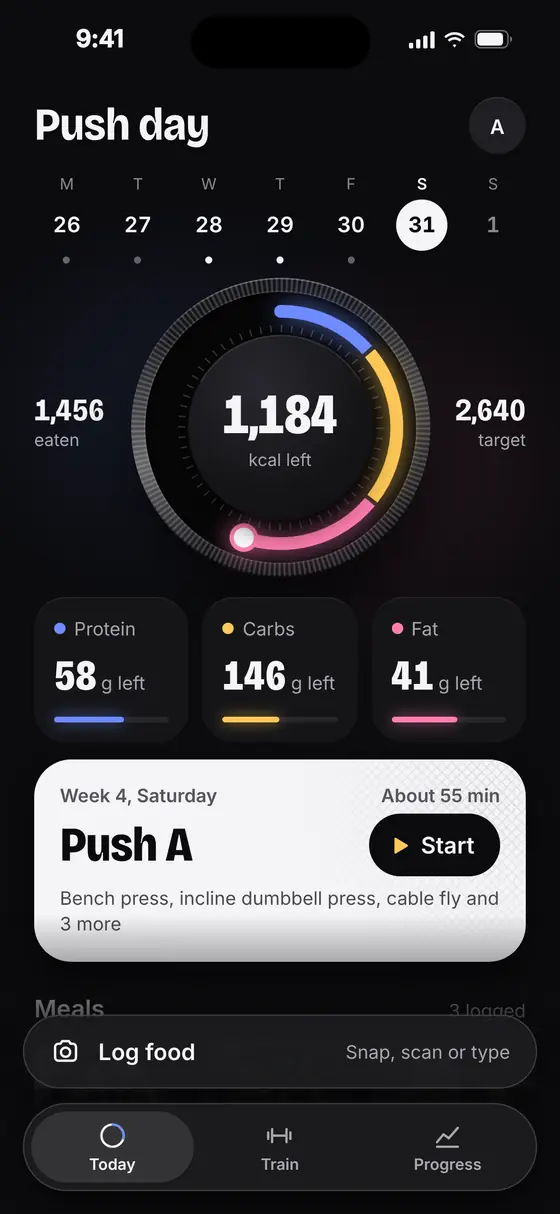

A bulk that stays lean
Indar sets your surplus from your experience, builds the training that puts it to use, and checks your rate of gain against your weigh-ins every week.


On Android? Get it on Google PlayOn iPhone? Get it on the App Store
Scan with your phone's camera to get Indar.
Free to download. Yearly Pro starts with a 7-day free trial.