 Indar
How to get rid of visceral fat
Visceral fat, the fat packed around your organs, comes off with regular exercise and a modest calorie deficit, and it drops faster in proportion than the fat under your skin. Exercise shrinks it even when your weight doesn't change, by about 6% on average in studies where weight held steady. Cardio does the most, lifting keeps your muscle, and your waist, not the scale, shows it going.
What gets rid of visceral fat?
- Cardio, most weeks: the exercise with the strongest effect on visceral fat, harder sessions possibly more so.
- Lifting, three or four days a week: a smaller effect on visceral fat, but it keeps your muscle while the fat goes.
- A modest calorie deficit: about 0.5% of your body weight a week. With modest weight loss, visceral fat drops faster in proportion than other fat.
- Enough sleep, and less alcohol: both are linked to how much visceral fat people carry.
- A tape measure: once a week, aiming for a waist under half your height.
What is visceral fat, and why does it matter?
Visceral fat sits deep in your abdomen, around organs like your liver, stomach and intestines. Everyone has some, and it cushions those organs. You can't pinch it: the fat you can pinch is subcutaneous fat, under the skin, which the belly fat guide covers.
Too much visceral fat is the problem. Measured accurately by CT or MRI scans, it predicts heart disease, type 2 diabetes and early death on its own, beyond what your weight says, according to a position statement from the International Atherosclerosis Society (Neeland et al., 2019). That's why two people of the same weight can carry very different risks, and why it's worth losing even if your weight is in the healthy range.
How can you check your visceral fat?
You can't see visceral fat, and only a scan measures it. The best cheap check is your waist compared with your height. Find the bottom of your lowest rib and the top of your hip bone, wrap the tape midway between them (just above the belly button for most people), and breathe out naturally before you read it. Divide your waist by your height in the same units: 96.5 cm around and 170 cm tall is 0.57 (NICE, 2025).
- 0.4 to 0.49: healthy, no increased health risk.
- 0.5 to 0.59: increased risk.
- 0.6 or more: further increased risk, of type 2 diabetes, high blood pressure and heart disease.
NICE uses it for adults with a BMI under 35. In a meta-analysis of studies with more than 300,000 adults in several ethnic groups, waist to height picked out diabetes, high blood pressure and heart disease better than waist alone or BMI, in men and women (Ashwell et al., 2012). Here is half and 0.6 of common heights:
Swipe the table for the high-risk line.
| Height | Healthy: under | High risk: from |
|---|---|---|
| 150 cm4 ft 11 in | 75 cm29.5 in | 90 cm35.4 in |
| 155 cm5 ft 1 in | 77.5 cm30.5 in | 93 cm36.6 in |
| 160 cm5 ft 3 in | 80 cm31.5 in | 96 cm37.8 in |
| 165 cm5 ft 5 in | 82.5 cm32.5 in | 99 cm39.0 in |
| 170 cm5 ft 7 in | 85 cm33.5 in | 102 cm40.2 in |
| 175 cm5 ft 9 in | 87.5 cm34.5 in | 105 cm41.4 in |
| 180 cm5 ft 11 in | 90 cm35.5 in | 108 cm42.6 in |
| 185 cm6 ft 1 in | 92.5 cm36.5 in | 111 cm43.8 in |
| 190 cm6 ft 3 in | 95 cm37.5 in | 114 cm45.0 in |
The centimetres are worked from the height in centimetres and the inches from the height in feet and inches, so the two can differ by a fraction. In between the two columns is increased risk. Waist alone is a rougher check: the World Health Organization puts raised risk over 94 cm (37 in) for men and 80 cm (31.5 in) for women, and substantially raised over 102 cm (40 in) and 88 cm (34.6 in) (WHO, 2008). The cut-offs are lower for some Asian populations. Two things BMI can hide: a healthy BMI doesn't rule out too much fat around the middle, and people with a South Asian, Chinese, other Asian, Middle Eastern, Black African or African-Caribbean background tend to carry more of it at the same BMI (NICE). The ratio is the better check for both. If you're slim with a soft middle, skinny fat covers that.
What about the visceral fat number on my scale?
Body composition scales estimate visceral fat from a weak electrical current, your height, age and sex. They don't measure it. Tanita's scales, for example, give a rating from 1 to 59, where 1 stands for about 10 cm² of visceral fat on an MRI slice; 1 to 12 counts as healthy and 13 to 59 as too high (Tanita). Other brands use their own scales, so their numbers don't compare.
How close are they? In 19 adults followed through a year of weight loss, a home scale tracked fat lost about as well as a DXA scan, but overestimated visceral fat compared with MRI, especially in men, and tracked its changes less well (Pietiläinen et al., 2013). In 106 adults, foot-to-foot scales estimated body fat and muscle less accurately for individuals than a device with hand and foot electrodes (Bosy-Westphal et al., 2008). So read a scale's visceral fat number as a rough trend over months, not a measurement, and trust the tape more.
Does exercise cut visceral fat before the scale moves?
In studies where weight didn't change, exercise still cut visceral fat by about 6%. Dieting without weight loss: about 1%.
This is the part most people miss. A meta-analysis of 117 studies with 4,815 people found that dieting lost more weight than exercise, but exercise tended to take off more visceral fat. In studies where body weight didn't change, exercise reduced visceral fat by about 6.1%; dieting with no weight loss, by 1.1% (Verheggen et al., 2016). The scale was a poor guide to what happened inside.
The same showed in a three-month trial of 52 men with obesity. Two groups lost 7.5 kg each, one by eating less and one by exercising more, and both lost similar visceral fat. A third group exercised without losing weight, and their abdominal and visceral fat still went down (Ross et al., 2000).
Which exercise? The trials point the same way:
- Cardio does the most. In 15 trials (852 people) of exercise without dieting, aerobic training at moderate or high intensity had the biggest effect, measurable in 12 weeks (Vissers et al., 2013). Pooling 84 trials (4,836 people with overweight or obesity), vigorous cardio and interval training were the most likely to be best (Chen et al., 2024).
- Intervals count. Across 39 studies (617 people), high-intensity interval training reduced visceral fat in men and women alike (Maillard et al., 2018).
- Lifting helps, less. In a meta-analysis of 54 trials in healthy adults, lifting reduced body fat and visceral fat compared with not exercising (Wewege et al., 2022). But it ranked last of the exercise types in the 84-trial analysis, where it helped men and people under 40% body fat but not women or people over 40% (Chen et al., 2024), and an earlier analysis found no clear effect of lifting alone (Ismail et al., 2012). Lift to keep and build muscle while you lose fat; do cardio for the visceral fat.
How much? The same earlier analysis suggested that less aerobic exercise than is usually recommended for weight loss may be enough to shift visceral fat (Ismail et al., 2012). The World Health Organization's recommendation for adults is at least 150 minutes of moderate activity a week (WHO), which is a good start: brisk walking counts. If you're new to hard exercise or have a heart condition, check with your doctor before you add intervals.
Does weight loss cut visceral fat?
Across 61 studies, people who lost a modest amount of weight lost a bigger share of their visceral fat than of the fat under their skin. The bigger the weight loss, the smaller that head start became. How the weight was lost made no difference to that head start, apart from a brief early edge for very low calorie diets that was gone by 12 to 14 weeks (Chaston and Dixon, 2008). So you don't need a crash diet: a steady deficit does it.
- Deficit: about 0.5% of your body weight a week, 300 to 600 kcal (about 1,250 to 2,500 kJ) a day for most people, and never more than a quarter of what you burn. The calorie deficit calculator sizes it to your body.
- Protein: about 2.2 g per kg of body weight (1 g per lb) while you lose, counted from a healthy weight if you carry a lot of fat, so the weight that comes off is fat rather than muscle (why).
- Food: what makes a deficit easier is food that fills you for its calories, protein at every meal, and fewer calories you drink. The trials on this page shifted visceral fat through exercise and weight loss, not particular foods.
Do sleep and alcohol matter?
Sleep. In 1,107 African American and Hispanic American adults followed for five years, those under 40 who slept 5 hours or less gained more visceral fat (13 cm² more on CT) than those who slept 6 to 7 hours. Those who slept 8 hours or more gained a little more too (6 cm²). Over 40, there was no clear link (Hairston et al., 2010). That kind of study can't prove sleep caused it. But in a small trial of 10 adults dieting for two weeks, 5.5 hours in bed instead of 8.5 meant less of the weight lost was fat (0.6 kg against 1.4 kg) and more was lean tissue (Nedeltcheva et al., 2010).
Alcohol. In 951 healthy Korean men scanned by CT, those who drank more had more visceral fat and less fat under the skin, after accounting for other factors, and light drinking didn't seem protective (Kim et al., 2012). It's one cross-sectional study of men, so it shows a link, not the cause. Drinks also add calories that make a deficit harder.
A week that shifts it
- Lift three or four days, whole body, as heavy as you can do well. The workout plan generator builds the week.
- Cardio on top: at least 150 minutes of moderate activity across the week, from brisk walks to cycling, with one or two harder sessions or intervals once you're fit enough.
- Eat in a modest deficit with high protein, and log it: without numbers, a deficit is a guess.
- Sleep at regular times, and keep alcohol low.
- Measure your waist once a week, same time, same place. Judge it over a month or more.
What to skip
- Ab exercises to burn it: in a trial of 24 adults, six weeks of ab exercises five days a week built endurance but didn't change belly fat or waist size (Vispute et al., 2011). Train your abs for strength, not to remove fat.
- Waist trainers and sweat belts: they squeeze and move water, and visceral fat sits inside the muscle wall, out of reach.
- "Fat-burning" teas, pills and detoxes: none of the trials above needed one. What moved visceral fat was exercise and weight loss.
Common questions
How long does it take to lose visceral fat?
Weeks to months, not days. In trials of aerobic exercise without dieting, the drop showed on scans after 12 weeks. Measure your waist once a week and judge it over a month or more: it often keeps shrinking in weeks when the scale stalls.
Can you lose visceral fat without losing weight?
Yes. In a meta-analysis of 117 studies, exercise reduced visceral fat by about 6% in studies where body weight didn't change, while dieting without weight loss barely changed it. Your waist is a better guide than the scale.
What is a healthy visceral fat level?
On a Tanita scale, 1 to 12 counts as healthy and 13 to 59 as too high; other brands use their own numbers. Scales estimate visceral fat rather than measure it, and in a study one overestimated it compared with MRI. For a free check, keep your waist under half your height.
Is cardio or weights better for visceral fat?
Cardio, especially vigorous cardio and intervals, did the most in the trials. Lifting reduced visceral fat less, but it keeps your muscle while you lose fat. Do both.
Is keto or fasting better for visceral fat?
Not on the evidence here. Across 61 studies, how people lost weight made no difference to how much of it came from visceral fat, apart from a brief early edge for very low calorie diets that was gone by 12 to 14 weeks. Pick the way of eating you can keep a deficit on, and add exercise, which shrinks visceral fat even without weight loss.
Can thin people have too much visceral fat?
Yes. A healthy BMI doesn't rule out too much fat around the middle, which is why the UK's NICE guideline measures waist to height as well as BMI. People with a South Asian, Chinese, other Asian, Middle Eastern, Black African or African-Caribbean background tend to carry more at the same BMI.
When should you see a doctor?
If your waist is half your height or more, it's worth asking your doctor to check your blood pressure, blood sugar and cholesterol, the risks a large waist is linked to. See a doctor soon if your belly has grown quickly without weight gain elsewhere, feels hard or swollen, or comes with pain or changes in digestion: those can be signs of something other than fat. Under 18, pregnant, or on medication for diabetes or blood pressure, plan weight loss with your doctor. If dieting has ever been hard on you, it's worth talking to someone first: in the US, the National Alliance for Eating Disorders on (866) 662-1235; in the UK, Beat on 0808 801 0677; in Canada, NEDIC on 1-866-633-4220; in Australia, the Butterfly Foundation on 1800 33 4673; in New Zealand, EDANZ on 0800 233 269; anywhere else, your doctor or a local eating disorder service.
Sources
- Neeland IJ, Ross R, Després JP, et al. Visceral and ectopic fat, atherosclerosis, and cardiometabolic disease: a position statement. Lancet Diabetes Endocrinol. 2019.
- National Institute for Health and Care Excellence. Overweight and obesity management (NG246): identifying and assessing overweight, obesity and central adiposity. 2025, updated 2026.
- Ashwell M, Gunn P, Gibson S. Waist-to-height ratio is a better screening tool than waist circumference and BMI for adult cardiometabolic risk factors: systematic review and meta-analysis. Obes Rev. 2012.
- World Health Organization. Waist circumference and waist-hip ratio: report of a WHO expert consultation. 2008.
- Tanita. How is visceral fat measured by Tanita?
- Pietiläinen KH, Kaye S, Karmi A, et al. Agreement of bioelectrical impedance with dual-energy X-ray absorptiometry and MRI to estimate changes in body fat, skeletal muscle and visceral fat during a 12-month weight loss intervention. Br J Nutr. 2013.
- Bosy-Westphal A, Later W, Hitze B, et al. Accuracy of bioelectrical impedance consumer devices for measurement of body composition in comparison to whole body magnetic resonance imaging and dual X-ray absorptiometry. Obes Facts. 2008.
- Verheggen RJ, Maessen MF, Green DJ, et al. A systematic review and meta-analysis on the effects of exercise training versus hypocaloric diet: distinct effects on body weight and visceral adipose tissue. Obes Rev. 2016.
- Ross R, Dagnone D, Jones PJ, et al. Reduction in obesity and related comorbid conditions after diet-induced weight loss or exercise-induced weight loss in men: a randomized, controlled trial. Ann Intern Med. 2000.
- Vissers D, Hens W, Taeymans J, et al. The effect of exercise on visceral adipose tissue in overweight adults: a systematic review and meta-analysis. PLoS One. 2013.
- Chen X, He H, Xie K, Zhang L, Cao C. Effects of various exercise types on visceral adipose tissue in individuals with overweight and obesity: a systematic review and network meta-analysis of 84 randomized controlled trials. Obes Rev. 2024.
- Maillard F, Pereira B, Boisseau N. Effect of high-intensity interval training on total, abdominal and visceral fat mass: a meta-analysis. Sports Med. 2018.
- Wewege MA, Desai I, Honey C, et al. The effect of resistance training in healthy adults on body fat percentage, fat mass and visceral fat: a systematic review and meta-analysis. Sports Med. 2022.
- Ismail I, Keating SE, Baker MK, Johnson NA. A systematic review and meta-analysis of the effect of aerobic vs. resistance exercise training on visceral fat. Obes Rev. 2012.
- World Health Organization. Physical activity fact sheet.
- Chaston TB, Dixon JB. Factors associated with percent change in visceral versus subcutaneous abdominal fat during weight loss: findings from a systematic review. Int J Obes. 2008.
- Hairston KG, Bryer-Ash M, Norris JM, et al. Sleep duration and five-year abdominal fat accumulation in a minority cohort: the IRAS family study. Sleep. 2010.
- Nedeltcheva AV, Kilkus JM, Imperial J, Schoeller DA, Penev PD. Insufficient sleep undermines dietary efforts to reduce adiposity. Ann Intern Med. 2010.
- Kim KH, Oh SW, Kwon H, et al. Alcohol consumption and its relation to visceral and subcutaneous adipose tissues in healthy male Koreans. Ann Nutr Metab. 2012.
- Vispute SS, Smith JD, LeCheminant JD, Hurley KS. The effect of abdominal exercise on abdominal fat. J Strength Cond Res. 2011.

Train it off, keep the muscle
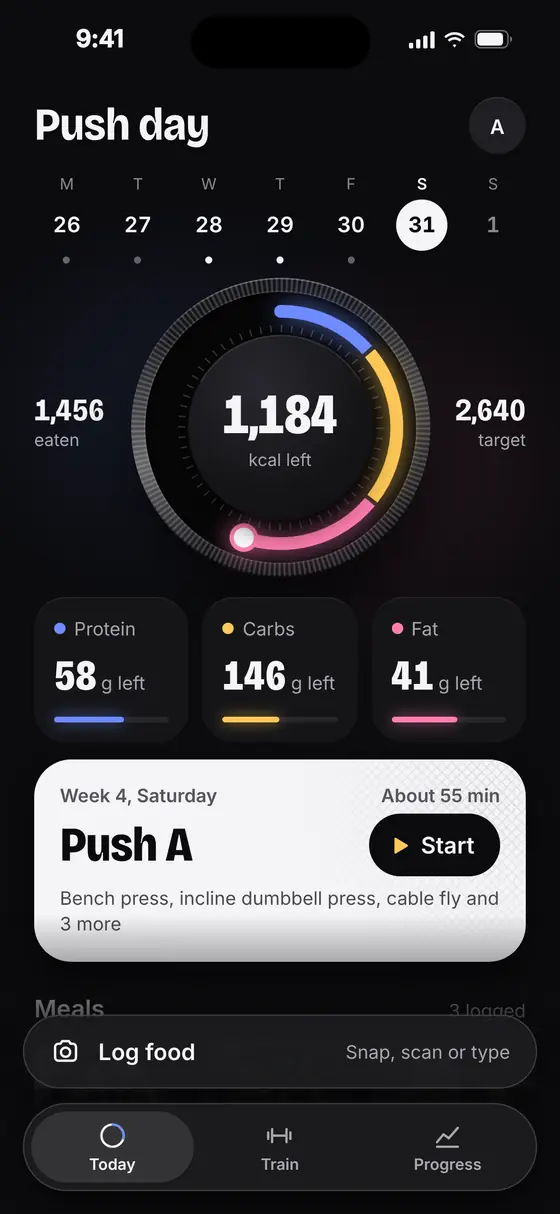
Indar builds your lifting week, sets a deficit sized to your body with the protein to match, and logs a meal from a photo, so the habits that shift visceral fat are easy to keep.


On Android? Get it on Google PlayOn iPhone? Get it on the App Store
Scan with your phone's camera to get Indar.
Free to download. Yearly Pro starts with a 7-day free trial.