 Indar
How to lose belly fat, the honest version
You can't choose where you lose fat, and ab exercises don't burn the fat on top of your abs. Belly fat comes off the way all fat does: a steady calorie deficit, lifting to keep your muscle, enough protein and enough sleep. The deep, visceral fat around your organs, the kind that matters most for health, responds to exercise even before the scale moves much.
What actually gets rid of belly fat?
- A calorie deficit that loses about 0.5% of your body weight a week.
- Exercise, lifting included, for the visceral fat and to keep your muscle.
- Protein at about 2.2 g per kg of body weight while you lose, counted from a healthy weight if you carry a lot of fat.
- Sleep: seven hours or more.
- Time. For many people, and many men especially, the belly is among the last places to lean out.
Can sit-ups burn belly fat?
Belly fat comes off the way all fat does: from everywhere at once, and often last from the belly.
Muscles don't burn the fat sitting on top of them. When you're in a deficit, fat is released from stores all over the body into the blood and used wherever it's needed, in an order your genes and hormones set, not the muscle you're training.
It's been tested directly. 24 adults did seven ab exercises, two sets of 10, five days a week for six weeks, on a steady diet. Their abs gained endurance, but there was no change in their belly fat, waist, or body fat compared with people who didn't train (Vispute et al., 2011). Train your abs for strength and for how they'll look once the fat is gone, not to remove it.
What are the two kinds of belly fat?
- Subcutaneous fat is the fat under the skin that you can pinch. It's what hides your abs. It comes off with overall fat loss, often last from the belly.
- Visceral fat sits deeper, around your organs. You can't pinch it, but it's the one linked to diabetes and heart disease, and a bigger waist is the simplest sign of it.
The good news is about the second kind. A meta-analysis of 117 studies with 4,815 people found exercise reduced visceral fat by about 6% in studies where body weight didn't change, while dieting without weight loss did almost nothing to it. Dieting lost more weight overall, and both reduced visceral fat (Verheggen et al., 2016). So training helps where it counts for health, even in weeks when the scale won't move. How to get rid of visceral fat has the detail: which exercise does most, and how to check yours with a tape measure.
How do you measure belly fat?
Measure around your middle halfway between your lowest rib and the top of your hip bone (for most people a little above the belly button), standing relaxed, after breathing out. The World Health Organization's thresholds for raised health risk are a waist over 94 cm (37 in) for men and 80 cm (31.5 in) for women, and a substantially raised risk over 102 cm (40 in) and 88 cm (34.6 in) (WHO, 2008). The cut-offs are lower for some Asian populations. Measure once a week, same time, same place: it often keeps moving when the scale stalls.
The plan, in numbers
- Deficit: about 0.5% of your body weight a week, 300 to 600 kcal a day for most people, and never more than a quarter of what you burn. Bigger cuts take more muscle with the fat. The calorie deficit calculator sizes it to your body.
- Lifting: three or four sessions a week, whole body, keeping the weights heavy. Muscle is what makes the leaner you look better, and a big deficit takes more of it. The workout plan generator builds the week.
- Protein: about 2.2 g per kg of body weight while you lose, from a healthy weight if you carry a lot of fat (why).
- Steps and cardio: anything you'll keep doing. They add to the deficit and, per the meta-analysis above, help visceral fat directly.
- Sleep: on the same diet, people who slept 5.5 hours instead of 8.5 lost 55% less fat and 60% more muscle and other lean tissue (Nedeltcheva et al., 2010).
How long does it take to lose belly fat?
Longer than the internet says, and that's normal. At 0.5% of body weight a week, an 85 kg man loses about 0.4 kg a week, from everywhere at once, and the lower belly is often the last place to flatten. Judge it by your waist measurement every week or two, not the mirror every morning. The guide to how fast you can lose weight shows the weeks; the timeline calculator works out your date.
What to skip
- Waist trainers and sweat belts: they move water and compress, they don't remove fat.
- "Fat-burning" foods, teas and supplements: nothing you eat targets belly fat.
- Cutting one food group for belly fat: in a year-long trial of 609 adults, a healthy low-carb diet and a healthy low-fat diet lost about the same weight (Gardner et al., 2018). Pick what you can keep up.
When should you see a doctor?
If your belly has grown quickly without weight gain elsewhere, feels hard or swollen, or comes with pain or changes in digestion, see a doctor: those can be signs of something other than fat. If dieting has ever been hard on you, it's worth talking to someone first: in the US, the National Alliance for Eating Disorders on (866) 662-1235; in the UK, Beat on 0808 801 0677; in Canada, NEDIC on 1-866-633-4220; in Australia, the Butterfly Foundation on 1800 33 4673; in New Zealand, EDANZ on 0800 233 269; anywhere else, your doctor or a local eating disorder service.
Sources
- Vispute SS, Smith JD, LeCheminant JD, Hurley KS. The effect of abdominal exercise on abdominal fat. J Strength Cond Res. 2011.
- Verheggen RJ, Maessen MF, Green DJ, et al. A systematic review and meta-analysis on the effects of exercise training versus hypocaloric diet: distinct effects on body weight and visceral adipose tissue. Obes Rev. 2016.
- World Health Organization. Waist circumference and waist-hip ratio: report of a WHO expert consultation. 2008.
- Nedeltcheva AV, et al. Insufficient sleep undermines dietary efforts to reduce adiposity. Ann Intern Med. 2010.
- Gardner CD, et al. Effect of low-fat vs low-carbohydrate diet on 12-month weight loss in overweight adults (DIETFITS). JAMA. 2018.
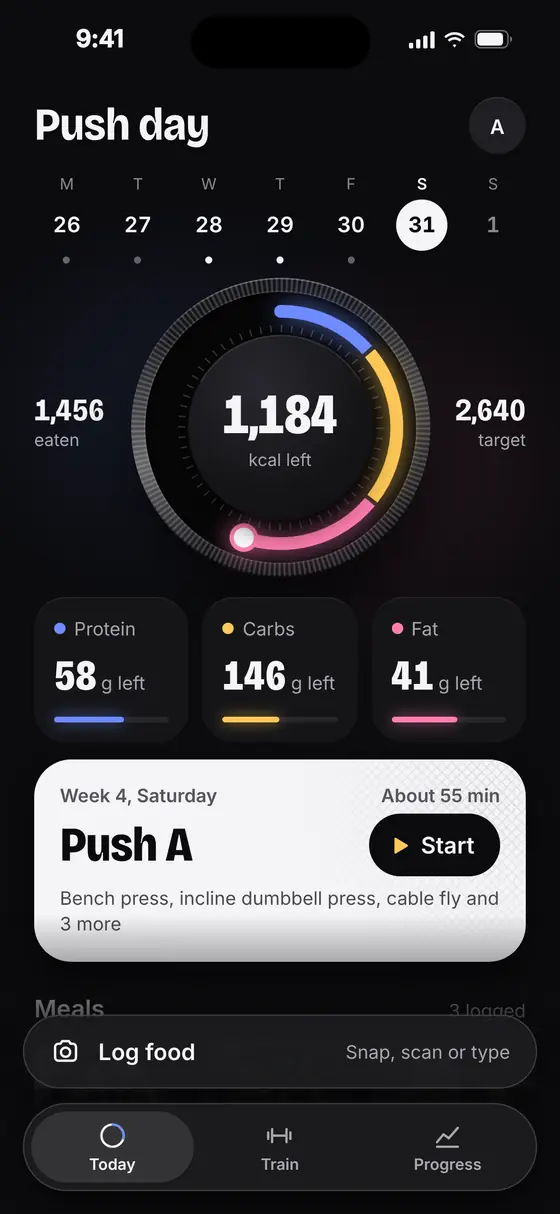

Lose the fat, keep the muscle
Indar builds your training week, sets a deficit sized to your body, and logs a meal from a photo, so the plan is easy to keep for the months it takes.


On Android? Get it on Google PlayOn iPhone? Get it on the App Store
Scan with your phone's camera to get Indar.
Free to download. Yearly Pro starts with a 7-day free trial.