 Indar
Weight loss percentage calculator
How much of your starting weight you've lost, as a percentage, how fast that's been each week, and how it compares with the paces Indar sets to protect your muscle.
How it's worked out
Weight loss percentage = weight lost ÷ starting weight × 100. From 90 kg to 84 kg is 6 kg lost: 6 ÷ 90 × 100 = 6.7%. In pounds it's the same sum and the same answer: 198 lb to 185 lb is 13 lb, 6.6%. Over 12 weeks, 6.7% is 0.56% a week.
A percentage beats kilograms for judging progress, because the same weight means different things for different bodies: 5 kg is 8% of 60 kg and 4% of 120 kg. It's also how research and Indar measure a safe pace.
The paces it's compared with
Indar sets fat loss as a share of body weight a week: 0.25% (steady), 0.5% (moderate) or 0.75% (faster), and 1% only with high body fat, where there's more fat to draw on. Slower losses keep more muscle: in a study of elite athletes, those losing about 0.7% of their weight a week gained lean mass and strength while the fat came off; those losing 1.4% a week didn't gain lean mass (Garthe et al., 2011). The guide to how fast you can lose weight goes into why.
The 5% and 10% marks
For health, the first few percent matter most. In a study of 5,145 adults with overweight and type 2 diabetes, those who lost 5 to 10% of their body weight in a year improved their blood sugar, blood pressure and blood fats, and those who lost more improved more (Wing et al., 2011). If you're on the way to a bigger goal, 5% is worth noticing.
Early weeks read high
The first week or two of a diet often drops a kilogram or more of water and food in the gut, especially if you cut carbs or salt. That counts on the scale but isn't fat, so judge your rate from about week three, on weekly averages.
Common questions
How do you calculate weight loss percentage?
Take the weight you've lost, divide it by your starting weight and multiply by 100. From 90 kg to 84 kg is 6 kg lost: 6 ÷ 90 × 100 = 6.7%. Use weekly averages for both weights, not single mornings.
What's a good weight loss percentage per week?
For keeping muscle, about 0.5% of your body weight a week, between 0.25% and 1%. Indar's paces are 0.25%, 0.5% and 0.75% a week, and 1% only for people with high body fat.
Is losing 5% of your body weight worth it?
Yes, for health it's a real change. In a large study of adults with overweight and type 2 diabetes, losing 5 to 10% of body weight in a year improved blood sugar, blood pressure and blood fats, and losing more improved them more.
Why use a percentage instead of kilograms?
Because the same kilograms mean different things for different bodies. 5 kg is 8% of 60 kg but 4% of 120 kg. A percentage lets you compare your progress with research, with safe paces and with other people fairly.
Who this isn't for
If you're losing weight without trying, see a doctor: unplanned weight loss can be a sign of illness. If weighing yourself or tracking food has ever been hard on you, it's worth talking to someone first: in the US, the National Alliance for Eating Disorders on (866) 662-1235; in the UK, Beat on 0808 801 0677; in Canada, NEDIC on 1-866-633-4220; in Australia, the Butterfly Foundation on 1800 33 4673; in New Zealand, EDANZ on 0800 233 269; anywhere else, your doctor or a local eating disorder service.
Sources
- Wing RR, Lang W, Wadden TA, et al. Benefits of modest weight loss in improving cardiovascular risk factors in overweight and obese individuals with type 2 diabetes. Diabetes Care. 2011.
- Garthe I, Raastad T, Refsnes PE, Koivisto A, Sundgot-Borgen J. Effect of two different weight-loss rates on body composition and strength and power-related performance in elite athletes. Int J Sport Nutr Exerc Metab. 2011.

See the trend, not the noise
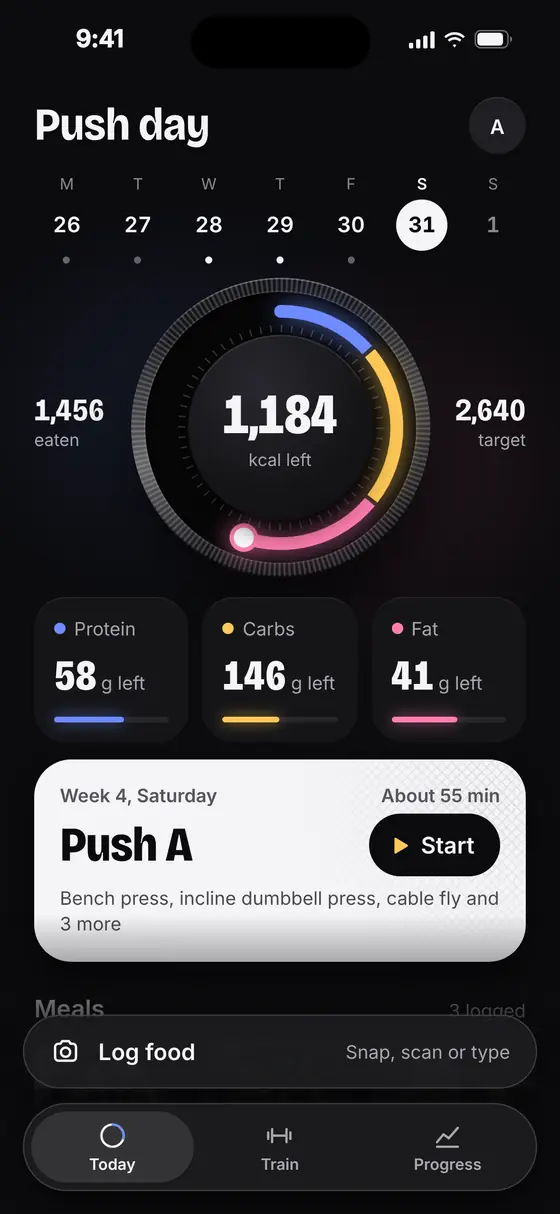
Indar keeps your weigh-ins, shows your weekly average and your rate as a share of your weight, and adjusts your targets when the trend says so.


On Android? Get it on Google PlayOn iPhone? Get it on the App Store
Scan with your phone's camera to get Indar.
Free to download. Yearly Pro starts with a 7-day free trial.