 Indar
How to lose weight fast without losing muscle
The fastest pace that stays mostly fat is about 1% of your body weight a week while you carry a lot of fat, and 0.5 to 0.75% once you don't: at most 1 kg (2.2 lb) a week at 100 kg, and often less once the limits that protect muscle apply. Get there with a calorie deficit sized to your body, plenty of protein, lifting three or four days a week, more walking and enough sleep. The first week's drop is mostly water whatever the pace; losing faster than this after that costs more muscle.
The fast plan, in six parts
- A deficit sized to you: up to 1% of your weight a week with high body fat (about 25% or more for men, 32% for women), 0.75% at most otherwise. The deficit calculator gives your number.
- Protein: Indar sets 2.2 g per kg while you lose, counted from a healthy weight if your body fat is above a healthy range. That's 150 to 203 g a day for the people below.
- Lift: three or four days a week, as heavy as you can do well. It gives your body a reason to keep its muscle, though a big deficit still costs some.
- Walk more: at Faster, the deficit is usually held to a quarter of what you burn, so burning more lets it grow without eating less.
- Track it: log what you eat, weigh yourself a few mornings a week, and compare weekly averages. Without numbers, a deficit is a guess.
- Sleep enough: short nights tip the loss away from fat (below).
What Indar's targets take off in 4, 8 and 12 weeks
These are worked out week by week with the targets Indar would set at Faster, its quickest pace, recalculated as the weight comes off. Faster means 1% a week with high body fat and 0.75% without, and Indar holds every deficit to a quarter of what you burn and to 40 kcal a day per kg of body fat. Those two limits are why most of these people lose less than the pace alone would say. Like most calculators (and the "3,500 kcal a pound" rule), it counts 7,700 kcal for each kg lost, which is a simplification.
Swipe the table for 12 weeks and the 0.5% pace.
| Who, and the first week's target | 4 weeks | 8 weeks | 12 weeks | 12 weeks at 0.5% |
|---|---|---|---|---|
| Man, 180 cm (5 ft 11 in), 100 kg (220 lb)Desk job, lifts 4 × 60 minutes. 2,080 kcal (8,700 kJ), 203 g protein | 2.5 kg5.6 lb | 5.2 kg11.4 lb | 7.7 kg17.1 lb | 5.8 kg12.9 lb |
| Man, 180 cm (5 ft 11 in), 85 kg (187 lb)Walks part of the day, lifts 4 × 60 minutes. 2,330 kcal (9,750 kJ), 187 g protein | 2.3 kg5.1 lb | 4.5 kg10.0 lb | 6.6 kg14.6 lb | 5.0 kg10.9 lb |
| Woman, 165 cm (5 ft 5 in), 85 kg (187 lb)Desk job, lifts 3 × 60 minutes. 1,630 kcal (6,820 kJ), 163 g protein | 2.0 kg4.3 lb | 3.9 kg8.6 lb | 5.8 kg12.8 lb | 5.0 kg10.9 lb |
| Woman, 165 cm (5 ft 5 in), 68 kg (150 lb)Walks part of the day, lifts 3 × 60 minutes. 1,690 kcal (7,070 kJ), 150 g protein | 2.0 kg4.4 lb | 4.0 kg8.8 lb | 5.9 kg12.9 lb | 4.0 kg8.8 lb |
All four are 30 and have lifted for 6 months to 3 years. Look at the 85 kg woman: Faster barely beats 0.5% a week, because with a desk job a quarter of what she burns is only about 540 kcal a day. If she walked part of the day instead, the same plan would take off 6.4 kg (14.2 lb) in 12 weeks. So the answer to "how do I lose weight faster" is: move more, don't eat much less. These figures assume you burn what the estimate says; real weeks vary, and Indar's weekly check-in corrects the targets from your weigh-ins.
Why does the first week look faster?
The scale often drops far more in the first week than in any week after. Most of that early drop is water. Eating less drains some of the glycogen (stored carbohydrate) in your muscles and liver, and each gram of it is stored with water: about 3 g, or more, in one study (Fernández-Elías et al., 2015). Less food in your gut weighs less too. It comes back when you eat more carbs again, and that isn't fat coming back. It's also most of why low-carb and fasting plans look so quick at the start. Fat comes off far more slowly, so judge your pace from week three on, on weekly averages.
Is losing weight fast bad? What the trials found
In two trials, losing fast didn't lead to more regain. Regaining more is the common warning, and a trial of 200 adults with obesity didn't find it. They set out to lose 15% of their weight, either in 12 weeks on a very low calorie diet (450 to 800 kcal a day, with clinic support) or in 36 weeks on a gradual one. More of the fast group lost at least 12.5% (81% against 50%). Over the next three years, the people who had lost at least 12.5% and finished the study regained about 71% of it in both groups (76% in both, counting everyone who started that phase) (Purcell et al., 2014). Regain is the hard part however fast you go, and that fast group was on a medical diet with clinic support, not dieting alone. One of them needed their gallbladder removed during the fast phase.
But faster losses cost more muscle. In a trial where 57 adults with overweight or obesity lost about 8 to 9 kg, either on 500 kcal a day for 5 weeks or 1,250 kcal a day for 12 weeks, both groups lost and regained about the same weight. But more of what the 500 kcal group lost was fat-free mass (8.8% against 1.3%), and across both groups, people who lost a bigger share of fat-free mass tended to regain more (Vink et al., 2016). Pooling trials where both groups lost about the same weight, slower losses took off about 1 kg more fat and kept resting energy about 97 kcal a day higher, though the difference in fat-free mass wasn't large enough to be sure of (Ashtary-Larky et al., 2020). In 24 elite athletes who lifted four times a week, the group aiming for 0.7% a week (they lost 0.7%) gained lean mass while the fat came off; the group aiming for 1.4% (they lost 1.0%) didn't (Garthe et al., 2011).
Lifting holds strength, not every gram of muscle. In a meta-analysis of lifting programs, a deficit of about 500 kcal a day was enough to stop lean mass gains, while strength still rose about as much as without a deficit (Murphy and Koehler, 2022). Every Faster target in the table is a deficit over 500 kcal. So Faster suits a few months with a lot of fat to lose; once you're leaner, 0.5% a week is the better trade.
Sleep changes what comes off. In a small study, 10 overweight adults dieted for two weeks twice, once with 5.5 hours in bed and once with 8.5. With 5.5 hours they lost 0.6 kg of fat and 2.4 kg of fat-free mass; with 8.5 hours, 1.4 kg of fat and 1.5 kg of fat-free mass (Nedeltcheva et al., 2010). Short nights tip the loss toward fat-free mass.
How fast is too fast?
- Very low calorie diets are a medical treatment. Diets like the one in that trial came with clinic support. If you're thinking of one, talk with your doctor first, partly because of gallstones (NIDDK).
- Losing weight very quickly can raise your chance of gallstones, partly because the gallbladder doesn't empty properly. A slower pace may make them less likely (NIDDK).
- If dieting has ever been hard on you, talk to someone before you start: helplines are below.
- Indar never sets calories below your resting energy, or 1,200 kcal a day for women and 1,500 for men, whichever is higher. If a pace needs less, the pace slows instead.
What should you eat to lose weight fast?
No food burns fat; the deficit does. What makes a deficit easier to keep is food that fills you for its calories: protein at every meal (chicken, fish, eggs, Greek yogurt, tofu, lentils), plenty of vegetables and fruit, and fewer calories you drink, alcohol included. The food pages give the calories and protein in common foods per real portion; high-protein meal prep has five weekday boxes with their exact macros, and healthy meal prep ideas has 12 more, four of them at about 400 to 450 kcal.
If you have a date
Count back from it. Twelve weeks at 0.5% a week takes about 6% off your weight; at Faster, about 7 to 9% for the four people above (7.7 kg for the 100 kg man). If that isn't enough, start earlier rather than cutting harder: the leaner you get, the more of a big deficit comes from muscle. The weight-loss timeline gives the weeks and the date for your own goal, and how fast you can lose weight explains the safe rates in more detail.
What if the scale stops moving?
Judge it over about three weeks of weekly averages before you change anything, because water can hide fat loss for a while. As you get lighter you also burn less, so a target that worked at the start gives a smaller deficit later. If the average really has stalled, check your logging first, then walk more before you eat less. Why weight loss slows down has the detail. Indar's weekly check-in does this from your weigh-ins and adjusts your target.
Common questions
Can I lose 10 kg in a month?
Not as fat. At the fastest pace Indar sets, 1% of body weight a week, the 100 kg (220 lb) man in the table loses about 2.5 kg (5.6 lb) in the first four weeks once the safety limits apply, and the 85 kg woman with a desk job about 2 kg (4.3 lb). 10 kg (22 lb) of fat is about 77,000 kcal, a deficit of about 2,570 kcal a day for 30 days: nearly everything the 100 kg man burns. The scale can drop more in the first week or two, but that extra is mostly water.
Why did I lose so much weight in the first week?
Mostly water. Eating less drains some of the glycogen (stored carbohydrate) in your muscles and liver, and each gram is stored with about 3 g of water or more. Less food in your gut weighs less too. It comes back when you eat more carbs, which is not fat coming back.
Is losing weight fast bad for you?
It doesn't seem to make you regain more: in a trial of 200 adults with obesity, people who lost weight in 12 weeks on a supervised very low calorie diet regained no more over the next three years than people who took 36. But faster losses have cost more muscle in several trials, and losing weight very quickly can raise the chance of gallstones. If you're thinking of a very low calorie diet, talk with your doctor first.
What is the fastest way to lose weight safely?
A deficit sized to your body (up to 1% of your weight a week while you carry a lot of fat, less as you get leaner), high protein, lifting three or four days a week, more walking, and enough sleep. At a fast pace, walking more usually lets the deficit be bigger without eating less.
Who this isn't for
This is for healthy adults. If you're losing weight without trying, see a doctor. Under 18, pregnant or breastfeeding, on medication for diabetes or blood pressure, or after weight-loss surgery, set a pace with your doctor or a dietitian. If dieting has ever been hard on you, it's worth talking to someone first: in the US, the National Alliance for Eating Disorders on (866) 662-1235; in the UK, Beat on 0808 801 0677; in Canada, NEDIC on 1-866-633-4220; in Australia, the Butterfly Foundation on 1800 33 4673; in New Zealand, EDANZ on 0800 233 269; anywhere else, your doctor or a local eating disorder service.
Sources
- Purcell K, Sumithran P, Prendergast LA, et al. The effect of rate of weight loss on long-term weight management: a randomised controlled trial. Lancet Diabetes Endocrinol. 2014.
- University of Melbourne. Slow and steady does not win the weight loss race (the trial's news release, which gives its diets). EurekAlert. 2014.
- Vink RG, Roumans NJ, Arkenbosch LA, Mariman EC, van Baak MA. The effect of rate of weight loss on long-term weight regain in adults with overweight and obesity. Obesity. 2016.
- Ashtary-Larky D, Bagheri R, Abbasnezhad A, Tinsley GM, Alipour M, Wong A. Effects of gradual weight loss v. rapid weight loss on body composition and RMR: a systematic review and meta-analysis. Br J Nutr. 2020.
- Garthe I, Raastad T, Refsnes PE, Koivisto A, Sundgot-Borgen J. Effect of two different weight-loss rates on body composition and strength and power-related performance in elite athletes. Int J Sport Nutr Exerc Metab. 2011.
- Murphy C, Koehler K. Energy deficiency impairs resistance training gains in lean mass but not strength: a meta-analysis and meta-regression. Scand J Med Sci Sports. 2022.
- Nedeltcheva AV, Kilkus JM, Imperial J, Schoeller DA, Penev PD. Insufficient sleep undermines dietary efforts to reduce adiposity. Ann Intern Med. 2010.
- Fernández-Elías VE, Ortega JF, Nelson RK, Mora-Rodriguez R. Relationship between muscle water and glycogen recovery after prolonged exercise in the heat in humans. Eur J Appl Physiol. 2015.
- National Institute of Diabetes and Digestive and Kidney Diseases. Dieting and gallstones.
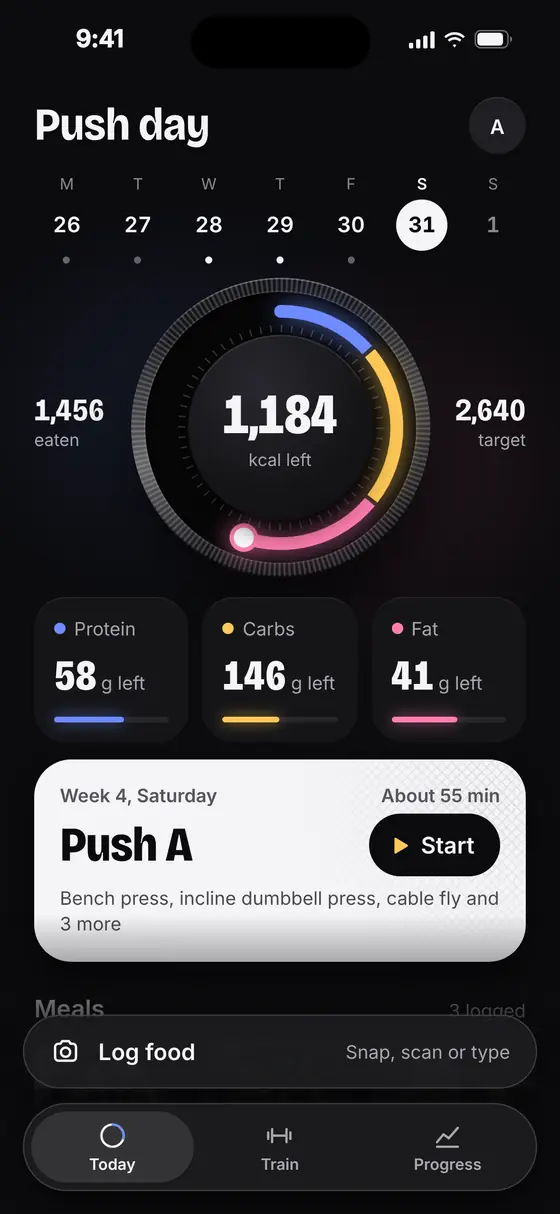

Fast, without losing the muscle
Indar sets your pace from your body fat, keeps the deficit inside what's safe for your body, and checks it against your weigh-ins every week.


On Android? Get it on Google PlayOn iPhone? Get it on the App Store
Scan with your phone's camera to get Indar.
Free to download. Yearly Pro starts with a 7-day free trial.