 Indar
Calorie tracker: how to track calories accurately
A calorie tracker is an app or food diary where you record what you eat and drink, so you can see your calories, and usually your protein, carbs and fat, against a daily target. To track calories accurately, log every meal as you eat it, weigh in most mornings, and after three weeks check what your log says against your weight trend, because every way of logging misses some calories. Below is what the studies say about how well tracking works, how accurate each way of logging is, what a good free tracker should do, and what Indar's free plan includes.
The short answer
- Set a target first: your maintenance calories, moved for your goal. The calorie calculator does it in a minute.
- Log each meal as you eat it, not from memory at night, and every day you can.
- Use the most exact way you have: the barcode or label for packaged food, weighed food for the rest, then a description or a photo.
- Log the extras: cooking oil, butter, sauces, milk in coffee and drinks.
- Weigh in most mornings, and after three weeks compare your weight trend with what your log says. Fix any food you know you missed; if the gap is still there, move the target.
- Keep protein in view, not only calories, if you lift or are losing fat.
What is a calorie tracker?
A calorie tracker is anything that adds up the energy in what you eat across a day: an app, a website or a paper food diary. Apps find each food's numbers for you, from a food database, a barcode, a photo or a description, and show what's left of your target as the day goes on. Most also count protein, carbs and fat (the macros).
A fitness watch is a different thing. It estimates the calories you burn, not the ones you eat, and roughly: in a 2017 Stanford lab test of seven wrist-worn devices on 60 people, none estimated energy burned to within 20%.
Is there a free calorie tracker?
Yes: several calorie trackers have free plans, with different limits. As of 4 November 2026, MyFitnessPal logged food by hand for free, with ads, and kept its barcode scanner and photo logging for Premium; Cal AI was free to download but needed a subscription for its photo results. Indar's free plan includes barcodes, one meal photo and three typed or spoken meals a day (three photos a day for your first three days, and a retake of the same meal is free). Calorie apps compared has the prices and plans side by side, and MyFitnessPal alternatives lists the free plans that scan barcodes.
On this website, the photo calorie counter estimates a meal from a photo with no sign-up, 3 photos a day, and the food pages give USDA's calories and protein for over 300 everyday foods, per 100 g and per portion. With a kitchen scale and a notebook, those two are a tracker.
How does Indar track calories?
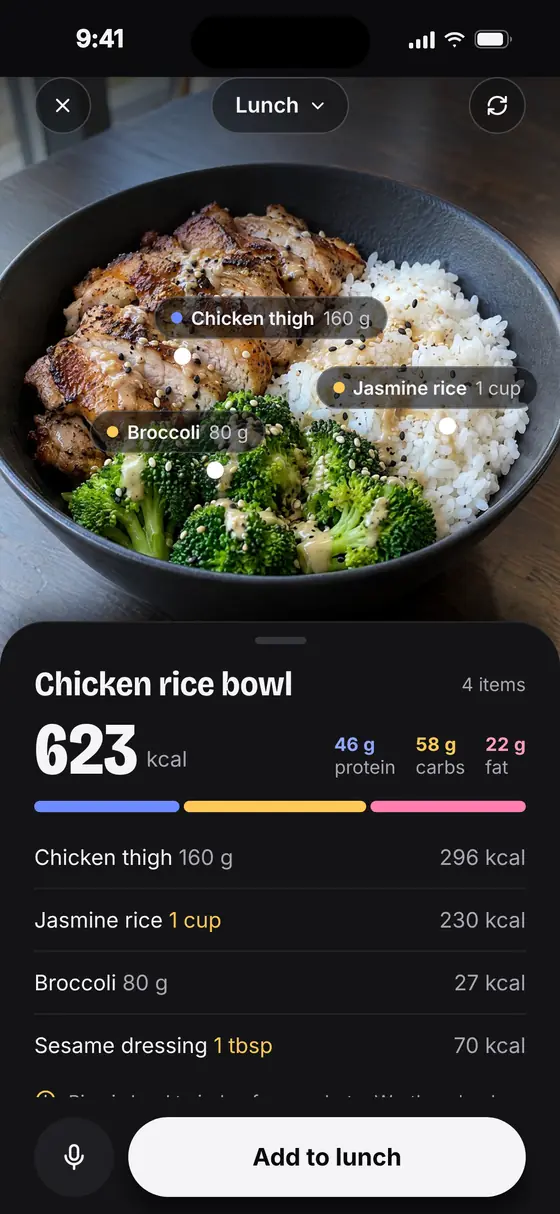
Indar sets your calorie and protein targets with the same maths as the calorie calculator, from your body, your day and your training, then counts down what's left as you log. A meal goes in four ways: a photo, where each food is named with its weight and every amount is yours to change; typing or saying what you ate; a barcode, read from Open Food Facts, an open database; or a meal from Recent in one tap. It shows kcal or kJ, and can bring in weigh-ins from a smart scale through Apple Health or Health Connect.
The free plan includes barcodes, Recent, changing amounts, one meal photo and three typed or spoken meals a day (three photos a day for your first three days, and a retake of the same meal is free), and the weekly check-in described below. Once the day's photos and three typed meals are used, a new meal without a barcode waits for the next day or needs Pro; meals from Recent, barcodes and changing amounts stay free. Yearly Pro starts with a 7-day free trial and raises the limits to 15 meal photos and 40 AI food estimates a day. The training program is free as well.
What it doesn't have is a giant searchable food list: packaged food comes by barcode, and home cooking and restaurant meals are estimates you check and correct, so a logger who wants to pick every food from a list will prefer an app built around one.
Does tracking calories help you lose weight?
Probably: keeping a food record is one of the habits most consistently linked with losing more weight, though the studies show a link rather than proof. Of 22 studies in a 2011 systematic review, the 15 on food records consistently linked them with more weight loss, but the authors rated the evidence weak, because the samples were mostly white women and relied on what people reported.
In a 24-week online program of 142 adults, the people who lost 10% or more of their weight opened their food diary 2.7 times a day, against 1.7 for those who lost less. Among those still logging at six months, how many minutes they spent made no difference. Logging each meal when you eat it is the simplest way to open the diary more often.
How long does calorie tracking take a day?
Calorie tracking took the adults in that 24-week program 23.2 minutes a day on average in the first month and 14.6 minutes a day in the sixth. A third had stopped recording by the sixth month, and the summary doesn't say whether they count in that average, so read 15 minutes as a lower bound for someone still logging. They logged on a website, most were women (90.8%), and their average BMI was 35.8.
The minutes probably fall partly because meals repeat. A tracker that lets you log a meal you've had before in one tap, or scan a barcode, saves most of the typing.
How accurate is calorie tracking?
Calorie tracking is an estimate at every step, and the biggest errors usually leave the log showing less than you ate. Where the gap comes from:
- What you remember to log. In a 1992 study, 9 women and 1 man with obesity who said they couldn't lose weight on under 1,200 kcal a day reported, on average, 47% less food than they ate over 14 days of measurement. They were picked out of 224 for saying their diets failed, so most people probably miss less, but oil, sauces, drinks and bites while cooking are easy to forget. A tablespoon of olive oil is 119 kcal (499 kJ), per USDA's numbers.
- The label itself. In the US, a packaged food is misbranded if lab tests find its calories more than 20% over the label. In a Tufts University study of reduced-calorie foods, 29 restaurant dishes averaged 18% more energy than stated and 10 supermarket frozen meals 8% more, though the averages weren't statistically significant because the foods varied so much. Other countries set their own tolerances.
- Photos. On 150 cafeteria meals from Google Research's Nutrition5k set, weighed ingredient by ingredient, Indar's photo estimate was a median 23% off the measured calories either way, running about 5% high on average (how we tested it). In a separate, early test from the US National Institutes of Health on 102 weighed meals, four other popular photo apps came in low by about 250 to 345 kcal (about 1,050 to 1,450 kJ) on average, especially on fat. Those results were presented at a conference and haven't been peer reviewed yet.
Barcodes and labels are the most exact way to log packaged food, as long as you weigh the part you eat when it isn't the whole pack. Weighed food with a good food database comes next, because food tables give their numbers by weight. A description or a photo is fastest and least exact: check the amounts it guessed, above all on fried food, sauces and mixed dishes.
What if your calorie log is wrong?
Your weight trend shows it: if your weight isn't moving the way your log says it should, add the foods you know you missed, then move the target. If your log misses about the same amount every week, a target set from your own log and weigh-ins still works, because it's measured in the same logged calories.
This is how Indar's weekly check-in works. It looks back over the last three weeks: the calories you logged and the slope of your weigh-ins. From those it works out what you burn: average logged calories, plus the weight you lost (or minus the weight you gained) at 7,700 kcal per kg (about 3,500 kcal per lb). Log an average of 2,000 kcal a day while your weight falls 0.5 kg (1.1 lb) a week, and your log says you burn 2,550 kcal a day.
Now say you really eat 300 kcal a day more than you log. Your log then reads your burn 300 kcal low as well, so a target set from it is 300 kcal low by the same amount. Keep logging the same way and that target still gives you the rate you planned.
It moves slowly, and only when the data is good enough. It waits 14 days after any change and needs at least 4 weigh-ins over 14 days or more. With 85% or more of the days logged and 5 or more weigh-ins a week, its estimate of your burn moves halfway toward what your log and weight say; with 70 to 85% logged, a quarter of the way; with less, it holds. A day counts only if at least half the day's target is logged in it, a target never moves more than 200 kcal at once, and nothing changes until you tap to accept it. Without an app, the maintenance calculator does the same sum from your own log and weigh-ins.
What should a good calorie tracker do?
- Set your target from your body (age, sex, height, weight, how much you move and train) and then adjust it from your weight trend, not only from a formula.
- Make the repeat meal one tap, and read barcodes, because repeat meals are most of what you log.
- Show what it counted: each food and its amount, from a photo or a description, so you can see a wrong guess and fix it.
- Count protein too. If you lift or are losing fat, the protein target matters as much as the calories (how much protein a day).
- Speak your units: grams or ounces, kg or lb, and kilojoules if that's what your labels lead with.
- Treat going over as information, not a failure. One day over changes little; the weekly average and the trend are what count.
- Say plainly what's free and what you pay for, and what happens to your food photos.
Can you use a calorie tracker to gain weight?
Yes: a calorie tracker works the same way for gaining, with the target above your maintenance instead of below it. For building muscle with little fat, that's about 100 to 400 kcal a day over maintenance, depending on your sex and how long you've lifted (lean bulk). The check is the same too: if your weight trend climbs faster or slower than you planned, change the target.
Common questions
Is calorie tracking worth it?
For most adults trying to lose weight, probably: in a 2011 review, the 15 studies on food records consistently linked them with more weight loss, though the authors rated the evidence weak. In one program it took about 23 minutes a day in the first month and less by the sixth.
Do I need to weigh my food?
No, but weighing is the most exact way to log food without a label, because food tables give their numbers by weight. If you weigh anything, weigh the foods that are high in calories and easy to misjudge, like oil, nut butter, rice and pasta: a tablespoon of olive oil is 119 kcal.
How accurate are calorie tracking apps?
Calorie tracking apps are only as accurate as what goes in: a label or a weighed food is close, while a photo estimate is typically off by a fifth or more, either way. Your weight trend over three weeks or more is the check, and an app that adjusts your target from it corrects for a log that misses about the same amount every week.
Can a smartwatch track calories?
A smartwatch estimates the calories you burn, not the ones you eat, and only roughly: in a 2017 Stanford lab test of seven wrist-worn devices, none estimated energy burned to within 20%. Your weight trend against your food log is a better guide to what you really burn.
How often should I log?
Log each meal as you eat it: in a 24-week program, adults who lost 10% or more opened their food diary 2.7 times a day, against 1.7 for those who lost less. Indar's check-in also needs 70% or more of days logged before it moves your target.
How many calories should I eat a day?
Start from your maintenance, the calories that hold your weight, then eat a few hundred less to lose fat or a little more to build muscle. How many calories should I eat? works through real examples, and the calorie calculator gives your own number.
Who this isn't for
This page is for healthy adults. Calorie tracking isn't for children or teenagers unless a doctor has asked for it, and if you're pregnant or breastfeeding, ask your doctor or midwife what to eat rather than setting a deficit. With a medical condition that depends on exact amounts (diabetes and insulin dosing, kidney disease), follow your care team. In a study of 493 college students, those who used calorie trackers had more eating concerns and dietary restraint, so if counting calories has ever been hard on you, it's worth talking to someone first: in the US, the National Alliance for Eating Disorders on (866) 662-1235; in the UK, Beat on 0808 801 0677; in Canada, NEDIC on 1-866-633-4220; in Australia, the Butterfly Foundation on 1800 33 4673; in New Zealand, EDANZ on 0800 233 269; anywhere else, your doctor or a local eating disorder service.
Sources
- Harvey J, Krukowski R, Priest J, West D. Log often, lose more: electronic dietary self-monitoring for weight loss. Obesity. 2019.
- Burke LE, Wang J, Sevick MA. Self-monitoring in weight loss: a systematic review of the literature. J Am Diet Assoc. 2011.
- Lichtman SW, Pisarska K, Berman ER, et al. Discrepancy between self-reported and actual caloric intake and exercise in obese subjects. N Engl J Med. 1992.
- Urban LE, Dallal GE, Robinson LM, et al. The accuracy of stated energy contents of reduced-energy, commercially prepared foods. J Am Diet Assoc. 2010.
- US Code of Federal Regulations. 21 CFR 101.9, Nutrition labeling of food, paragraph (g)(5).
- American Society for Nutrition. Photo-based calorie-tracking apps may underestimate energy in meals. NUTRITION 2026, 25 July 2026 (a conference abstract, not yet peer reviewed).
- Shcherbina A, Mattsson CM, Waggott D, et al. Accuracy in wrist-worn, sensor-based measurements of heart rate and energy expenditure in a diverse cohort. J Pers Med. 2017.
- Simpson CC, Mazzeo SE. Calorie counting and fitness tracking technology: associations with eating disorder symptomatology. Eat Behav. 2017.
- Google Research. Nutrition5k: the weighed meals behind Indar's photo test, checked 2 November 2026.
- U.S. Department of Agriculture. FoodData Central, SR Legacy: olive oil, FDC ID 171413, on its food page.

Track calories free, with the target set for you
Indar sets your calories and protein from your body and your training, logs a meal from a photo, a barcode or a sentence, and checks the target against your weigh-ins every week.


On Android? Get it on Google PlayOn iPhone? Get it on the App Store
Scan with your phone's camera to get Indar.
Free to download. Yearly Pro starts with a 7-day free trial.